
WGU D668
Study online at https://quizlet.com/_heg8wi
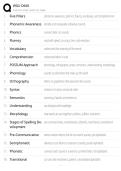
1. Five Pillars phonemic awareness, phonics, fluency, vocabulary, and comprehension
2. Phonemic Awareness identify and manipulate individual sounds
3. Phonics connect letters to sounds
4. Fluency read with speed, accuracy, tone, and emotions
5. Vocabulary understand the meaning of the words
6. Comprehension understand what is read
7. POSSUM Approach phonology, orthography, syntax, semantics, understanding, morphology
8. Phonology sounds or phonemes that make up the word
9. Orthography letters or graphemes that represent the sounds
10. Syntax sentence structure and word order
11. Semantics meaning of words and sentences
12. Understanding any background knowledge
13. Morphology how words are put together; prefixes, suffixes, root word
14. Stages of Spelling De- pre-communicative, semiphonetic, phonetic, transitional, conventional
velopment
15. Pre-Communicative writes random letters that do not match sounds; pre-alphabetic
16. Semiphonetic attempt to use letters to represent sounds; partial alphabetic
17. Phonetic connects each sound in a word to a printed letter; full alphabetic
18. Transitional can use and see phonics pattern; consolidated alphabetic
1/6
, WGU D668
Study online at https://quizlet.com/_heg8wi
19. Conventional good grasp of spelling conventions and uses them in writing; automatic
20. Four Part Processor Orthographic Processor, Phonological Processor, Meaning Processor, Con-
text Processor
21. Orthographic Proces- recognizes and remembers the visual patters of written words and letters;
sory visual input
22. Phonological Proces- recognize, remember, and work with the sounds in spoken language;
sor sound input/output
23. Meaning Processor understand and interpret the meaning and words and sentences; vocab-
ulary and comprehension
24. Context Processor understand words and sentences based on the surrounding text and
overall situation; sentence and background knowledge; syntax
25. Brains Role in Reading Visual Cortex, Phonological Cortex, Semantic Cortex, Syntactic Cortex,
26. Visual Cortex recognizes letters and words
27. Phonological Cortext connects letters to sounds
28. Semantic Cortex understand word meaning
29. Syntactic Cortex grasps sentence structure
30. The Reading Brain Frontal Lobe, Temporal Lobe, Parietal Lobe, Occipital Lobe, Broca's Area,
Planum Temporale,
31. Frontal Lobe helps us focus and remember what we're reading; speech
32. Temporal Lobe listens to sounds; helps us understand words
33. Parietal Lobe
2/6
Study online at https://quizlet.com/_heg8wi
1. Five Pillars phonemic awareness, phonics, fluency, vocabulary, and comprehension
2. Phonemic Awareness identify and manipulate individual sounds
3. Phonics connect letters to sounds
4. Fluency read with speed, accuracy, tone, and emotions
5. Vocabulary understand the meaning of the words
6. Comprehension understand what is read
7. POSSUM Approach phonology, orthography, syntax, semantics, understanding, morphology
8. Phonology sounds or phonemes that make up the word
9. Orthography letters or graphemes that represent the sounds
10. Syntax sentence structure and word order
11. Semantics meaning of words and sentences
12. Understanding any background knowledge
13. Morphology how words are put together; prefixes, suffixes, root word
14. Stages of Spelling De- pre-communicative, semiphonetic, phonetic, transitional, conventional
velopment
15. Pre-Communicative writes random letters that do not match sounds; pre-alphabetic
16. Semiphonetic attempt to use letters to represent sounds; partial alphabetic
17. Phonetic connects each sound in a word to a printed letter; full alphabetic
18. Transitional can use and see phonics pattern; consolidated alphabetic
1/6
, WGU D668
Study online at https://quizlet.com/_heg8wi
19. Conventional good grasp of spelling conventions and uses them in writing; automatic
20. Four Part Processor Orthographic Processor, Phonological Processor, Meaning Processor, Con-
text Processor
21. Orthographic Proces- recognizes and remembers the visual patters of written words and letters;
sory visual input
22. Phonological Proces- recognize, remember, and work with the sounds in spoken language;
sor sound input/output
23. Meaning Processor understand and interpret the meaning and words and sentences; vocab-
ulary and comprehension
24. Context Processor understand words and sentences based on the surrounding text and
overall situation; sentence and background knowledge; syntax
25. Brains Role in Reading Visual Cortex, Phonological Cortex, Semantic Cortex, Syntactic Cortex,
26. Visual Cortex recognizes letters and words
27. Phonological Cortext connects letters to sounds
28. Semantic Cortex understand word meaning
29. Syntactic Cortex grasps sentence structure
30. The Reading Brain Frontal Lobe, Temporal Lobe, Parietal Lobe, Occipital Lobe, Broca's Area,
Planum Temporale,
31. Frontal Lobe helps us focus and remember what we're reading; speech
32. Temporal Lobe listens to sounds; helps us understand words
33. Parietal Lobe
2/6


