

D774 WGU
Study online at https://quizlet.com/_gvip5s
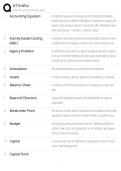
1. Accounting Equation An algebraic equation that expresses the relationship between
assets (resources), liabilities (obligations), and owner's equity (net
assets, or the residual interest in a business after all liabilities have
been met): Assets = Liabilities + Owners' Equity.
2. Activity-based Costing A method of attributing overhead costs to products based on mea-
(ABC) surable factors that relate to activities that create overhead costs.
3. Agency Problem A conflict that arises when an agent (managemnet), who is expect-
ed to act in the best interests of a principal (shareholders), has an
incentive to act in their own best interest instead.
4. Articulation The interrelationships among the financial statements.
5. Assets Economic resources that are owned or controlled by a company.
6. Balance Sheet A summary of the financial position of a company at a particular
date.
7. Board of Directors A group of individuals elected by the stockholders to govern a
corporation.
8. Break-even Point The amount of sales at which total costs of the number of units sold
equal total revenues; the point at which there is no profit or loss.
9. Budget A financial spending and income plan for a defined period that
outlines how a firm, an organization, or an individual will acquire
and use financial resources.
10. Capital Financial assets that an individual or organization uses for invest-
ment or generating profit.
11. Capital Stock
1/9
, D774 WGU
Study online at https://quizlet.com/_gvip5s
The portion of stockholder's equity that represents investment by
owners in exchange for shares of stock; also referred to as paid-in
capital.
12. Cash Budget A schedule of expected cash receipts and disbursements during
the budget period.
13. Cash Flow Statement The financial statement that shows an entity's cash inflows (re-
ceipts) and outflows (payments) during a period of time.
14. Certified Public Accountant A special designation given to an accountant who has passed a
(CPA) national uniform examination and has met other certifying require-
ments.
15. Classified Balance Sheet A balance sheet that distinguishes between current and long-term
assets.
16. Common-size Financial Financial statements achieved by dividing all financial statement
Statements numbers by total sales for the year.
17. Comparative Balance Sheet A balance sheet that includes information for both the current year
and preceding year(s) that are prepared for users to identify any
significant changes in particular items.
18. Contribution Margin The difference between total sales and variable costs; the portion
of sales revenue available to cover fixed costs and provide a profit.
19. Corporation An organization that combines resources, skills, capital, labor, and
knowledge to provide goods and services to a market in pursuit of
profit.
20. Cost Budgets Budgets that estimate a company's expected expenses for a com-
ing period.
2/9
Study online at https://quizlet.com/_gvip5s
1. Accounting Equation An algebraic equation that expresses the relationship between
assets (resources), liabilities (obligations), and owner's equity (net
assets, or the residual interest in a business after all liabilities have
been met): Assets = Liabilities + Owners' Equity.
2. Activity-based Costing A method of attributing overhead costs to products based on mea-
(ABC) surable factors that relate to activities that create overhead costs.
3. Agency Problem A conflict that arises when an agent (managemnet), who is expect-
ed to act in the best interests of a principal (shareholders), has an
incentive to act in their own best interest instead.
4. Articulation The interrelationships among the financial statements.
5. Assets Economic resources that are owned or controlled by a company.
6. Balance Sheet A summary of the financial position of a company at a particular
date.
7. Board of Directors A group of individuals elected by the stockholders to govern a
corporation.
8. Break-even Point The amount of sales at which total costs of the number of units sold
equal total revenues; the point at which there is no profit or loss.
9. Budget A financial spending and income plan for a defined period that
outlines how a firm, an organization, or an individual will acquire
and use financial resources.
10. Capital Financial assets that an individual or organization uses for invest-
ment or generating profit.
11. Capital Stock
1/9
, D774 WGU
Study online at https://quizlet.com/_gvip5s
The portion of stockholder's equity that represents investment by
owners in exchange for shares of stock; also referred to as paid-in
capital.
12. Cash Budget A schedule of expected cash receipts and disbursements during
the budget period.
13. Cash Flow Statement The financial statement that shows an entity's cash inflows (re-
ceipts) and outflows (payments) during a period of time.
14. Certified Public Accountant A special designation given to an accountant who has passed a
(CPA) national uniform examination and has met other certifying require-
ments.
15. Classified Balance Sheet A balance sheet that distinguishes between current and long-term
assets.
16. Common-size Financial Financial statements achieved by dividing all financial statement
Statements numbers by total sales for the year.
17. Comparative Balance Sheet A balance sheet that includes information for both the current year
and preceding year(s) that are prepared for users to identify any
significant changes in particular items.
18. Contribution Margin The difference between total sales and variable costs; the portion
of sales revenue available to cover fixed costs and provide a profit.
19. Corporation An organization that combines resources, skills, capital, labor, and
knowledge to provide goods and services to a market in pursuit of
profit.
20. Cost Budgets Budgets that estimate a company's expected expenses for a com-
ing period.
2/9


