

WGU - Scripting and Programming Foundations
Study online at https://quizlet.com/_4szbdg
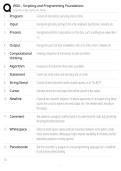
1. Program Consists of instructions executing one at a time.
2. Input A program gets data, perhaps from a file, keyboard, touchscreen, network, etc.
3. Process A programs performs computations on that data, such as adding two values like x
+ y.
4. Output A programs puts that data somewhere, such as to a file, screen, network, etc.
5. Computational Creating a sequence of instructions to solve a problem.
thinking
6. Algorithm A sequence of instructions that solves a problem.
7. Statement Carries out some action and executing one at a time.
8. String literal Consists of text (characters) within double quotes, as in "Go #57!".
9. Cursor Indicates where the next output item will be placed in the output.
10. Newline A special two-character sequence \n whose appearance in an output string literal
causes the cursor to move to the next output line. The newline exists invisibly in
the output.
11. Comment Text added to a program, read by humans to understand the code, but ignored by
the program when executed.
12. Whitespace Refers to blank spaces (space and tab characters) between items within a state-
ment, and to newlines. Whitespace helps improve readability for humans, but for
execution purposes is mostly ignored.
13. Pseudocode Text that resembles a program in a real programming language but is simplified
to aid human understanding.
14.
1/8
, WGU - Scripting and Programming Foundations
Study online at https://quizlet.com/_4szbdg
Assignment Assigns a variable with a value, such as x = 5. An assignment statement's left side
statement must be a variable. The right side is an expression.Examples: x = 5, y = a, or z = w
+ 2.
15. = In programming, = is an assignment of a left-side variable with a right-side value.
It does not represent equality like in mathematics.
16. Variable declara- Declares a new variable, specifying the variable's name and type.
tion
17. Identifier A name created by a programmer for an item like a variable or function. An
identifier must: be a sequence of letters (a-z, A-Z), underscores (_), and digits (0-9),
AND start with a letter or underscore.
18. Reserved word or A word that is part of the language, like integer, Get, or Put. A programmer cannot
keyword use a reserved word as an identifier.
19. Lower camel case Abuts multiple words, capitalizing each word except the first, such as numApples.
20. Underscore sepa- Words are lowercase and separated by an underscore, such as num_apples.
rated
21. Expression A combination of items, like variables, literals, operators, and parentheses, that
evaluates to a value. Example: 2 * (x+1)
22. Literal A specific value in code, like 2.
23. Operator A symbol that performs a built-in calculation, like the operator + which performs
addition.
24. Unary minus The subtraction sign (-) used as a negative.
25. Note about inte- Commas are not allowed, so 1,333,555 must be written as 1333555.
ger literal
2/8
Study online at https://quizlet.com/_4szbdg
1. Program Consists of instructions executing one at a time.
2. Input A program gets data, perhaps from a file, keyboard, touchscreen, network, etc.
3. Process A programs performs computations on that data, such as adding two values like x
+ y.
4. Output A programs puts that data somewhere, such as to a file, screen, network, etc.
5. Computational Creating a sequence of instructions to solve a problem.
thinking
6. Algorithm A sequence of instructions that solves a problem.
7. Statement Carries out some action and executing one at a time.
8. String literal Consists of text (characters) within double quotes, as in "Go #57!".
9. Cursor Indicates where the next output item will be placed in the output.
10. Newline A special two-character sequence \n whose appearance in an output string literal
causes the cursor to move to the next output line. The newline exists invisibly in
the output.
11. Comment Text added to a program, read by humans to understand the code, but ignored by
the program when executed.
12. Whitespace Refers to blank spaces (space and tab characters) between items within a state-
ment, and to newlines. Whitespace helps improve readability for humans, but for
execution purposes is mostly ignored.
13. Pseudocode Text that resembles a program in a real programming language but is simplified
to aid human understanding.
14.
1/8
, WGU - Scripting and Programming Foundations
Study online at https://quizlet.com/_4szbdg
Assignment Assigns a variable with a value, such as x = 5. An assignment statement's left side
statement must be a variable. The right side is an expression.Examples: x = 5, y = a, or z = w
+ 2.
15. = In programming, = is an assignment of a left-side variable with a right-side value.
It does not represent equality like in mathematics.
16. Variable declara- Declares a new variable, specifying the variable's name and type.
tion
17. Identifier A name created by a programmer for an item like a variable or function. An
identifier must: be a sequence of letters (a-z, A-Z), underscores (_), and digits (0-9),
AND start with a letter or underscore.
18. Reserved word or A word that is part of the language, like integer, Get, or Put. A programmer cannot
keyword use a reserved word as an identifier.
19. Lower camel case Abuts multiple words, capitalizing each word except the first, such as numApples.
20. Underscore sepa- Words are lowercase and separated by an underscore, such as num_apples.
rated
21. Expression A combination of items, like variables, literals, operators, and parentheses, that
evaluates to a value. Example: 2 * (x+1)
22. Literal A specific value in code, like 2.
23. Operator A symbol that performs a built-in calculation, like the operator + which performs
addition.
24. Unary minus The subtraction sign (-) used as a negative.
25. Note about inte- Commas are not allowed, so 1,333,555 must be written as 1333555.
ger literal
2/8


