

WGU D340
Study online at https://quizlet.com/_dee185
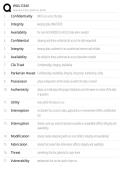
1. Confidentiality WHO can access the data
2. Integrity keeping data UNALTERED
3. Availability for ones AUTHORIZED to ACCESS data when needed
4. Confidential allowing only those authorized to access the data requested
5. Integrity keeping data unaltered in an unauthorized manner and reliable
6. Availability the ability for those authorized to access data when needed
7. CIA Triad Confidentiality, Integrity, Availability
8. Parkerian Hexad Confidentiality, Availability, Integrity, Possession, Authenticity, Utility
9. Possession physical deposition of the media on which the data is stored
10. Authenticity allows us to talk about the proper attribution as to the owner or creator of the data
in question
11. Utility how useful the data is to us
12. Interception an attacker has access to data, applications, or environment (effects confidential-
ity)
13. Interruption attacks cause our assets to become unusable or unavailable (effects integrity and
availability)
14. Modification attacks involve tampering with our asset (effects integrity and availability)
15. Fabrication attacks that create false information (effects integrity and avaliblilty)
16. Threat something that has potential to cause harm
17. Vulnerability weaknesses that can be used to harm us
, WGU D340
Study online at https://quizlet.com/_dee185
18. Authentication verifying that a person is who they claim to be
19. Something you username, password, PIN
know:
20. Something you ID badge, swipe card, OTP
have:
21. Something you fingerprint, Iris, Retina scan
are:
22. Somewhere you geolocation
are:
23. Something you handwriting, typing, walking
do:
24. Mutual authenti- both parties in a transaction to authenticate each other
cation
25. Mutual authenti- -Has digital certificates
cation
-Prevents man in the middle attacks
-The man in the middle is where the attacker inserts themselves into the traffic
flow
-Ex. Both the PC and server authenticate each other before data is sent in either
direction
26. Risk manage- 1. Identify Asset
ment process 2. Identify Threats
3. Assess Vulnerabilities
Study online at https://quizlet.com/_dee185
1. Confidentiality WHO can access the data
2. Integrity keeping data UNALTERED
3. Availability for ones AUTHORIZED to ACCESS data when needed
4. Confidential allowing only those authorized to access the data requested
5. Integrity keeping data unaltered in an unauthorized manner and reliable
6. Availability the ability for those authorized to access data when needed
7. CIA Triad Confidentiality, Integrity, Availability
8. Parkerian Hexad Confidentiality, Availability, Integrity, Possession, Authenticity, Utility
9. Possession physical deposition of the media on which the data is stored
10. Authenticity allows us to talk about the proper attribution as to the owner or creator of the data
in question
11. Utility how useful the data is to us
12. Interception an attacker has access to data, applications, or environment (effects confidential-
ity)
13. Interruption attacks cause our assets to become unusable or unavailable (effects integrity and
availability)
14. Modification attacks involve tampering with our asset (effects integrity and availability)
15. Fabrication attacks that create false information (effects integrity and avaliblilty)
16. Threat something that has potential to cause harm
17. Vulnerability weaknesses that can be used to harm us
, WGU D340
Study online at https://quizlet.com/_dee185
18. Authentication verifying that a person is who they claim to be
19. Something you username, password, PIN
know:
20. Something you ID badge, swipe card, OTP
have:
21. Something you fingerprint, Iris, Retina scan
are:
22. Somewhere you geolocation
are:
23. Something you handwriting, typing, walking
do:
24. Mutual authenti- both parties in a transaction to authenticate each other
cation
25. Mutual authenti- -Has digital certificates
cation
-Prevents man in the middle attacks
-The man in the middle is where the attacker inserts themselves into the traffic
flow
-Ex. Both the PC and server authenticate each other before data is sent in either
direction
26. Risk manage- 1. Identify Asset
ment process 2. Identify Threats
3. Assess Vulnerabilities


