
RN ATI Capstone Maternal Newborn
2026 Exam · 50 Questions · With Rationales
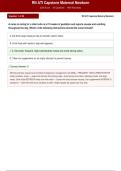
Question: 1 of 50 RN ATI Capstone Maternal Newborn
A nurse is caring for a client who is at 10 weeks of gestation and reports nausea and vomiting
throughout the day. Which of the following instructions should the nurse include?
A. Eat three large meals per day to maintain caloric intake.
B. Drink fluids with meals to help with digestion.
✓ C. Eat small, frequent, high-carbohydrate meals and avoid strong odors.
D. Take iron supplements on an empty stomach to prevent nausea.
✓ Correct Answer: C
Morning sickness (nausea and vomiting of pregnancy) management: eat SMALL, FREQUENT, HIGH-CARBOHYDRATE
meals (crackers, toast) — keeps the stomach from being empty. Avoid strong food odors, fatty/spicy foods, and large
meals. Drink fluids BETWEEN meals (not with meals — liquids with food increase nausea). Iron supplements WORSEN GI
symptoms — take with food and a full glass of water. Ginger (ginger ale, ginger tea) may help.
, RN ATI Capstone Maternal Newborn
2026 Exam · 50 Questions · With Rationales
Question: 2 of 50 RN ATI Capstone Maternal Newborn
A nurse is reviewing the laboratory results of a client at 28 weeks of gestation. The client's
hemoglobin is 10.2 g/dL and hematocrit is 30%. Which of the following is the most appropriate
nursing action?
A. Document findings as normal for pregnancy.
✓ B. Notify the provider of the results and anticipate iron supplementation.
C. Prepare the client for an immediate blood transfusion.
D. Instruct the client to increase red meat consumption only.
✓ Correct Answer: B
Hemoglobin <11 g/dL and hematocrit <33% in pregnancy indicate IRON-DEFICIENCY ANEMIA (the most common
anemia in pregnancy). The nurse should NOTIFY THE PROVIDER and anticipate a prescription for oral iron
supplementation. A blood transfusion is reserved for severe, symptomatic anemia (Hgb <7-8 g/dL). Dietary changes alone
are insufficient. Iron-rich foods AND iron supplements are typically recommended together.
, RN ATI Capstone Maternal Newborn
2026 Exam · 50 Questions · With Rationales
Question: 3 of 50 RN ATI Capstone Maternal Newborn
A nurse is providing care for a client who is at 36 weeks of gestation and is diagnosed with
preeclampsia. The client is receiving magnesium sulfate via IV infusion. Which of the following
findings indicates magnesium toxicity?
A. Blood pressure 150/95 mmHg.
B. Deep tendon reflexes 2+.
✓ C. Respiratory rate 10 breaths per minute.
D. Urine output 35 mL/hr.
✓ Correct Answer: C
MAGNESIUM TOXICITY signs progress with rising serum levels. A RESPIRATORY RATE of 10 breaths/min indicates
respiratory depression — a sign of toxicity requiring IMMEDIATE action: STOP the infusion, administer calcium gluconate
(antidote), notify provider. DTR loss is the FIRST sign of toxicity (>7 mEq/L). DTR 2+ is normal. Urine output 35 mL/hr
meets the minimum threshold (>25-30 mL/hr for safe magnesium therapy). Hypertension is the reason for the infusion, not
a toxicity sign.
, RN ATI Capstone Maternal Newborn
2026 Exam · 50 Questions · With Rationales
Question: 4 of 50 RN ATI Capstone Maternal Newborn
A nurse is assessing a newborn immediately after birth. The newborn has a heart rate of 104 bpm, a
weak cry, some flexion of the extremities, a grimace with stimulation, and pink body with blue
extremities. What is the Apgar score?
A. 6
✓ B. 7
C. 8
D. 9
✓ Correct Answer: B
Apgar scoring: Heart rate 104 (>100) = 2; Respiratory effort weak cry = 1; Muscle tone some flexion = 1; Reflex grimace =
1; Color pink body/blue extremities (acrocyanosis) = 1. Total = 2+1+1+1+1 = 6. Wait — heart rate >100 = 2, weak cry = 1,
some flexion = 1, grimace = 1, acrocyanosis = 1. Total = 6. A score of 6 indicates moderate depression requiring
stimulation. Score 7-10 normal; 4-6 moderate; 0-3 severe.
2026 Exam · 50 Questions · With Rationales
Question: 1 of 50 RN ATI Capstone Maternal Newborn
A nurse is caring for a client who is at 10 weeks of gestation and reports nausea and vomiting
throughout the day. Which of the following instructions should the nurse include?
A. Eat three large meals per day to maintain caloric intake.
B. Drink fluids with meals to help with digestion.
✓ C. Eat small, frequent, high-carbohydrate meals and avoid strong odors.
D. Take iron supplements on an empty stomach to prevent nausea.
✓ Correct Answer: C
Morning sickness (nausea and vomiting of pregnancy) management: eat SMALL, FREQUENT, HIGH-CARBOHYDRATE
meals (crackers, toast) — keeps the stomach from being empty. Avoid strong food odors, fatty/spicy foods, and large
meals. Drink fluids BETWEEN meals (not with meals — liquids with food increase nausea). Iron supplements WORSEN GI
symptoms — take with food and a full glass of water. Ginger (ginger ale, ginger tea) may help.
, RN ATI Capstone Maternal Newborn
2026 Exam · 50 Questions · With Rationales
Question: 2 of 50 RN ATI Capstone Maternal Newborn
A nurse is reviewing the laboratory results of a client at 28 weeks of gestation. The client's
hemoglobin is 10.2 g/dL and hematocrit is 30%. Which of the following is the most appropriate
nursing action?
A. Document findings as normal for pregnancy.
✓ B. Notify the provider of the results and anticipate iron supplementation.
C. Prepare the client for an immediate blood transfusion.
D. Instruct the client to increase red meat consumption only.
✓ Correct Answer: B
Hemoglobin <11 g/dL and hematocrit <33% in pregnancy indicate IRON-DEFICIENCY ANEMIA (the most common
anemia in pregnancy). The nurse should NOTIFY THE PROVIDER and anticipate a prescription for oral iron
supplementation. A blood transfusion is reserved for severe, symptomatic anemia (Hgb <7-8 g/dL). Dietary changes alone
are insufficient. Iron-rich foods AND iron supplements are typically recommended together.
, RN ATI Capstone Maternal Newborn
2026 Exam · 50 Questions · With Rationales
Question: 3 of 50 RN ATI Capstone Maternal Newborn
A nurse is providing care for a client who is at 36 weeks of gestation and is diagnosed with
preeclampsia. The client is receiving magnesium sulfate via IV infusion. Which of the following
findings indicates magnesium toxicity?
A. Blood pressure 150/95 mmHg.
B. Deep tendon reflexes 2+.
✓ C. Respiratory rate 10 breaths per minute.
D. Urine output 35 mL/hr.
✓ Correct Answer: C
MAGNESIUM TOXICITY signs progress with rising serum levels. A RESPIRATORY RATE of 10 breaths/min indicates
respiratory depression — a sign of toxicity requiring IMMEDIATE action: STOP the infusion, administer calcium gluconate
(antidote), notify provider. DTR loss is the FIRST sign of toxicity (>7 mEq/L). DTR 2+ is normal. Urine output 35 mL/hr
meets the minimum threshold (>25-30 mL/hr for safe magnesium therapy). Hypertension is the reason for the infusion, not
a toxicity sign.
, RN ATI Capstone Maternal Newborn
2026 Exam · 50 Questions · With Rationales
Question: 4 of 50 RN ATI Capstone Maternal Newborn
A nurse is assessing a newborn immediately after birth. The newborn has a heart rate of 104 bpm, a
weak cry, some flexion of the extremities, a grimace with stimulation, and pink body with blue
extremities. What is the Apgar score?
A. 6
✓ B. 7
C. 8
D. 9
✓ Correct Answer: B
Apgar scoring: Heart rate 104 (>100) = 2; Respiratory effort weak cry = 1; Muscle tone some flexion = 1; Reflex grimace =
1; Color pink body/blue extremities (acrocyanosis) = 1. Total = 2+1+1+1+1 = 6. Wait — heart rate >100 = 2, weak cry = 1,
some flexion = 1, grimace = 1, acrocyanosis = 1. Total = 6. A score of 6 indicates moderate depression requiring
stimulation. Score 7-10 normal; 4-6 moderate; 0-3 severe.


