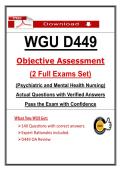
WGU D449
Objective Assessment
(2 Full Exams Set)
(Psychiatric and Mental Health Nursing)
Actual Questions with Verified Answers
Pass the Exam with Confidence
What You Will Get:
➢140 Questions with correct answers.
➢Expert Rationales included.
➢D449 OA Review
, Preview Pages Below
Get the Complete PDF After Purchase
"If you require further clarification or in need of any
study resources, feel free to Message me."
Digital preview sample
,Table of Contents
D449 OA EXAM SET 1 ....................................................................... 2
D449 OA EXAM SET 2 ..................................................................... 42
D449 OA Review ............................................................................. 80
D449 OA EXAM SET 1
1. A 34-year-old client is brought to the emergency department by family
members who report she has not left her home in 3 months. She states, "I can't
go to the grocery store because I might get trapped and not be able to escape."
During the assessment, the nurse observes the client is trembling and
diaphoretic when discussing leaving the house. Which nursing diagnosis should
the nurse prioritize?
A. Ineffective coping related to inadequate stress management
B. Fear related to being in situations where escape may be difficult
C. Social isolation related to altered thought processes
D. Risk for injury related to hyperventilation and panic episodes
Correct Answer: B
Expert Rationale:
This client is exhibiting classic signs of agoraphobia, characterized by intense fear of
being in situations where escape might be difficult or help unavailable. The client's
specific statement about being "trapped and not able to escape" directly aligns with the
diagnostic criteria for agoraphobia. While social isolation (C) is a consequence, it is
secondary to the underlying fear. Ineffective coping (A) is too vague and doesn't
address the specific phobic nature. Risk for injury (D) is not the primary concern at this
stage. The nurse should prioritize addressing the fear response to guide therapeutic
interventions such as gradual exposure therapy and cognitive-behavioral techniques.
2. A 28-year-old client with a severe phobia of flying has been referred for
implosion therapy. During the first session, the therapist asks the client to vividly
imagine being on a turbulent flight while simultaneously describing the
,experience in detail. The client becomes extremely anxious and asks to stop.
Which response by the therapist is most appropriate?
A. "We can stop now and try again next week with a less intense scenario."
B. "Let's take a break and practice deep breathing before continuing."
C. "I understand this is difficult, but we need to continue through the anxiety to break the
fear cycle."
D. "Perhaps exposure therapy is too advanced; let's switch to medication management
instead."
Correct Answer: C
Expert Rationale:
Implosion therapy (flooding) is a behavioral intervention that involves intense,
prolonged exposure to the feared stimulus or situation to extinguish the conditioned fear
response. Unlike systematic desensitization, which uses gradual exposure, implosion
therapy exposes the client to the maximum anxiety-provoking stimulus from the start.
The therapist must maintain the exposure without allowing avoidance behaviors, as
escape would reinforce the phobic response. Stopping (A) or switching approaches (D)
undermines the therapeutic goal. While breathing techniques (B) are useful adjuncts,
the core principle of flooding is sustained exposure until anxiety naturally habituates.
The therapist should provide support while encouraging continuation.
3. A 42-year-old client with obsessive-compulsive disorder (OCD) is observed
washing her hands for the 15th time in the past hour. When the nurse
approaches, the client says, "I know this doesn't make sense, but I can't stop. If I
don't wash, something terrible will happen." Which statement best explains the
underlying psychodynamic mechanism driving this behavior?
A. The hand-washing serves as a displacement of unconscious aggressive impulses
toward others.
B. The ritual temporarily reduces anxiety through negative reinforcement of the
compulsive behavior.
C. The behavior represents a reaction formation against underlying desires for
contamination.
D. The compulsion is maintained by positive reinforcement from family members who
accommodate the ritual.
Correct Answer: B
Expert Rationale:
In OCD, compulsions are repetitive behaviors performed in response to obsessions
,(intrusive thoughts, images, or urges) to reduce anxiety or prevent a feared outcome.
The negative reinforcement mechanism is critical: when the client performs the ritual
(hand-washing), anxiety temporarily decreases, which strengthens the likelihood of
future ritual performance. This creates a self-perpetuating cycle. Displacement (A) is
more characteristic of conversion disorders. Reaction formation (C) involves
transforming unacceptable impulses into their opposite, which is not the primary
mechanism here. While family accommodation (D) can maintain OCD, the question
specifically asks about the client's internal mechanism, and negative reinforcement is
the core behavioral explanation.
4. A 19-year-old client with newly diagnosed OCD spends 3 hours daily
performing elaborate cleaning rituals. During the initial nursing assessment, the
client becomes extremely agitated when the nurse suggests skipping one ritual.
Which intervention should the nurse include in the initial care plan?
A. Establish a contract to gradually reduce ritual time by 10 minutes each day.
B. Allow the client to complete rituals while building a therapeutic relationship and trust.
C. Immediately implement response prevention techniques to interrupt the compulsive
cycle.
D. Administer PRN anxiolytics whenever the client begins performing rituals.
Correct Answer: B
Expert Rationale:
During the initial phase of care for a client with OCD, the priority is establishing trust
and rapport. Abruptly interfering with rituals (C) or demanding immediate behavior
change (A) can severely damage the therapeutic relationship and increase anxiety to
intolerable levels. PRN anxiolytics (D) may mask symptoms but do not address the
underlying disorder and can create dependency. The evidence-based approach is to
initially allow rituals while building trust, then gradually introduce exposure and
response prevention (ERP) as the therapeutic alliance strengthens. This phased
approach respects the client's current coping mechanisms while laying groundwork for
definitive behavioral intervention.
5. A 26-year-old client arrives at the emergency department via ambulance,
hyperventilating, clutching their chest, and shouting, "I'm dying! My heart is
going to explode!" Vital signs show heart rate 142, BP 168/98, respirations 36,
SpO2 96%. The client is unable to sit still and repeatedly asks for someone to
"make it stop." Which action should the nurse take first?
, D449 OA EXAM SET 2
1. The nurse is performing the admission assessment for a client with
schizophrenia in an acute care inpatient facility. The nurse should identify which
observed behavior is characteristic of schizophrenia?
A. Responds with illogical answers to questions
B. Demonstrates goal-directed, organized speech
C. Maintains consistent eye contact throughout the interview
D. Expresses coherent, reality-based thought processes
Correct Answer: A
Rationale: Schizophrenia is characterized by disturbances in thought processes,
including disorganized thinking, loose associations, illogical responses, and thought
blocking. Illogical answers to questions reflect the formal thought disorder (disorganized
speech) that is a hallmark positive symptom of schizophrenia. Options B, C, and D
describe organized, coherent behavior that would be inconsistent with an acute
psychotic episode. Other characteristic behaviors include hallucinations, delusions,
grossly disorganized or catatonic behavior, and negative symptoms (flat affect, avolition,
alogia).
2. The mental health unit nurse completes the admission assessment for a
depressed adolescent client with suicidal ideation. The client reports becoming
angry with a sibling, so the client took a handful of pills. Which goal is most
important for the nurse to establish with this client?
A. Identify three effective ways to cope with anger and stress
B. Apologize to the sibling for the argument
C. Agree to take medications as prescribed
D. Participate in daily group therapy sessions
,Correct Answer: A
Rationale: The client's suicidal behavior was triggered by anger toward a sibling,
indicating poor impulse control and inadequate coping mechanisms. The most important
goal is to develop adaptive coping strategies to manage anger and stress, thereby
reducing future suicide risk. Teaching the client to identify emotions, use distress
tolerance skills, and employ problem-solving techniques addresses the root cause of
the suicidal behavior. While medication compliance (C) and group participation (D) are
important components of treatment, they do not directly address the precipitating factor.
Apologizing (B) is premature and does not teach coping skills.
3. A client who has agoraphobia (a fear of crowds) is beginning desensitization
with the therapist, and the nurse is reinforcing the process. Which intervention
has the highest priority for this client's plan of care?
A. Teach progressive muscle relaxation techniques
B. Establish trust by providing a calm, safe environment
C. Encourage gradual exposure to crowded shopping malls
D. Administer PRN anxiolytic medications before each session
Correct Answer: B
Rationale: The foundation of all therapeutic interventions, particularly for clients with
anxiety disorders such as agoraphobia, is the establishment of trust and a sense of
safety. Without a trusting therapeutic relationship and a calm, safe environment, the
client will be unable to engage effectively in desensitization therapy. Trust is essential
before any behavioral intervention can be successful. While relaxation techniques (A)
and gradual exposure (C) are important components of desensitization, they are
secondary to establishing safety and trust. PRN medications (D) may be used
adjunctively but do not address the core therapeutic need.
4. The nurse is assessing a client who reports using cocaine several times in the
past week. Which observations should the nurse document?
A. Sedation, constricted pupils, and respiratory depression
B. Stimulation, dilated pupils, and elevated blood pressure
C. Ataxia, slurred speech, and emotional lability
D. Euphoria, hypotension, and bradycardia
, D449 OA Review
Know the priority diagnosis's you would consider when someone presents with
confusion, paranoia/suspiciousness, etc.. what is the MOST concerning issue
present?
Most concerning issue : risk of harm to self or others.
Risk for injury, risk for violence with delusions, hallucinations or paranoia.
distorted thinking process.
Risk for suicide.
Benztropine (Cogentin), what is it used for ?
What effects does it have on the body?
Anticholinergic drug used to treat EPS. also helps with parkinson's.
Benzotropine restores balance between dopamine and acetylcholine in the parts of the
brain that control action of muscles. This improves the side effects caused by
antipsychotic drugs & parkinson's .
delerium tremens
severe alcohol withdrawal symptoms like shaking, confusion, and hallucinations.
Present with agitation, aggression, sweating , delirium .
Usually occurs within 48-72 hours of alcohol withdrawal.
Interventions include benzo's , monitor vitals & respirations., Thiamine, magnesium,
restraints if necessary and seizure precautions
Phenobarbital is deadly if taken with alcohol.
,Depression
Increased risk for suicide & suicidal thoughts.
S/S: anhedonia, weight loss or gain, psychomotor retardation. insomnia, feeling of
worthlessness or guilt.
Suicide risk assessment.
Tx: ECT, CBT, antidepressants, individual & group therapy.
Adolescents: presents with aggression, outbursts ,vandalism , skipping class
How to determine if interventions are effective ? increased mood, talking about future,.
antisocial personality disorder
major concerns: pt's dont show guilt or remorse, reckless disregard for safety of self and
others. lack of empathy or concern.
risk for self harm or others.
antisocial personality disorder (APD)
A personality disorder marked by disregard for and violation of the rights of others and
by lack of remorse.
These pt's don't think they're the problem, they think it's others
Worried about pt harm to themselves or others
Know about Schizophrenia! Med compliance! What happens to these patients
when they're off their meds?
Signs/symptoms of this?
How would we treat this, what would we monitor for, and how can we work to
increase compliance?
Schizophrenia:
POSITIVE signs: “D’s” Dreaming up sounds and objects (hallucinations); Delusions;
Disconnected speech patterns,
, Disorganized behavior
NEGATIVE signs: “A’s” Anhedonia, Anergia, Affect flat, Absence of normal
characteristics, Avolition, Alogia
1st gen & 2nd gen antipsychotics
1st gen: Haldol (Haloperidol); Chlorpromazine (Thorazine); Thioridazine (Mellaril);
Fluphenazine (Prolixin)
Side effects for 1st Gen antipsychotics
Increased risk of EPS, TD, and NMS!!
SE include: “ENRAGED”
EPS
NMS
Risk of seizures
Anticholinergic effects
Gynecomastia & menstrual issues
EsExual dysfunction
Damaged liver
2nd generation antipsychotics
Risperidone (Risperdol); Clozapine (Clozaril);
Olanzapine (Zyprexa);
Palperidone (Invega);
Ziprasidone (Geodon);
Aripiprazole (Abilify)
Objective Assessment
(2 Full Exams Set)
(Psychiatric and Mental Health Nursing)
Actual Questions with Verified Answers
Pass the Exam with Confidence
What You Will Get:
➢140 Questions with correct answers.
➢Expert Rationales included.
➢D449 OA Review
, Preview Pages Below
Get the Complete PDF After Purchase
"If you require further clarification or in need of any
study resources, feel free to Message me."
Digital preview sample
,Table of Contents
D449 OA EXAM SET 1 ....................................................................... 2
D449 OA EXAM SET 2 ..................................................................... 42
D449 OA Review ............................................................................. 80
D449 OA EXAM SET 1
1. A 34-year-old client is brought to the emergency department by family
members who report she has not left her home in 3 months. She states, "I can't
go to the grocery store because I might get trapped and not be able to escape."
During the assessment, the nurse observes the client is trembling and
diaphoretic when discussing leaving the house. Which nursing diagnosis should
the nurse prioritize?
A. Ineffective coping related to inadequate stress management
B. Fear related to being in situations where escape may be difficult
C. Social isolation related to altered thought processes
D. Risk for injury related to hyperventilation and panic episodes
Correct Answer: B
Expert Rationale:
This client is exhibiting classic signs of agoraphobia, characterized by intense fear of
being in situations where escape might be difficult or help unavailable. The client's
specific statement about being "trapped and not able to escape" directly aligns with the
diagnostic criteria for agoraphobia. While social isolation (C) is a consequence, it is
secondary to the underlying fear. Ineffective coping (A) is too vague and doesn't
address the specific phobic nature. Risk for injury (D) is not the primary concern at this
stage. The nurse should prioritize addressing the fear response to guide therapeutic
interventions such as gradual exposure therapy and cognitive-behavioral techniques.
2. A 28-year-old client with a severe phobia of flying has been referred for
implosion therapy. During the first session, the therapist asks the client to vividly
imagine being on a turbulent flight while simultaneously describing the
,experience in detail. The client becomes extremely anxious and asks to stop.
Which response by the therapist is most appropriate?
A. "We can stop now and try again next week with a less intense scenario."
B. "Let's take a break and practice deep breathing before continuing."
C. "I understand this is difficult, but we need to continue through the anxiety to break the
fear cycle."
D. "Perhaps exposure therapy is too advanced; let's switch to medication management
instead."
Correct Answer: C
Expert Rationale:
Implosion therapy (flooding) is a behavioral intervention that involves intense,
prolonged exposure to the feared stimulus or situation to extinguish the conditioned fear
response. Unlike systematic desensitization, which uses gradual exposure, implosion
therapy exposes the client to the maximum anxiety-provoking stimulus from the start.
The therapist must maintain the exposure without allowing avoidance behaviors, as
escape would reinforce the phobic response. Stopping (A) or switching approaches (D)
undermines the therapeutic goal. While breathing techniques (B) are useful adjuncts,
the core principle of flooding is sustained exposure until anxiety naturally habituates.
The therapist should provide support while encouraging continuation.
3. A 42-year-old client with obsessive-compulsive disorder (OCD) is observed
washing her hands for the 15th time in the past hour. When the nurse
approaches, the client says, "I know this doesn't make sense, but I can't stop. If I
don't wash, something terrible will happen." Which statement best explains the
underlying psychodynamic mechanism driving this behavior?
A. The hand-washing serves as a displacement of unconscious aggressive impulses
toward others.
B. The ritual temporarily reduces anxiety through negative reinforcement of the
compulsive behavior.
C. The behavior represents a reaction formation against underlying desires for
contamination.
D. The compulsion is maintained by positive reinforcement from family members who
accommodate the ritual.
Correct Answer: B
Expert Rationale:
In OCD, compulsions are repetitive behaviors performed in response to obsessions
,(intrusive thoughts, images, or urges) to reduce anxiety or prevent a feared outcome.
The negative reinforcement mechanism is critical: when the client performs the ritual
(hand-washing), anxiety temporarily decreases, which strengthens the likelihood of
future ritual performance. This creates a self-perpetuating cycle. Displacement (A) is
more characteristic of conversion disorders. Reaction formation (C) involves
transforming unacceptable impulses into their opposite, which is not the primary
mechanism here. While family accommodation (D) can maintain OCD, the question
specifically asks about the client's internal mechanism, and negative reinforcement is
the core behavioral explanation.
4. A 19-year-old client with newly diagnosed OCD spends 3 hours daily
performing elaborate cleaning rituals. During the initial nursing assessment, the
client becomes extremely agitated when the nurse suggests skipping one ritual.
Which intervention should the nurse include in the initial care plan?
A. Establish a contract to gradually reduce ritual time by 10 minutes each day.
B. Allow the client to complete rituals while building a therapeutic relationship and trust.
C. Immediately implement response prevention techniques to interrupt the compulsive
cycle.
D. Administer PRN anxiolytics whenever the client begins performing rituals.
Correct Answer: B
Expert Rationale:
During the initial phase of care for a client with OCD, the priority is establishing trust
and rapport. Abruptly interfering with rituals (C) or demanding immediate behavior
change (A) can severely damage the therapeutic relationship and increase anxiety to
intolerable levels. PRN anxiolytics (D) may mask symptoms but do not address the
underlying disorder and can create dependency. The evidence-based approach is to
initially allow rituals while building trust, then gradually introduce exposure and
response prevention (ERP) as the therapeutic alliance strengthens. This phased
approach respects the client's current coping mechanisms while laying groundwork for
definitive behavioral intervention.
5. A 26-year-old client arrives at the emergency department via ambulance,
hyperventilating, clutching their chest, and shouting, "I'm dying! My heart is
going to explode!" Vital signs show heart rate 142, BP 168/98, respirations 36,
SpO2 96%. The client is unable to sit still and repeatedly asks for someone to
"make it stop." Which action should the nurse take first?
, D449 OA EXAM SET 2
1. The nurse is performing the admission assessment for a client with
schizophrenia in an acute care inpatient facility. The nurse should identify which
observed behavior is characteristic of schizophrenia?
A. Responds with illogical answers to questions
B. Demonstrates goal-directed, organized speech
C. Maintains consistent eye contact throughout the interview
D. Expresses coherent, reality-based thought processes
Correct Answer: A
Rationale: Schizophrenia is characterized by disturbances in thought processes,
including disorganized thinking, loose associations, illogical responses, and thought
blocking. Illogical answers to questions reflect the formal thought disorder (disorganized
speech) that is a hallmark positive symptom of schizophrenia. Options B, C, and D
describe organized, coherent behavior that would be inconsistent with an acute
psychotic episode. Other characteristic behaviors include hallucinations, delusions,
grossly disorganized or catatonic behavior, and negative symptoms (flat affect, avolition,
alogia).
2. The mental health unit nurse completes the admission assessment for a
depressed adolescent client with suicidal ideation. The client reports becoming
angry with a sibling, so the client took a handful of pills. Which goal is most
important for the nurse to establish with this client?
A. Identify three effective ways to cope with anger and stress
B. Apologize to the sibling for the argument
C. Agree to take medications as prescribed
D. Participate in daily group therapy sessions
,Correct Answer: A
Rationale: The client's suicidal behavior was triggered by anger toward a sibling,
indicating poor impulse control and inadequate coping mechanisms. The most important
goal is to develop adaptive coping strategies to manage anger and stress, thereby
reducing future suicide risk. Teaching the client to identify emotions, use distress
tolerance skills, and employ problem-solving techniques addresses the root cause of
the suicidal behavior. While medication compliance (C) and group participation (D) are
important components of treatment, they do not directly address the precipitating factor.
Apologizing (B) is premature and does not teach coping skills.
3. A client who has agoraphobia (a fear of crowds) is beginning desensitization
with the therapist, and the nurse is reinforcing the process. Which intervention
has the highest priority for this client's plan of care?
A. Teach progressive muscle relaxation techniques
B. Establish trust by providing a calm, safe environment
C. Encourage gradual exposure to crowded shopping malls
D. Administer PRN anxiolytic medications before each session
Correct Answer: B
Rationale: The foundation of all therapeutic interventions, particularly for clients with
anxiety disorders such as agoraphobia, is the establishment of trust and a sense of
safety. Without a trusting therapeutic relationship and a calm, safe environment, the
client will be unable to engage effectively in desensitization therapy. Trust is essential
before any behavioral intervention can be successful. While relaxation techniques (A)
and gradual exposure (C) are important components of desensitization, they are
secondary to establishing safety and trust. PRN medications (D) may be used
adjunctively but do not address the core therapeutic need.
4. The nurse is assessing a client who reports using cocaine several times in the
past week. Which observations should the nurse document?
A. Sedation, constricted pupils, and respiratory depression
B. Stimulation, dilated pupils, and elevated blood pressure
C. Ataxia, slurred speech, and emotional lability
D. Euphoria, hypotension, and bradycardia
, D449 OA Review
Know the priority diagnosis's you would consider when someone presents with
confusion, paranoia/suspiciousness, etc.. what is the MOST concerning issue
present?
Most concerning issue : risk of harm to self or others.
Risk for injury, risk for violence with delusions, hallucinations or paranoia.
distorted thinking process.
Risk for suicide.
Benztropine (Cogentin), what is it used for ?
What effects does it have on the body?
Anticholinergic drug used to treat EPS. also helps with parkinson's.
Benzotropine restores balance between dopamine and acetylcholine in the parts of the
brain that control action of muscles. This improves the side effects caused by
antipsychotic drugs & parkinson's .
delerium tremens
severe alcohol withdrawal symptoms like shaking, confusion, and hallucinations.
Present with agitation, aggression, sweating , delirium .
Usually occurs within 48-72 hours of alcohol withdrawal.
Interventions include benzo's , monitor vitals & respirations., Thiamine, magnesium,
restraints if necessary and seizure precautions
Phenobarbital is deadly if taken with alcohol.
,Depression
Increased risk for suicide & suicidal thoughts.
S/S: anhedonia, weight loss or gain, psychomotor retardation. insomnia, feeling of
worthlessness or guilt.
Suicide risk assessment.
Tx: ECT, CBT, antidepressants, individual & group therapy.
Adolescents: presents with aggression, outbursts ,vandalism , skipping class
How to determine if interventions are effective ? increased mood, talking about future,.
antisocial personality disorder
major concerns: pt's dont show guilt or remorse, reckless disregard for safety of self and
others. lack of empathy or concern.
risk for self harm or others.
antisocial personality disorder (APD)
A personality disorder marked by disregard for and violation of the rights of others and
by lack of remorse.
These pt's don't think they're the problem, they think it's others
Worried about pt harm to themselves or others
Know about Schizophrenia! Med compliance! What happens to these patients
when they're off their meds?
Signs/symptoms of this?
How would we treat this, what would we monitor for, and how can we work to
increase compliance?
Schizophrenia:
POSITIVE signs: “D’s” Dreaming up sounds and objects (hallucinations); Delusions;
Disconnected speech patterns,
, Disorganized behavior
NEGATIVE signs: “A’s” Anhedonia, Anergia, Affect flat, Absence of normal
characteristics, Avolition, Alogia
1st gen & 2nd gen antipsychotics
1st gen: Haldol (Haloperidol); Chlorpromazine (Thorazine); Thioridazine (Mellaril);
Fluphenazine (Prolixin)
Side effects for 1st Gen antipsychotics
Increased risk of EPS, TD, and NMS!!
SE include: “ENRAGED”
EPS
NMS
Risk of seizures
Anticholinergic effects
Gynecomastia & menstrual issues
EsExual dysfunction
Damaged liver
2nd generation antipsychotics
Risperidone (Risperdol); Clozapine (Clozaril);
Olanzapine (Zyprexa);
Palperidone (Invega);
Ziprasidone (Geodon);
Aripiprazole (Abilify)