
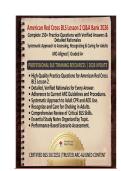
,American Red Cross BLS Lesson 2 Q&A Bank 2026 – Complete
150+ Practice Questions with Verified Answers & Detailed
Rationales | Systematic Approach to Assessing, Recognizing &
Caring for Adults | ARC-Aligned | Graded A+ | Instant
Download
Question 1
What is the very first step a rescuer should take upon arriving
at the scene of a medical emergency?
• A) Begin chest compressions immediately
• B) Verify scene safety for both the rescuer and the victim
• C) Check the victim's carotid pulse
• D) Administer high-flow oxygen via non-rebreather mask
• Correct Answer: B
• Rationale: Ensuring scene safety prevents rescuers from
becoming secondary victims of environmental hazards,
traffic, fire, or violence.
Question 2
Which of the following is considered a standard precaution to
protect healthcare providers from bloodborne pathogens?
, • A) Wearing personal protective equipment (PPE) such as
medical gloves and eye protection
• B) Washing hands only after finishing a full shift
• C) Recapping all used needles by hand immediately after
use
• D) Avoiding all physical contact with conscious patients
• Correct Answer: A
• Rationale: Standard precautions, including barrier devices
and PPE, protect providers from exposure to infectious
body fluids.
Question 3
When should a rescuer don personal protective equipment
(PPE)?
• A) Only after the patient has been transported to a
hospital
• B) Before initiating patient care or contact with body fluids
• C) Only if the patient requests it
• D) After completing all chest compressions
• Correct Answer: B
, • Rationale: PPE must be put on before any potential
exposure to blood or other potentially infectious materials
occurs.
Question 4
What should a rescuer do if the emergency scene becomes
unsafe during resuscitation efforts?
• A) Continue CPR and ignore the hazard
• B) Immediately evacuate the area and take the patient if
possible, or move to safety until the hazard is resolved
• C) Wait for bystanders to handle the hazard
• D) Stop all emergency response permanently
• Correct Answer: B
• Rationale: Rescuers must never endanger themselves. If a
scene becomes unsafe, withdraw to a safe location
immediately.
Question 5
What is the primary purpose of using a pocket mask with a
one-way valve during rescue breaths?
• A) To increase the delivery of carbon dioxide
• B) To protect the rescuer from direct contact with the
victim's saliva and respiratory secretions
150+ Practice Questions with Verified Answers & Detailed
Rationales | Systematic Approach to Assessing, Recognizing &
Caring for Adults | ARC-Aligned | Graded A+ | Instant
Download
Question 1
What is the very first step a rescuer should take upon arriving
at the scene of a medical emergency?
• A) Begin chest compressions immediately
• B) Verify scene safety for both the rescuer and the victim
• C) Check the victim's carotid pulse
• D) Administer high-flow oxygen via non-rebreather mask
• Correct Answer: B
• Rationale: Ensuring scene safety prevents rescuers from
becoming secondary victims of environmental hazards,
traffic, fire, or violence.
Question 2
Which of the following is considered a standard precaution to
protect healthcare providers from bloodborne pathogens?
, • A) Wearing personal protective equipment (PPE) such as
medical gloves and eye protection
• B) Washing hands only after finishing a full shift
• C) Recapping all used needles by hand immediately after
use
• D) Avoiding all physical contact with conscious patients
• Correct Answer: A
• Rationale: Standard precautions, including barrier devices
and PPE, protect providers from exposure to infectious
body fluids.
Question 3
When should a rescuer don personal protective equipment
(PPE)?
• A) Only after the patient has been transported to a
hospital
• B) Before initiating patient care or contact with body fluids
• C) Only if the patient requests it
• D) After completing all chest compressions
• Correct Answer: B
, • Rationale: PPE must be put on before any potential
exposure to blood or other potentially infectious materials
occurs.
Question 4
What should a rescuer do if the emergency scene becomes
unsafe during resuscitation efforts?
• A) Continue CPR and ignore the hazard
• B) Immediately evacuate the area and take the patient if
possible, or move to safety until the hazard is resolved
• C) Wait for bystanders to handle the hazard
• D) Stop all emergency response permanently
• Correct Answer: B
• Rationale: Rescuers must never endanger themselves. If a
scene becomes unsafe, withdraw to a safe location
immediately.
Question 5
What is the primary purpose of using a pocket mask with a
one-way valve during rescue breaths?
• A) To increase the delivery of carbon dioxide
• B) To protect the rescuer from direct contact with the
victim's saliva and respiratory secretions


