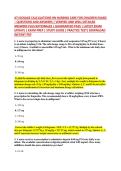
ATI DOSAGE CALCULATIONS-RN NURSING CARE FOR CHILDREN EXAM]
– QUESTIONS AND ANSWERS | VERIFIED AND WELL DETAILED
ANSWERS PLUS RATIONALES | GUARANTEED PASS | LATEST EXAM
UPDATE | EXAM PREP | STUDY GUIDE | PRACTICE TEST| DOWNLOAD
INSTANT PDF
1. A nurse is preparing to administer amoxicillin oral suspension 125 mg PO every 8 hours
to an infant weighing 11 lb. The safe dosage range is 20 to 40 mg/kg/day in divided doses
every 8 hours. Available is amoxicillin 125 mg/5 mL. What is the minimum safe daily dose
in milligrams for this infant?
A. 50 mg
B. 100 mg
C. 125 mg
D. 200 mg
To find the minimum safe daily dose, first convert the infant's weight from pounds to
kilograms by dividing by 2.2 (11 lb / 2.2 = 5 kg). Next, multiply the weight in kilograms by the
minimum dosage rate (5 kg x 20 mg/kg/day = 100 mg/day). Options A, C, and D do not reflect
the correct mathematical conversion and minimum dosage calculation.
2. A nurse is calculating the safe dosage range for a toddler weighing 28 lb who has a
prescription for ibuprofen. The recommended dose is 10 mg/kg/dose every 6 hours PRN.
What is the correct single dose in milligrams?
A. 100 mg
B. 127 mg
C. 140 mg
D. 280 mg
Convert the toddler's weight to kilograms: 28 lb / 2.2 = 12.727 kg. Multiply by the ordered
dose per kilogram: 12.727 kg x 10 mg/kg = 127.27 mg, which rounds to 127 mg. Options A, C,
and D represent incorrect weight conversions or arithmetic errors.
3. A nurse receives a prescription to administer digoxin 0.04 mg PO twice daily to an
infant. The available concentration is digoxin pediatric elixir 0.05 mg/mL. How many
milliliters should the nurse administer per dose?
A. 0.4 mL
,B. 0.8 mL
C. 1.25 mL
D. 2.0 mL
Using the formula (Desired / Have) x Volume, divide the desired dose by the available
concentration: (0.04 mg / 0.05 mg) x 1 mL = 0.8 mL. Options A, C, and D are incorrect
calculations based on improper division or multiplication.
4. A nurse is preparing to administer gentamicin IV to a school-age child weighing 44 lb.
The prescription reads 2.5 mg/kg IV every 8 hours. What is the correct single dose in
milligrams?
A. 25 mg
B. 50 mg
C. 88 mg
D. 110 mg
Convert the child's weight to kilograms: 44 lb / 2.2 = 20 kg. Multiply the weight by the
prescribed dose: 20 kg x 2.5 mg/kg = 50 mg per dose. Options A, C, and D are incorrect.
5. A pediatric nurse is reviewing a medication order for acetaminophen syrup 160 mg PO
every 4 hours PRN for fever. The child weighs 32 lb. The recommended dosage is 10 to 15
mg/kg/dose. Is this ordered dose safe for this child?
A. Yes, because the dose is 11 mg/kg, which falls within the safe range.
B. No, because the dose is below the minimum safe range.
C. No, because the dose exceeds the maximum safe range.
D. Yes, because acetaminophen is safe at any dose in children.
Convert the weight to kg: 32 lb / 2.2 = 14.54 kg. Calculate the dose per kg: 160 mg / 14.54 kg
= 11.0 mg/kg. Since the recommended range is 10 to 15 mg/kg, 11 mg/kg is safe and within
parameters. Options B, C, and D are incorrect interpretations of the safe dosage calculation.
6. A nurse is preparing to administer furosemide 1 mg/kg IV to a toddler weighing 33 lb.
Available is furosemide injection 10 mg/mL. How many milliliters should the nurse
administer?
A. 0.5 mL
B. 1.0 mL
, C. 1.5 mL
D. 2.0 mL
Convert weight to kg: 33 lb / 2.2 = 15 kg. Calculate the required dose: 15 kg x 1 mg/kg = 15
mg. Calculate the volume to administer: (15 mg / 10 mg) x 1 mL = 1.5 mL. Options A, B, and
D are incorrect volume calculations.
7. A nurse is caring for an infant prescribed phenobarbital 5 mg/kg/day PO divided in two
equal doses. The infant weighs 13.2 lb. What is the dose in milligrams the nurse should
administer for each individual dose?
A. 15 mg
B. 30 mg
C. 60 mg
D. 132 mg
Convert weight to kg: 13.2 lb / 2.2 = 6 kg. Calculate total daily dose: 6 kg x 5 mg/kg/day = 30
mg/day. Divide by 2 for the twice-daily schedule: 30 mg / 2 = 15 mg per dose. Options B, C,
and D reflect math errors in weight conversion or dose division.
8. A nurse is calculating the body surface area (BSA) for an adolescent patient using the
most common formula. The patient's height is 130 cm and weight is 30 kg. Using the BSA
formula, what is the approximate BSA in square meters?
A. 0.52 m2
B. 1.03 m2
C. 1.50 m2
D. 2.05 m2
BSA is calculated using the square root of [(Height in cm x Weight in kg) / 3600].
Substituting the values: sqrt[(130 x 30) / 3600] = sqrt() = sqrt(1.0833) = 1.04 m2
(approx 1.03 m2). Options A, C, and D are incorrect calculations.
9. A nurse is preparing to administer prednisolone syrup 2 mg/kg/day PO divided equally
every 12 hours to a child weighing 48 lb. Available is prednisolone 15 mg/5 mL. How many
milliliters should the nurse administer for each dose?
A. 2.2 mL
B. 3.6 mL
– QUESTIONS AND ANSWERS | VERIFIED AND WELL DETAILED
ANSWERS PLUS RATIONALES | GUARANTEED PASS | LATEST EXAM
UPDATE | EXAM PREP | STUDY GUIDE | PRACTICE TEST| DOWNLOAD
INSTANT PDF
1. A nurse is preparing to administer amoxicillin oral suspension 125 mg PO every 8 hours
to an infant weighing 11 lb. The safe dosage range is 20 to 40 mg/kg/day in divided doses
every 8 hours. Available is amoxicillin 125 mg/5 mL. What is the minimum safe daily dose
in milligrams for this infant?
A. 50 mg
B. 100 mg
C. 125 mg
D. 200 mg
To find the minimum safe daily dose, first convert the infant's weight from pounds to
kilograms by dividing by 2.2 (11 lb / 2.2 = 5 kg). Next, multiply the weight in kilograms by the
minimum dosage rate (5 kg x 20 mg/kg/day = 100 mg/day). Options A, C, and D do not reflect
the correct mathematical conversion and minimum dosage calculation.
2. A nurse is calculating the safe dosage range for a toddler weighing 28 lb who has a
prescription for ibuprofen. The recommended dose is 10 mg/kg/dose every 6 hours PRN.
What is the correct single dose in milligrams?
A. 100 mg
B. 127 mg
C. 140 mg
D. 280 mg
Convert the toddler's weight to kilograms: 28 lb / 2.2 = 12.727 kg. Multiply by the ordered
dose per kilogram: 12.727 kg x 10 mg/kg = 127.27 mg, which rounds to 127 mg. Options A, C,
and D represent incorrect weight conversions or arithmetic errors.
3. A nurse receives a prescription to administer digoxin 0.04 mg PO twice daily to an
infant. The available concentration is digoxin pediatric elixir 0.05 mg/mL. How many
milliliters should the nurse administer per dose?
A. 0.4 mL
,B. 0.8 mL
C. 1.25 mL
D. 2.0 mL
Using the formula (Desired / Have) x Volume, divide the desired dose by the available
concentration: (0.04 mg / 0.05 mg) x 1 mL = 0.8 mL. Options A, C, and D are incorrect
calculations based on improper division or multiplication.
4. A nurse is preparing to administer gentamicin IV to a school-age child weighing 44 lb.
The prescription reads 2.5 mg/kg IV every 8 hours. What is the correct single dose in
milligrams?
A. 25 mg
B. 50 mg
C. 88 mg
D. 110 mg
Convert the child's weight to kilograms: 44 lb / 2.2 = 20 kg. Multiply the weight by the
prescribed dose: 20 kg x 2.5 mg/kg = 50 mg per dose. Options A, C, and D are incorrect.
5. A pediatric nurse is reviewing a medication order for acetaminophen syrup 160 mg PO
every 4 hours PRN for fever. The child weighs 32 lb. The recommended dosage is 10 to 15
mg/kg/dose. Is this ordered dose safe for this child?
A. Yes, because the dose is 11 mg/kg, which falls within the safe range.
B. No, because the dose is below the minimum safe range.
C. No, because the dose exceeds the maximum safe range.
D. Yes, because acetaminophen is safe at any dose in children.
Convert the weight to kg: 32 lb / 2.2 = 14.54 kg. Calculate the dose per kg: 160 mg / 14.54 kg
= 11.0 mg/kg. Since the recommended range is 10 to 15 mg/kg, 11 mg/kg is safe and within
parameters. Options B, C, and D are incorrect interpretations of the safe dosage calculation.
6. A nurse is preparing to administer furosemide 1 mg/kg IV to a toddler weighing 33 lb.
Available is furosemide injection 10 mg/mL. How many milliliters should the nurse
administer?
A. 0.5 mL
B. 1.0 mL
, C. 1.5 mL
D. 2.0 mL
Convert weight to kg: 33 lb / 2.2 = 15 kg. Calculate the required dose: 15 kg x 1 mg/kg = 15
mg. Calculate the volume to administer: (15 mg / 10 mg) x 1 mL = 1.5 mL. Options A, B, and
D are incorrect volume calculations.
7. A nurse is caring for an infant prescribed phenobarbital 5 mg/kg/day PO divided in two
equal doses. The infant weighs 13.2 lb. What is the dose in milligrams the nurse should
administer for each individual dose?
A. 15 mg
B. 30 mg
C. 60 mg
D. 132 mg
Convert weight to kg: 13.2 lb / 2.2 = 6 kg. Calculate total daily dose: 6 kg x 5 mg/kg/day = 30
mg/day. Divide by 2 for the twice-daily schedule: 30 mg / 2 = 15 mg per dose. Options B, C,
and D reflect math errors in weight conversion or dose division.
8. A nurse is calculating the body surface area (BSA) for an adolescent patient using the
most common formula. The patient's height is 130 cm and weight is 30 kg. Using the BSA
formula, what is the approximate BSA in square meters?
A. 0.52 m2
B. 1.03 m2
C. 1.50 m2
D. 2.05 m2
BSA is calculated using the square root of [(Height in cm x Weight in kg) / 3600].
Substituting the values: sqrt[(130 x 30) / 3600] = sqrt() = sqrt(1.0833) = 1.04 m2
(approx 1.03 m2). Options A, C, and D are incorrect calculations.
9. A nurse is preparing to administer prednisolone syrup 2 mg/kg/day PO divided equally
every 12 hours to a child weighing 48 lb. Available is prednisolone 15 mg/5 mL. How many
milliliters should the nurse administer for each dose?
A. 2.2 mL
B. 3.6 mL