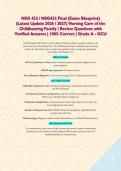
Childbearing Family | Review Questions with
This 88-question NSG 432 Final Exam Blueprint features verified, up-to-date questions with
exact Answers for the Nursing Care of the Childbearing Family. It perfectly prepares nursing
students for high-stakes exams on high-risk pregnancies, labor emergencies, postpartum
hemorrhage, and newborn care.
What’s Included
88 Core Questions: Multiple-choice and alternate-format questions designed to test
clinical judgment.
NCLEX-style questions & Detailed Answers:
Exam Blueprint Alignment: Covers critical concepts for the childbearing family course.
Key Topics Covered
High-Risk Antepartum Care: Gestational hypertension, preeclampsia, HELLP syndrome,
and fetal monitoring.
Intrapartum & Labor Complications: Dystocia, umbilical cord prolapse, oxytocin
(Pitocin) use, and epidural/pain management.
Postpartum Adaptations: Fundal assessment, lochia stages (rubra, serosa, alba), and
hemorrhage priority interventions.
Newborn Assessment & Care: APGAR scoring, thermoregulation, hyperbilirubinemia,
and safe sleep education.
Pharmacology: Magnesium sulfate toxicity, Betamethasone, and RhoGAM administration.
Why Students Need This
This comprehensive study resource helps eliminate test anxiety. Instead of memorizing
flashcards, you will master the clinical judgment skills needed to pass your final and
confidently tackle your nursing boards.
1
,Q1. Which set of findings is characteristic of a pulmonary embolism (PE) as
described in this material? [Multiple Choice]
A) Erythema toxicum that needs no treatment
B) Unilateral leg pain or calf tenderness, edema, warmth, redness
C) Passing of blood clots
D) Difficulty breathing, feeling of 'impending doom'
Answer: Difficulty breathing, feeling of 'impending doom'
Explanation: A pulmonary embolism typically presents with sudden shortness of breath and a
subjective sense of severe anxiety or impending doom due to impaired oxygenation and
cardiovascular strain. The first distractor lists DVT signs (leg findings), "passing of blood clots" is
a sign noted with postpartum hemorrhage, and "erythema toxicum" is a benign newborn rash
that requires no treatment; none of these describe PE.
Q2. Explain how the listed causes (overdistended bladder, long labor, rapid
delivery, retained placenta, magnesium use, large baby, subinvolution) can lead
to uterine atony — failure of the uterus to contract after delivery. [Short Answer]
Answer: These factors interfere with the uterus’s ability to contract: overdistention
(from a full bladder or large baby) and retained placenta physically prevent effective
contraction; prolonged or precipitous labor can fatigue or disrupt normal contractile
function; magnesium relaxes uterine muscle; and subinvolution means the uterus fails to
return to its contracted state — all resulting in uterine atony.
Explanation: Uterine contraction after delivery compresses uterine blood vessels and stops
bleeding. Causes listed either mechanically prevent contraction (distention, retained tissue),
pharmacologically relax the muscle (magnesium), or impair the uterus’s recovery (subinvolution
or muscle fatigue), so recognizing these risk factors guides prevention and treatment of
postpartum bleeding.
Q3. What specific cord-care instruction should new parents be taught for the
newborn's umbilical cord? [Multiple Choice]
A) Dry baby completely after birth
B) Keep the umbilical cord clean and dry
C) Turn the warmer on before you put the baby in
D) Keep the baby covered (Hat and blanket)
Answer: Keep the umbilical cord clean and dry
2
, Explanation: Cord care focuses on preventing infection and promoting natural drying of the
stump; keeping it clean and dry reduces bacterial growth and allows the cord to separate. "Dry
baby completely after birth" is a measure to prevent evaporative heat loss, not cord care. "Keep
the baby covered (Hat and blanket)" and "Turn the warmer on before you put the baby in" are
strategies to prevent other types of heat loss, not guidance about cord hygiene.
Q4. What is the appropriate level of care for a patient experiencing postpartum
psychosis? [Multiple Choice]
A) Hospitalization
B) None
C) Fundal massage
D) SSRIs and SNRIs
Answer: Hospitalization
Explanation: Postpartum psychosis is a severe psychiatric emergency that requires prompt
inpatient treatment to ensure the safety of the mother and infant; hospitalization allows close
monitoring and intensive psychiatric care. "None" is the recommended approach for baby blues
but is inappropriate for psychosis. "SSRIs and SNRIs" are outpatient medication classes commonly
used for postpartum depression, not the immediate definitive management for psychosis.
"Fundal massage" is an obstetric intervention for postpartum hemorrhage and unrelated to
psychiatric emergencies.
Q5. Why is vitamin K given intramuscularly to newborns rather than orally?
[Multiple Choice]
A) Newborns have sterile stomachs, and cannot use the vitamin K if given orally
B) Kickstart clotting factors and prevent internal bleeds
C) Consent
D) To prevent bacterial infection
Answer: Newborns have sterile stomachs, and cannot use the vitamin K if given orally
Explanation: Newborns lack intestinal bacterial flora needed to synthesize and absorb vitamin K
effectively from an oral dose; giving it intramuscularly ensures reliable uptake and rapid
availability for clotting factor function. "Kickstart clotting factors and prevent internal bleeds" is
the purpose of vitamin K (not an explanation of route choice), "Consent" relates to vaccination
decisions, and "To prevent bacterial infection" is the purpose of erythromycin eye ointment.
Q6. Which pair of benefits is commonly associated with breastfeeding? [Multiple
Choice]
3
This 88-question NSG 432 Final Exam Blueprint features verified, up-to-date questions with
exact Answers for the Nursing Care of the Childbearing Family. It perfectly prepares nursing
students for high-stakes exams on high-risk pregnancies, labor emergencies, postpartum
hemorrhage, and newborn care.
What’s Included
88 Core Questions: Multiple-choice and alternate-format questions designed to test
clinical judgment.
NCLEX-style questions & Detailed Answers:
Exam Blueprint Alignment: Covers critical concepts for the childbearing family course.
Key Topics Covered
High-Risk Antepartum Care: Gestational hypertension, preeclampsia, HELLP syndrome,
and fetal monitoring.
Intrapartum & Labor Complications: Dystocia, umbilical cord prolapse, oxytocin
(Pitocin) use, and epidural/pain management.
Postpartum Adaptations: Fundal assessment, lochia stages (rubra, serosa, alba), and
hemorrhage priority interventions.
Newborn Assessment & Care: APGAR scoring, thermoregulation, hyperbilirubinemia,
and safe sleep education.
Pharmacology: Magnesium sulfate toxicity, Betamethasone, and RhoGAM administration.
Why Students Need This
This comprehensive study resource helps eliminate test anxiety. Instead of memorizing
flashcards, you will master the clinical judgment skills needed to pass your final and
confidently tackle your nursing boards.
1
,Q1. Which set of findings is characteristic of a pulmonary embolism (PE) as
described in this material? [Multiple Choice]
A) Erythema toxicum that needs no treatment
B) Unilateral leg pain or calf tenderness, edema, warmth, redness
C) Passing of blood clots
D) Difficulty breathing, feeling of 'impending doom'
Answer: Difficulty breathing, feeling of 'impending doom'
Explanation: A pulmonary embolism typically presents with sudden shortness of breath and a
subjective sense of severe anxiety or impending doom due to impaired oxygenation and
cardiovascular strain. The first distractor lists DVT signs (leg findings), "passing of blood clots" is
a sign noted with postpartum hemorrhage, and "erythema toxicum" is a benign newborn rash
that requires no treatment; none of these describe PE.
Q2. Explain how the listed causes (overdistended bladder, long labor, rapid
delivery, retained placenta, magnesium use, large baby, subinvolution) can lead
to uterine atony — failure of the uterus to contract after delivery. [Short Answer]
Answer: These factors interfere with the uterus’s ability to contract: overdistention
(from a full bladder or large baby) and retained placenta physically prevent effective
contraction; prolonged or precipitous labor can fatigue or disrupt normal contractile
function; magnesium relaxes uterine muscle; and subinvolution means the uterus fails to
return to its contracted state — all resulting in uterine atony.
Explanation: Uterine contraction after delivery compresses uterine blood vessels and stops
bleeding. Causes listed either mechanically prevent contraction (distention, retained tissue),
pharmacologically relax the muscle (magnesium), or impair the uterus’s recovery (subinvolution
or muscle fatigue), so recognizing these risk factors guides prevention and treatment of
postpartum bleeding.
Q3. What specific cord-care instruction should new parents be taught for the
newborn's umbilical cord? [Multiple Choice]
A) Dry baby completely after birth
B) Keep the umbilical cord clean and dry
C) Turn the warmer on before you put the baby in
D) Keep the baby covered (Hat and blanket)
Answer: Keep the umbilical cord clean and dry
2
, Explanation: Cord care focuses on preventing infection and promoting natural drying of the
stump; keeping it clean and dry reduces bacterial growth and allows the cord to separate. "Dry
baby completely after birth" is a measure to prevent evaporative heat loss, not cord care. "Keep
the baby covered (Hat and blanket)" and "Turn the warmer on before you put the baby in" are
strategies to prevent other types of heat loss, not guidance about cord hygiene.
Q4. What is the appropriate level of care for a patient experiencing postpartum
psychosis? [Multiple Choice]
A) Hospitalization
B) None
C) Fundal massage
D) SSRIs and SNRIs
Answer: Hospitalization
Explanation: Postpartum psychosis is a severe psychiatric emergency that requires prompt
inpatient treatment to ensure the safety of the mother and infant; hospitalization allows close
monitoring and intensive psychiatric care. "None" is the recommended approach for baby blues
but is inappropriate for psychosis. "SSRIs and SNRIs" are outpatient medication classes commonly
used for postpartum depression, not the immediate definitive management for psychosis.
"Fundal massage" is an obstetric intervention for postpartum hemorrhage and unrelated to
psychiatric emergencies.
Q5. Why is vitamin K given intramuscularly to newborns rather than orally?
[Multiple Choice]
A) Newborns have sterile stomachs, and cannot use the vitamin K if given orally
B) Kickstart clotting factors and prevent internal bleeds
C) Consent
D) To prevent bacterial infection
Answer: Newborns have sterile stomachs, and cannot use the vitamin K if given orally
Explanation: Newborns lack intestinal bacterial flora needed to synthesize and absorb vitamin K
effectively from an oral dose; giving it intramuscularly ensures reliable uptake and rapid
availability for clotting factor function. "Kickstart clotting factors and prevent internal bleeds" is
the purpose of vitamin K (not an explanation of route choice), "Consent" relates to vaccination
decisions, and "To prevent bacterial infection" is the purpose of erythromycin eye ointment.
Q6. Which pair of benefits is commonly associated with breastfeeding? [Multiple
Choice]
3