
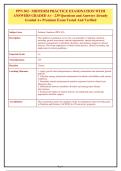
PPN 302 - MIDTERM PRACTICE EXAMINATION WITH
ANSWERS GRADED A+ - 239 Questions and Answers Already
Graded A+ Premium Exam Tested And Verified
Subject Area Pediatric Nutrition (PPN 302)
Description This midterm examination covers the core principles of pediatric nutrition,
including growth assessment, nutrient requirements, enteral and parenteral
nutrition, management of metabolic disorders, and nutrition support in chronic
diseases. The exam emphasizes evidence-based practice, clinical reasoning, and
application of current guidelines.
Expected Grade A+
Total Questions 239
Duration 3 hours
Learning Outcomes 1. Apply growth chart interpretation to identify malnutrition and abnormal growth
patterns.
2. Calculate energy and protein requirements for infants and children with various
conditions.
3. Formulate enteral and parenteral nutrition regimens based on clinical and
laboratory data.
4. Differentiate between metabolic disorders and manage their dietary
interventions.
5. Evaluate the impact of chronic diseases on nutritional status and design
appropriate nutrition support.
Accreditation This examination meets the standards of the Accreditation Council for Education
in Nutrition and Dietetics (ACEND) for US university programs.
Page 1
,1. A 2-year-old child with failure to thrive has a weight-for-length z-score of -2.5.
Which of the following is the most appropriate initial step in nutrition management?
A. Initiate a high-calorie formula at 150% of estimated energy needs
B. Refer for gastrostomy tube placement
C. Calculate energy requirements based on ideal body weight for length
D. Begin parenteral nutrition due to severe malnutrition
Answer: C. Calculate energy requirements based on ideal body weight for length
For children with severe malnutrition, energy needs should be calculated using ideal
body weight for length to avoid overfeeding and refeeding syndrome. Initiating
high-calorie feeds at 150% of needs (A) may be too aggressive initially. Gastrostomy (B)
is not first-line. Parenteral nutrition (D) is reserved for intestinal failure.
2. In a preterm infant born at 28 weeks gestation, which of the following reflects the
most accurate protein requirement in grams per kg per day during the first week of
life?
A. 1.5-2.0
B. 2.5-3.0
C. 3.5-4.0
D. 4.5-5.0
Answer: C. 3.5-4.0
Preterm infants require high protein intake (3.5-4.0 g/kg/day) in the first week to
approximate intrauterine accretion rates. Lower intakes (A, B) are insufficient for
catch-up growth, while 4.5-5.0 g/kg/day (D) exceeds current recommendations and may
increase metabolic load.
Page 2
,3. A 4-year-old child with phenylketonuria (PKU) on a phenylalanine-restricted diet
presents with poor growth and irritability. Laboratory results show plasma
phenylalanine level of 60 µmol/L (normal: 30-120). Which of the following is the
most likely cause of the symptoms?
A. Inadequate phenylalanine intake leading to deficiency
B. Excessive phenylalanine intake from dietary noncompliance
C. Tyrosine deficiency due to insufficient precursor
D. Soy-based formula intolerance
Answer: A. Inadequate phenylalanine intake leading to deficiency
In PKU, plasma phenylalanine levels below 120 µmol/L indicate over-restriction. Poor
growth and irritability with low-normal phenylalanine suggest inadequate intake (A).
Noncompliance (B) would elevate levels. Tyrosine deficiency (C) can occur but is less
likely with adequate medical formula. Soy intolerance (D) is not specific.
4. Which of the following best explains the lower energy requirement per kg body
weight in a 12-year-old child compared to a 6-month-old infant?
A. Lower basal metabolic rate relative to body mass
B. Decreased physical activity level
C. Reduced thermic effect of food
D. Lower growth velocity
Answer: D. Lower growth velocity
Energy requirements per kg decline with age primarily due to decreasing growth
velocity (D). BMR per kg is higher in infants (A), not lower. Physical activity (B) is
variable. Thermic effect of food (C) is relatively constant. Growth accounts for a large
proportion of infant energy needs.
Page 3
, 5. A 6-month-old infant with short bowel syndrome is receiving parenteral nutrition.
Current lab values: sodium 128 mEq/L, potassium 3.2 mEq/L, chloride 100 mEq/L,
bicarbonate 18 mEq/L, BUN 25 mg/dL. Which of the following is the most likely
explanation for these findings?
A. Excessive free water administration
B. Inadequate sodium and potassium in the PN
C. Metabolic acidosis from D-lactic acidosis
D. Renal tubular acidosis secondary to PN
Answer: C. Metabolic acidosis from D-lactic acidosis
Short bowel syndrome can lead to D-lactic acidosis from bacterial fermentation of
unabsorbed carbohydrates, causing metabolic acidosis with low bicarbonate and
hyponatremia/hypokalemia from osmotic diarrhea. Free water excess (A) would not
cause low bicarbonate. Inadequate electrolytes (B) is possible but acidosis is key. RTA
(D) is less common.
6. In a child with cow's milk protein allergy (CMPA), which of the following
formulas is most appropriate for initial management?
A. Partially hydrolyzed whey formula
B. Soy-based formula
C. Extensively hydrolyzed casein formula
D. Amino acid-based formula
Answer: C. Extensively hydrolyzed casein formula
Extensively hydrolyzed formulas (C) are recommended for initial management of
CMPA as they are tolerated by most infants. Partially hydrolyzed (A) still contain
allergenic epitopes. Soy (B) may be used but carries risk of cross-reactivity. Amino acid
formulas (D) are reserved for severe cases or failure of extensively hydrolyzed formula.
Page 4
ANSWERS GRADED A+ - 239 Questions and Answers Already
Graded A+ Premium Exam Tested And Verified
Subject Area Pediatric Nutrition (PPN 302)
Description This midterm examination covers the core principles of pediatric nutrition,
including growth assessment, nutrient requirements, enteral and parenteral
nutrition, management of metabolic disorders, and nutrition support in chronic
diseases. The exam emphasizes evidence-based practice, clinical reasoning, and
application of current guidelines.
Expected Grade A+
Total Questions 239
Duration 3 hours
Learning Outcomes 1. Apply growth chart interpretation to identify malnutrition and abnormal growth
patterns.
2. Calculate energy and protein requirements for infants and children with various
conditions.
3. Formulate enteral and parenteral nutrition regimens based on clinical and
laboratory data.
4. Differentiate between metabolic disorders and manage their dietary
interventions.
5. Evaluate the impact of chronic diseases on nutritional status and design
appropriate nutrition support.
Accreditation This examination meets the standards of the Accreditation Council for Education
in Nutrition and Dietetics (ACEND) for US university programs.
Page 1
,1. A 2-year-old child with failure to thrive has a weight-for-length z-score of -2.5.
Which of the following is the most appropriate initial step in nutrition management?
A. Initiate a high-calorie formula at 150% of estimated energy needs
B. Refer for gastrostomy tube placement
C. Calculate energy requirements based on ideal body weight for length
D. Begin parenteral nutrition due to severe malnutrition
Answer: C. Calculate energy requirements based on ideal body weight for length
For children with severe malnutrition, energy needs should be calculated using ideal
body weight for length to avoid overfeeding and refeeding syndrome. Initiating
high-calorie feeds at 150% of needs (A) may be too aggressive initially. Gastrostomy (B)
is not first-line. Parenteral nutrition (D) is reserved for intestinal failure.
2. In a preterm infant born at 28 weeks gestation, which of the following reflects the
most accurate protein requirement in grams per kg per day during the first week of
life?
A. 1.5-2.0
B. 2.5-3.0
C. 3.5-4.0
D. 4.5-5.0
Answer: C. 3.5-4.0
Preterm infants require high protein intake (3.5-4.0 g/kg/day) in the first week to
approximate intrauterine accretion rates. Lower intakes (A, B) are insufficient for
catch-up growth, while 4.5-5.0 g/kg/day (D) exceeds current recommendations and may
increase metabolic load.
Page 2
,3. A 4-year-old child with phenylketonuria (PKU) on a phenylalanine-restricted diet
presents with poor growth and irritability. Laboratory results show plasma
phenylalanine level of 60 µmol/L (normal: 30-120). Which of the following is the
most likely cause of the symptoms?
A. Inadequate phenylalanine intake leading to deficiency
B. Excessive phenylalanine intake from dietary noncompliance
C. Tyrosine deficiency due to insufficient precursor
D. Soy-based formula intolerance
Answer: A. Inadequate phenylalanine intake leading to deficiency
In PKU, plasma phenylalanine levels below 120 µmol/L indicate over-restriction. Poor
growth and irritability with low-normal phenylalanine suggest inadequate intake (A).
Noncompliance (B) would elevate levels. Tyrosine deficiency (C) can occur but is less
likely with adequate medical formula. Soy intolerance (D) is not specific.
4. Which of the following best explains the lower energy requirement per kg body
weight in a 12-year-old child compared to a 6-month-old infant?
A. Lower basal metabolic rate relative to body mass
B. Decreased physical activity level
C. Reduced thermic effect of food
D. Lower growth velocity
Answer: D. Lower growth velocity
Energy requirements per kg decline with age primarily due to decreasing growth
velocity (D). BMR per kg is higher in infants (A), not lower. Physical activity (B) is
variable. Thermic effect of food (C) is relatively constant. Growth accounts for a large
proportion of infant energy needs.
Page 3
, 5. A 6-month-old infant with short bowel syndrome is receiving parenteral nutrition.
Current lab values: sodium 128 mEq/L, potassium 3.2 mEq/L, chloride 100 mEq/L,
bicarbonate 18 mEq/L, BUN 25 mg/dL. Which of the following is the most likely
explanation for these findings?
A. Excessive free water administration
B. Inadequate sodium and potassium in the PN
C. Metabolic acidosis from D-lactic acidosis
D. Renal tubular acidosis secondary to PN
Answer: C. Metabolic acidosis from D-lactic acidosis
Short bowel syndrome can lead to D-lactic acidosis from bacterial fermentation of
unabsorbed carbohydrates, causing metabolic acidosis with low bicarbonate and
hyponatremia/hypokalemia from osmotic diarrhea. Free water excess (A) would not
cause low bicarbonate. Inadequate electrolytes (B) is possible but acidosis is key. RTA
(D) is less common.
6. In a child with cow's milk protein allergy (CMPA), which of the following
formulas is most appropriate for initial management?
A. Partially hydrolyzed whey formula
B. Soy-based formula
C. Extensively hydrolyzed casein formula
D. Amino acid-based formula
Answer: C. Extensively hydrolyzed casein formula
Extensively hydrolyzed formulas (C) are recommended for initial management of
CMPA as they are tolerated by most infants. Partially hydrolyzed (A) still contain
allergenic epitopes. Soy (B) may be used but carries risk of cross-reactivity. Amino acid
formulas (D) are reserved for severe cases or failure of extensively hydrolyzed formula.
Page 4


