
CERTIFIED
PASS.
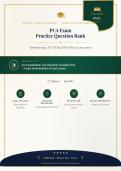
PAT I E N T C A R E A S S I S TA N T · C E R T I F I C AT I O N E X A M P R E P
PCA Exam
Practice Question Bank
Ophthalmology, ENT & Head/Neck Physical Assessment
EXAM FOCUS:
Eye Examination, Ear Disorders, Hearing Tests
— Facial Abnormalities & Oral Lesions
Edition 1 · July 2026
EXAM FOCUSED DETAILED HEAD-TO-TOE BUILD CONFIDENCE
RATIONALES
Aligned with PCA Eyes, ears, nose, mouth & Master your PCA exam
certification Clear explanations for mastery thyroid
P r e pa r e · P r a c t i c e · Pa s s
Excellence in Patient Care Assistant Certification
,PCA EXAM · OPHTHALMOLOGY & ENT QUESTIONS 1–30
Section 1: Eye Examination, Pupillary Disorders & Retinal Findings
1 Shadows on the iris during eye examination are indicative of:
A Acute narrow angle glaucoma — a medical emergency
B Normal age-related changes in the anterior chamber
C Benign conjunctival pigmentation
D Cataract formation in the lens
CORRECT ANSWER: A
CLINICAL RATIONALE: An iris shadow indicates a shallow anterior chamber —
the iris bows forward when illuminated from the temporal side. This is a critical
sign of impending angle-closure glaucoma requiring immediate ophthalmology
referral to prevent permanent vision loss.
2 Miosis refers to:
A Constricted pupils
B Dilated pupils
C Unequal pupil size
D Irregular pupil shape
CORRECT ANSWER: A
CLINICAL RATIONALE: Miosis is pupillary constriction — mediated by the
parasympathetic system. Mydriasis is dilation; anisocoria is unequal size. Miotic
pupils may indicate opioid use, pontine lesions, or cholinergic medications.
, 3 Mydriasis refers to:
A Dilation of the pupil
B Constriction of the pupil
C Absence of pupillary response
D Rhythmic oscillation of the eyes
CORRECT ANSWER: A
CLINICAL RATIONALE: Mydriasis is pupillary dilation — mediated by the
sympathetic system. Pathologic mydriasis may indicate CN III palsy,
anticholinergic medications, or Adie's tonic pupil. It also occurs normally in dim
light.
4 The near reaction test assesses pupillary constriction, convergence (CN
III), and:
A Accommodation
B Visual acuity
C Peripheral vision
D Color discrimination
CORRECT ANSWER: A
CLINICAL RATIONALE: The near reaction tests the accommodation triad —
when the patient shifts gaze from far to near (4-6 inches), the pupils should
constrict, eyes converge (CN III), and lenses accommodate (change shape for
near focus).
PASS.
PAT I E N T C A R E A S S I S TA N T · C E R T I F I C AT I O N E X A M P R E P
PCA Exam
Practice Question Bank
Ophthalmology, ENT & Head/Neck Physical Assessment
EXAM FOCUS:
Eye Examination, Ear Disorders, Hearing Tests
— Facial Abnormalities & Oral Lesions
Edition 1 · July 2026
EXAM FOCUSED DETAILED HEAD-TO-TOE BUILD CONFIDENCE
RATIONALES
Aligned with PCA Eyes, ears, nose, mouth & Master your PCA exam
certification Clear explanations for mastery thyroid
P r e pa r e · P r a c t i c e · Pa s s
Excellence in Patient Care Assistant Certification
,PCA EXAM · OPHTHALMOLOGY & ENT QUESTIONS 1–30
Section 1: Eye Examination, Pupillary Disorders & Retinal Findings
1 Shadows on the iris during eye examination are indicative of:
A Acute narrow angle glaucoma — a medical emergency
B Normal age-related changes in the anterior chamber
C Benign conjunctival pigmentation
D Cataract formation in the lens
CORRECT ANSWER: A
CLINICAL RATIONALE: An iris shadow indicates a shallow anterior chamber —
the iris bows forward when illuminated from the temporal side. This is a critical
sign of impending angle-closure glaucoma requiring immediate ophthalmology
referral to prevent permanent vision loss.
2 Miosis refers to:
A Constricted pupils
B Dilated pupils
C Unequal pupil size
D Irregular pupil shape
CORRECT ANSWER: A
CLINICAL RATIONALE: Miosis is pupillary constriction — mediated by the
parasympathetic system. Mydriasis is dilation; anisocoria is unequal size. Miotic
pupils may indicate opioid use, pontine lesions, or cholinergic medications.
, 3 Mydriasis refers to:
A Dilation of the pupil
B Constriction of the pupil
C Absence of pupillary response
D Rhythmic oscillation of the eyes
CORRECT ANSWER: A
CLINICAL RATIONALE: Mydriasis is pupillary dilation — mediated by the
sympathetic system. Pathologic mydriasis may indicate CN III palsy,
anticholinergic medications, or Adie's tonic pupil. It also occurs normally in dim
light.
4 The near reaction test assesses pupillary constriction, convergence (CN
III), and:
A Accommodation
B Visual acuity
C Peripheral vision
D Color discrimination
CORRECT ANSWER: A
CLINICAL RATIONALE: The near reaction tests the accommodation triad —
when the patient shifts gaze from far to near (4-6 inches), the pupils should
constrict, eyes converge (CN III), and lenses accommodate (change shape for
near focus).


