
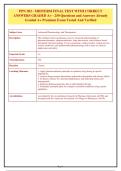
PPN 302 - MIDTERM FINAL TEST WITH CORRECT
ANSWERS GRADED A+ - 250 Questions and Answers Already
Graded A+ Premium Exam Tested And Verified
Subject Area Advanced Pharmacology and Therapeutics
Description This midterm final examination assesses advanced understanding of
pharmacodynamics, pharmacokinetics, drug interactions, and evidence-based
therapeutic decision-making. Covers autonomic, cardiovascular, central nervous
system, endocrine, and antimicrobial pharmacology with a focus on clinical
application and safety.
Expected Grade A+
Total Questions 250
Duration 3 hours
Learning Outcomes 1. Apply pharmacokinetic principles to optimize drug dosing in special
populations.
2. Analyze drug-receptor interactions and predict therapeutic and adverse effects.
3. Evaluate evidence for rational polypharmacy and drug-drug interaction
management.
4. Integrate pharmacogenomic data to individualize therapy.
5. Formulate treatment plans for complex comorbid conditions using current
guidelines.
Accreditation Accredited by the Accreditation Council for Pharmacy Education (ACPE) and
recognized by the American Association of Colleges of Pharmacy (AACP).
Page 1
,1. A drug follows one-compartment kinetics with an elimination half-life of 6 hours.
If a 500 mg dose achieves a peak plasma concentration of 10 mg/L, what is the
approximate volume of distribution?
A. 25 L
B. 50 L
C. 75 L
D. 100 L
Answer: B. 50 L
Volume of distribution (Vd) = Dose / C0 = 500 mg / 10 mg/L = 50 L. Half-life is not
needed for this calculation. Options A, C, D are incorrect because they do not match the
direct calculation.
2. A patient on warfarin requires an antibiotic. Which of the following
antimicrobials is LEAST likely to potentiate warfarin's anticoagulant effect?
A. Ciprofloxacin
B. Rifampin
C. Metronidazole
D. Fluconazole
Answer: B. Rifampin
Rifampin is a potent CYP450 inducer, which increases warfarin metabolism and
reduces its effect, thus it is least likely to potentiate (it actually antagonizes).
Ciprofloxacin, metronidazole, and fluconazole inhibit CYP450 and potentiate warfarin.
3. A drug displays zero-order elimination kinetics. Which statement accurately
describes its clearance?
A. Clearance is constant and independent of dose.
B. Clearance decreases with increasing dose.
C. Clearance increases proportionally with plasma concentration.
D. Clearance is directly proportional to the elimination rate constant.
Answer: B. Clearance decreases with increasing dose.
In zero-order elimination, the rate of elimination is constant, so as dose increases,
clearance (rate/concentration) decreases because concentration rises proportionally
more. A is true for first-order, not zero-order. C and D are incorrect.
Page 2
,4. Which of the following drug-receptor interactions is most consistent with a partial
agonist?
A. High efficacy, high affinity
B. Low efficacy, high affinity
C. High efficacy, low affinity
D. Low efficacy, low affinity
Answer: B. Low efficacy, high affinity
A partial agonist has lower intrinsic efficacy than a full agonist but can bind with high
affinity. It produces a submaximal response even at full receptor occupancy. Option A
describes a full agonist; C and D are not typical.
5. A patient with type 2 diabetes and chronic kidney disease (eGFR 25 mL/min)
requires glycemic control. Which agent is safest to use without dose adjustment?
A. Metformin
B. Sitagliptin
C. Liraglutide
D. Glipizide
Answer: C. Liraglutide
Liraglutide (a GLP-1 agonist) is primarily metabolized by peptidases and does not
require renal dose adjustment. Metformin is contraindicated when eGFR <30.
Sitagliptin requires dose reduction. Glipizide can be used but with caution; it is not the
safest.
6. A drug is a weak acid with pKa 4.5. In which compartment will it be
predominantly ionized?
A. Stomach (pH 2)
B. Duodenum (pH 6)
C. Blood (pH 7.4)
D. Urine (pH 5)
Answer: B. Duodenum (pH 6)
For a weak acid, ionization is high when pH > pKa. At pH 6 (duodenum), pH > pKa
(4.5), so it is mostly ionized. In stomach (pH 2) and urine (pH 5), pH < pKa, so it is
unionized. Blood pH 7.4 also yields ionization, but duodenum is listed and correct.
Page 3
, 7. Which of the following best describes the mechanism of action of metformin?
A. Increases insulin secretion from pancreatic beta cells
B. Inhibits hepatic gluconeogenesis and improves insulin sensitivity
C. Slows carbohydrate absorption in the gut
D. Activates peroxisome proliferator-activated receptor gamma
Answer: B. Inhibits hepatic gluconeogenesis and improves insulin sensitivity
Metformin primarily suppresses hepatic glucose production (gluconeogenesis) and
enhances peripheral insulin sensitivity. It does not stimulate insulin secretion (A), nor is
it an alpha-glucosidase inhibitor (C) or a thiazolidinedione (D).
8. A patient on digoxin develops toxicity. Which of the following interventions is
most appropriate for life-threatening arrhythmias?
A. Administer lidocaine
B. Administer digoxin immune Fab
C. Administer amiodarone
D. Administer phenytoin
Answer: B. Administer digoxin immune Fab
Digoxin immune Fab is the specific antidote for severe digoxin toxicity, including
life-threatening arrhythmias. Lidocaine and phenytoin can be used for ventricular
arrhythmias but are not first-line in this context. Amiodarone may worsen toxicity.
9. A patient with hypertension and asthma requires a beta-blocker. Which agent is
most appropriate?
A. Propranolol
B. Metoprolol
C. Atenolol
D. Carvedilol
Answer: B. Metoprolol
Metoprolol is a cardioselective beta-1 blocker, which is safer in asthma than
non-selective agents like propranolol or carvedilol. Atenolol is also cardioselective but
metoprolol is more commonly used. However, all beta-blockers should be used with
caution.
Page 4
ANSWERS GRADED A+ - 250 Questions and Answers Already
Graded A+ Premium Exam Tested And Verified
Subject Area Advanced Pharmacology and Therapeutics
Description This midterm final examination assesses advanced understanding of
pharmacodynamics, pharmacokinetics, drug interactions, and evidence-based
therapeutic decision-making. Covers autonomic, cardiovascular, central nervous
system, endocrine, and antimicrobial pharmacology with a focus on clinical
application and safety.
Expected Grade A+
Total Questions 250
Duration 3 hours
Learning Outcomes 1. Apply pharmacokinetic principles to optimize drug dosing in special
populations.
2. Analyze drug-receptor interactions and predict therapeutic and adverse effects.
3. Evaluate evidence for rational polypharmacy and drug-drug interaction
management.
4. Integrate pharmacogenomic data to individualize therapy.
5. Formulate treatment plans for complex comorbid conditions using current
guidelines.
Accreditation Accredited by the Accreditation Council for Pharmacy Education (ACPE) and
recognized by the American Association of Colleges of Pharmacy (AACP).
Page 1
,1. A drug follows one-compartment kinetics with an elimination half-life of 6 hours.
If a 500 mg dose achieves a peak plasma concentration of 10 mg/L, what is the
approximate volume of distribution?
A. 25 L
B. 50 L
C. 75 L
D. 100 L
Answer: B. 50 L
Volume of distribution (Vd) = Dose / C0 = 500 mg / 10 mg/L = 50 L. Half-life is not
needed for this calculation. Options A, C, D are incorrect because they do not match the
direct calculation.
2. A patient on warfarin requires an antibiotic. Which of the following
antimicrobials is LEAST likely to potentiate warfarin's anticoagulant effect?
A. Ciprofloxacin
B. Rifampin
C. Metronidazole
D. Fluconazole
Answer: B. Rifampin
Rifampin is a potent CYP450 inducer, which increases warfarin metabolism and
reduces its effect, thus it is least likely to potentiate (it actually antagonizes).
Ciprofloxacin, metronidazole, and fluconazole inhibit CYP450 and potentiate warfarin.
3. A drug displays zero-order elimination kinetics. Which statement accurately
describes its clearance?
A. Clearance is constant and independent of dose.
B. Clearance decreases with increasing dose.
C. Clearance increases proportionally with plasma concentration.
D. Clearance is directly proportional to the elimination rate constant.
Answer: B. Clearance decreases with increasing dose.
In zero-order elimination, the rate of elimination is constant, so as dose increases,
clearance (rate/concentration) decreases because concentration rises proportionally
more. A is true for first-order, not zero-order. C and D are incorrect.
Page 2
,4. Which of the following drug-receptor interactions is most consistent with a partial
agonist?
A. High efficacy, high affinity
B. Low efficacy, high affinity
C. High efficacy, low affinity
D. Low efficacy, low affinity
Answer: B. Low efficacy, high affinity
A partial agonist has lower intrinsic efficacy than a full agonist but can bind with high
affinity. It produces a submaximal response even at full receptor occupancy. Option A
describes a full agonist; C and D are not typical.
5. A patient with type 2 diabetes and chronic kidney disease (eGFR 25 mL/min)
requires glycemic control. Which agent is safest to use without dose adjustment?
A. Metformin
B. Sitagliptin
C. Liraglutide
D. Glipizide
Answer: C. Liraglutide
Liraglutide (a GLP-1 agonist) is primarily metabolized by peptidases and does not
require renal dose adjustment. Metformin is contraindicated when eGFR <30.
Sitagliptin requires dose reduction. Glipizide can be used but with caution; it is not the
safest.
6. A drug is a weak acid with pKa 4.5. In which compartment will it be
predominantly ionized?
A. Stomach (pH 2)
B. Duodenum (pH 6)
C. Blood (pH 7.4)
D. Urine (pH 5)
Answer: B. Duodenum (pH 6)
For a weak acid, ionization is high when pH > pKa. At pH 6 (duodenum), pH > pKa
(4.5), so it is mostly ionized. In stomach (pH 2) and urine (pH 5), pH < pKa, so it is
unionized. Blood pH 7.4 also yields ionization, but duodenum is listed and correct.
Page 3
, 7. Which of the following best describes the mechanism of action of metformin?
A. Increases insulin secretion from pancreatic beta cells
B. Inhibits hepatic gluconeogenesis and improves insulin sensitivity
C. Slows carbohydrate absorption in the gut
D. Activates peroxisome proliferator-activated receptor gamma
Answer: B. Inhibits hepatic gluconeogenesis and improves insulin sensitivity
Metformin primarily suppresses hepatic glucose production (gluconeogenesis) and
enhances peripheral insulin sensitivity. It does not stimulate insulin secretion (A), nor is
it an alpha-glucosidase inhibitor (C) or a thiazolidinedione (D).
8. A patient on digoxin develops toxicity. Which of the following interventions is
most appropriate for life-threatening arrhythmias?
A. Administer lidocaine
B. Administer digoxin immune Fab
C. Administer amiodarone
D. Administer phenytoin
Answer: B. Administer digoxin immune Fab
Digoxin immune Fab is the specific antidote for severe digoxin toxicity, including
life-threatening arrhythmias. Lidocaine and phenytoin can be used for ventricular
arrhythmias but are not first-line in this context. Amiodarone may worsen toxicity.
9. A patient with hypertension and asthma requires a beta-blocker. Which agent is
most appropriate?
A. Propranolol
B. Metoprolol
C. Atenolol
D. Carvedilol
Answer: B. Metoprolol
Metoprolol is a cardioselective beta-1 blocker, which is safer in asthma than
non-selective agents like propranolol or carvedilol. Atenolol is also cardioselective but
metoprolol is more commonly used. However, all beta-blockers should be used with
caution.
Page 4


