

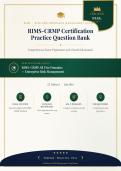
C ERT I F I ED
PASS.
RIMS · RISK AND INSURANCE MANAGEMENT SOCIET Y
RIMS-CRMP Certification
Practice Question Bank
Comprehensive Exam Preparation with Detailed Rationales
C E R T I F I C AT I O N F O C U S :
RIMS-CRMP All Five Domains
— Enterprise Risk Management
Edition 1 · July 2026
EXAM FOCUSED DETAILED ALL 5 DOMAINS 138 QUESTIONS
RATIONALES
Questions aligned with RIMS- Complete competency model Comprehensive exam
CRMP standards Clear explanations for every coverage preparation
answer
P r e pa r e · P r a c t i c e · Pa s s
Excellence in Risk Management Certification
,RIMS-CRMP · CERTIFICATION EXAM PREP PRACTICE QUESTION BANK
Table of Contents
1. Instructions for Use 2
2. Domain 1: Organizational Model & Strategy 2
3. Domain 2: Risk Strategy & Governance 8
4. Domain 3: Risk Process Implementation 14
5. Domain 4: Risk Network & Training 20
6. Domain 5: Decision-Making & Resilience 24
How to Use This Guide
Read each stem, choose your answer, then check the rationale directly below. The correct
option is marked, and each distractor is explained so you understand why it's wrong — not just
that it is. Questions span all five domains of the RIMS-CRMP competency model.
Domain 1: Organizational Model & Strategy Analysis
,1 What is the primary purpose of analyzing the organizational model in
enterprise risk management?
A To determine the organization's tax liability and regulatory exposure
B To identify value proposition, understand operations, and assess resilience
C To calculate the organization's total insurable risk portfolio
D To benchmark executive compensation against industry standards
CORRECT ANSWER: B
CLINICAL RATIONALE: Analyzing the organizational model reveals how the
entity creates value, operates, and withstands disruption — forming the
foundation for all subsequent risk management activities. Tax liability and
regulatory exposure are narrower considerations within this broader analysis.
Insurance portfolio calculation and compensation benchmarking are specific
tactical activities, not the primary strategic purpose.
2 Name two analytical tools useful for analyzing the business model.
A Value chain analysis and benchmarking
B Monte Carlo simulation and regression analysis
C Gantt charts and critical path method
D Pareto analysis and fishbone diagrams
CORRECT ANSWER: A
CLINICAL RATIONALE: Value chain analysis maps activities that create
competitive advantage, while benchmarking measures performance against
external standards. Monte Carlo and regression are quantitative risk analysis
tools. Gantt charts and critical path are project management techniques. Pareto
and fishbone diagrams are quality improvement tools — useful but not primary
business model analysis instruments.
, 3 What are the two dimensions of organizational resilience?
A Financial resilience and operational resilience
B Planned resilience and adaptive resilience
C Strategic resilience and tactical resilience
D Internal resilience and external resilience
CORRECT ANSWER: B
CLINICAL RATIONALE: Planned resilience addresses predictable events through
business impact analysis and scenario planning, while adaptive resilience enables
response to emerging, less predictable events. Financial/operational,
strategic/tactical, and internal/external are not the established dimensions in the
RIMS-CRMP framework, though they may describe aspects of resilience.
4 Define risk appetite versus risk tolerance.
A Appetite is the maximum loss acceptable; tolerance is the minimum gain
required
B Appetite is the total exposed amount undertaken for desired outcomes;
tolerance is the amount of uncertainty accepted
C Appetite applies to strategic risks only; tolerance applies to operational
risks only
D Appetite is set by the board; tolerance is set by line managers
CORRECT ANSWER: B
CLINICAL RATIONALE: Risk appetite represents the total exposed amount an
organization wishes to undertake based on risk-return trade-offs, while tolerance
is the amount of uncertainty it is prepared to accept. Both exist simultaneously
and influence strategy. Appetite applies broadly across risk categories, not just
strategic risks. Both appetite and tolerance require board-level guidance, not just
management discretion.
PASS.
RIMS · RISK AND INSURANCE MANAGEMENT SOCIET Y
RIMS-CRMP Certification
Practice Question Bank
Comprehensive Exam Preparation with Detailed Rationales
C E R T I F I C AT I O N F O C U S :
RIMS-CRMP All Five Domains
— Enterprise Risk Management
Edition 1 · July 2026
EXAM FOCUSED DETAILED ALL 5 DOMAINS 138 QUESTIONS
RATIONALES
Questions aligned with RIMS- Complete competency model Comprehensive exam
CRMP standards Clear explanations for every coverage preparation
answer
P r e pa r e · P r a c t i c e · Pa s s
Excellence in Risk Management Certification
,RIMS-CRMP · CERTIFICATION EXAM PREP PRACTICE QUESTION BANK
Table of Contents
1. Instructions for Use 2
2. Domain 1: Organizational Model & Strategy 2
3. Domain 2: Risk Strategy & Governance 8
4. Domain 3: Risk Process Implementation 14
5. Domain 4: Risk Network & Training 20
6. Domain 5: Decision-Making & Resilience 24
How to Use This Guide
Read each stem, choose your answer, then check the rationale directly below. The correct
option is marked, and each distractor is explained so you understand why it's wrong — not just
that it is. Questions span all five domains of the RIMS-CRMP competency model.
Domain 1: Organizational Model & Strategy Analysis
,1 What is the primary purpose of analyzing the organizational model in
enterprise risk management?
A To determine the organization's tax liability and regulatory exposure
B To identify value proposition, understand operations, and assess resilience
C To calculate the organization's total insurable risk portfolio
D To benchmark executive compensation against industry standards
CORRECT ANSWER: B
CLINICAL RATIONALE: Analyzing the organizational model reveals how the
entity creates value, operates, and withstands disruption — forming the
foundation for all subsequent risk management activities. Tax liability and
regulatory exposure are narrower considerations within this broader analysis.
Insurance portfolio calculation and compensation benchmarking are specific
tactical activities, not the primary strategic purpose.
2 Name two analytical tools useful for analyzing the business model.
A Value chain analysis and benchmarking
B Monte Carlo simulation and regression analysis
C Gantt charts and critical path method
D Pareto analysis and fishbone diagrams
CORRECT ANSWER: A
CLINICAL RATIONALE: Value chain analysis maps activities that create
competitive advantage, while benchmarking measures performance against
external standards. Monte Carlo and regression are quantitative risk analysis
tools. Gantt charts and critical path are project management techniques. Pareto
and fishbone diagrams are quality improvement tools — useful but not primary
business model analysis instruments.
, 3 What are the two dimensions of organizational resilience?
A Financial resilience and operational resilience
B Planned resilience and adaptive resilience
C Strategic resilience and tactical resilience
D Internal resilience and external resilience
CORRECT ANSWER: B
CLINICAL RATIONALE: Planned resilience addresses predictable events through
business impact analysis and scenario planning, while adaptive resilience enables
response to emerging, less predictable events. Financial/operational,
strategic/tactical, and internal/external are not the established dimensions in the
RIMS-CRMP framework, though they may describe aspects of resilience.
4 Define risk appetite versus risk tolerance.
A Appetite is the maximum loss acceptable; tolerance is the minimum gain
required
B Appetite is the total exposed amount undertaken for desired outcomes;
tolerance is the amount of uncertainty accepted
C Appetite applies to strategic risks only; tolerance applies to operational
risks only
D Appetite is set by the board; tolerance is set by line managers
CORRECT ANSWER: B
CLINICAL RATIONALE: Risk appetite represents the total exposed amount an
organization wishes to undertake based on risk-return trade-offs, while tolerance
is the amount of uncertainty it is prepared to accept. Both exist simultaneously
and influence strategy. Appetite applies broadly across risk categories, not just
strategic risks. Both appetite and tolerance require board-level guidance, not just
management discretion.


