

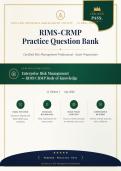
C ERT I F I ED
PASS.
RISK AND INSURANCE MANAGEMENT SOCIET Y · G L O B A L C E R T I F I C AT I O N
RIMS-CRMP
Practice Question Bank
Certified Risk Management Professional · Exam Preparation
C E R T I F I C AT I O N F O C U S :
Enterprise Risk Management
— RIMS CRMP Body of Knowledge
Edition 1 · July 2026
EXAM FOCUSED DETAILED HIGH-YIELD CONFIDENCE
RATIONALES CONTENT BUILDER
Questions aligned with
RIMS CRMP exam Clear explanations for Focus on tested concepts Practice smarter and pass
standards every answer to maximize your score with confidence
P r e pa r e · P r a c t i c e · Pa s s
Excellence in Risk Management Certification
,RIMS-CRMP · PRACTICE GUIDE TABLE OF CONTENTS
Table of Contents
1. Instructions for Use 3
2. Practice Questions — Risk Management Process & Framework 3
3. Practice Questions — Risk Analysis Methods & Tools 8
4. Practice Questions — Enterprise Risk Management (ERM) 12
5. Practice Questions — Risk Governance, Strategy & Competency 15
6. Seller Appreciation 18
RIMS-CRMP · Certified Risk Management Professional Page 2
,RIMS-CRMP PRACTICE GUIDE INSTRUCTIONS & PRACTICE QUESTIONS
How to Use This Guide
Read each stem carefully, select your best answer, then review the rationale below. The correct
option is clearly marked. Each incorrect option includes an explanation so you understand why it
is wrong. This guide covers the RIMS-CRMP Body of Knowledge and is designed for
comprehensive exam preparation.
Section 1: Risk Management Process & Framework
1 What are the six steps of implementing the risk management process?
A Identify risks and opportunities, analyze risk, evaluate risk, consult and
create risk solutions, monitor risk, and advise on RM
B Plan, assess, mitigate, report, review, and close
C Discover, measure, control, finance, audit, and disclose
D Scope, identify, quantify, respond, monitor, and communicate
Correct Answer: A. The six steps are: identify risks and opportunities, analyze risk,
evaluate risk, consult and create risk solutions, monitor risk, and advise on RM.
Rationale: The RIMS-CRMP framework defines this structured sequence to ensure
comprehensive risk coverage. Steps build sequentially — identification informs
analysis, which feeds evaluation. The consult-and-create step emphasizes
collaborative solution development. Monitoring ensures ongoing effectiveness,
and advising embeds RM into organizational decision-making. The other options
describe generic process flows not aligned with the RIMS-CRMP methodology.
, 2 Which of the following are methods used to find and recognize risks?
A Brainstorming, checklists, interviews, facilitated workshops, risk
questionnaires, scenario analysis, value chain analysis, system design
review, process analysis, and benchmarking
B Monte Carlo simulation, sensitivity analysis, and probability modeling only
C Financial statement review and credit scoring exclusively
D Regulatory filing review and legal precedent analysis only
Correct Answer: A. Ten recognized methods exist: brainstorming, checklists,
interviews and self-assessment, facilitated workshops, risk questionnaires and
surveys, scenario analysis, value chain analysis, system design review, process
analysis, and benchmarking.
Rationale: Risk identification requires diverse techniques spanning qualitative
(brainstorming, workshops), analytical (value chain, process analysis), and
comparative (benchmarking) approaches. Option B lists quantitative analysis tools,
not identification methods. Options C and D are too narrow — risk identification
extends beyond financial and legal domains. Effective risk managers select
methods appropriate to organizational context and the nature of risks being
explored.
3 What are the two steps of identifying risks and opportunities?
A Finding and recognizing risks, then recording risks and opportunities using
a risk register
B Analyzing risks and evaluating risks
C Consulting stakeholders and creating solutions
D Monitoring risks and advising on RM
Correct Answer: A. Step one is finding and recognizing risks; step two is
recording risks and opportunities using a risk register.
Rationale: Identification is a two-part process — discovery followed by
documentation. The risk register serves as the central repository capturing risk
descriptions, categories, likelihood, impact, and assigned owners. Options B, C,
and D describe subsequent steps in the broader RM process, not the identification
phase specifically. Without proper recording, identified risks may be lost or
inconsistently tracked, undermining the entire RM framework.
PASS.
RISK AND INSURANCE MANAGEMENT SOCIET Y · G L O B A L C E R T I F I C AT I O N
RIMS-CRMP
Practice Question Bank
Certified Risk Management Professional · Exam Preparation
C E R T I F I C AT I O N F O C U S :
Enterprise Risk Management
— RIMS CRMP Body of Knowledge
Edition 1 · July 2026
EXAM FOCUSED DETAILED HIGH-YIELD CONFIDENCE
RATIONALES CONTENT BUILDER
Questions aligned with
RIMS CRMP exam Clear explanations for Focus on tested concepts Practice smarter and pass
standards every answer to maximize your score with confidence
P r e pa r e · P r a c t i c e · Pa s s
Excellence in Risk Management Certification
,RIMS-CRMP · PRACTICE GUIDE TABLE OF CONTENTS
Table of Contents
1. Instructions for Use 3
2. Practice Questions — Risk Management Process & Framework 3
3. Practice Questions — Risk Analysis Methods & Tools 8
4. Practice Questions — Enterprise Risk Management (ERM) 12
5. Practice Questions — Risk Governance, Strategy & Competency 15
6. Seller Appreciation 18
RIMS-CRMP · Certified Risk Management Professional Page 2
,RIMS-CRMP PRACTICE GUIDE INSTRUCTIONS & PRACTICE QUESTIONS
How to Use This Guide
Read each stem carefully, select your best answer, then review the rationale below. The correct
option is clearly marked. Each incorrect option includes an explanation so you understand why it
is wrong. This guide covers the RIMS-CRMP Body of Knowledge and is designed for
comprehensive exam preparation.
Section 1: Risk Management Process & Framework
1 What are the six steps of implementing the risk management process?
A Identify risks and opportunities, analyze risk, evaluate risk, consult and
create risk solutions, monitor risk, and advise on RM
B Plan, assess, mitigate, report, review, and close
C Discover, measure, control, finance, audit, and disclose
D Scope, identify, quantify, respond, monitor, and communicate
Correct Answer: A. The six steps are: identify risks and opportunities, analyze risk,
evaluate risk, consult and create risk solutions, monitor risk, and advise on RM.
Rationale: The RIMS-CRMP framework defines this structured sequence to ensure
comprehensive risk coverage. Steps build sequentially — identification informs
analysis, which feeds evaluation. The consult-and-create step emphasizes
collaborative solution development. Monitoring ensures ongoing effectiveness,
and advising embeds RM into organizational decision-making. The other options
describe generic process flows not aligned with the RIMS-CRMP methodology.
, 2 Which of the following are methods used to find and recognize risks?
A Brainstorming, checklists, interviews, facilitated workshops, risk
questionnaires, scenario analysis, value chain analysis, system design
review, process analysis, and benchmarking
B Monte Carlo simulation, sensitivity analysis, and probability modeling only
C Financial statement review and credit scoring exclusively
D Regulatory filing review and legal precedent analysis only
Correct Answer: A. Ten recognized methods exist: brainstorming, checklists,
interviews and self-assessment, facilitated workshops, risk questionnaires and
surveys, scenario analysis, value chain analysis, system design review, process
analysis, and benchmarking.
Rationale: Risk identification requires diverse techniques spanning qualitative
(brainstorming, workshops), analytical (value chain, process analysis), and
comparative (benchmarking) approaches. Option B lists quantitative analysis tools,
not identification methods. Options C and D are too narrow — risk identification
extends beyond financial and legal domains. Effective risk managers select
methods appropriate to organizational context and the nature of risks being
explored.
3 What are the two steps of identifying risks and opportunities?
A Finding and recognizing risks, then recording risks and opportunities using
a risk register
B Analyzing risks and evaluating risks
C Consulting stakeholders and creating solutions
D Monitoring risks and advising on RM
Correct Answer: A. Step one is finding and recognizing risks; step two is
recording risks and opportunities using a risk register.
Rationale: Identification is a two-part process — discovery followed by
documentation. The risk register serves as the central repository capturing risk
descriptions, categories, likelihood, impact, and assigned owners. Options B, C,
and D describe subsequent steps in the broader RM process, not the identification
phase specifically. Without proper recording, identified risks may be lost or
inconsistently tracked, undermining the entire RM framework.


