

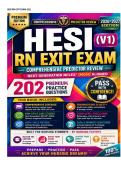
HESI RN EXIT EXAM (V1)
, Table of Contents
HESI RN Exit Exam (V1)
Comprehensive Predictor Review (2026–2027 Edition
Chapter Content Questions Pages
1 Management of Care 1–20 _____
2 Safety & Infection Control 21–30 _____
3 Pharmacology 31–40 _____
4 Adult Medical-Surgical Nursing 41–50 _____
5 Cardiovascular & Respiratory 51–60 _____
6 Endocrine & Diabetes 61–70 _____
7 Neurology 71–80 _____
8 Renal & Urinary 81–90 _____
9 Gastrointestinal 91–100 _____
10 Maternity & Newborn 101–110 _____
11 Pediatrics 111–120 _____
12 Mental Health & Psychiatric Nursing 121–130 _____
13 Pharmacology & Medication Safety 131–140 _____
14 Leadership, Delegation & Prioritization 141–150 _____
15 HESI Exit Exam NGN Clinical Judgment Case Studies 151–162 _____
16 Mixed Comprehensive HESI Exit Exam Predictor Review 163–202 _____
Features Included
• 202 Premium HESI RN Exit Exam Questions
• Comprehensive Predictor Review
• Next Generation NCLEX (NGN)-Style Clinical Judgment Case Studies
, • Randomized A–D Answer Distribution
• Detailed Rationales for Every Question
• Why the Other Options Are Less Appropriate
• Clinical Pearl for Every Question
• HESI High-Yield Tip for Every Question
• Prioritization, Delegation & Leadership Scenarios
• SATA (Select All That Apply) Questions
• Emergency & Critical Care Prioritization
• Maternity, Pediatrics & Mental Health Integration
• Pharmacology & Medication Safety Review
• Exam-Level Critical Thinking Questions
• Designed to Mirror the Difficulty and Style of the HESI RN Exit Exam Predictor
• Ideal for Comprehensive Review, Self-Assessment, and NCLEX-RN Preparation
HESI RN Exit Exam (V1)
Chapter 1: Mixed Fundamentals & Nursing Process
Question 1
During morning rounds, a nurse discovers that a postoperative client suddenly becomes restless and confused.
The client's oxygen saturation has decreased from 97% to 86%. Which nursing action should the nurse perform
first?
A. Apply oxygen and assess the client's airway and breathing.
B. Notify the healthcare provider immediately.
C. Document the findings in the medical record.
D. Obtain another complete set of vital signs.
Answer: A
Rationale: Restlessness and confusion are early signs of hypoxemia. According to the ABC priority framework,
the nurse should immediately assess airway and breathing while administering oxygen to improve
oxygenation.
Why the other options are less appropriate:
, • B: The provider should be notified after immediate nursing interventions.
• C: Documentation follows patient stabilization.
• D: Additional vital signs are important but should not delay oxygen therapy.
Clinical Pearl: Acute mental status changes are often the earliest indicator of inadequate oxygenation.
HESI High-Yield Tip: In priority questions, always apply the ABCs before notifying the provider.
Question 2
A nurse prepares to administer scheduled medications. Which prescription should be questioned before
administration?
A. Furosemide for a client with bilateral crackles.
B. Potassium chloride for a client whose serum potassium is 5.9 mEq/L.
C. Ceftriaxone for bacterial pneumonia.
D. Pantoprazole before breakfast.
Answer: B
Rationale: Potassium chloride should not be administered to a client with hyperkalemia because it may
precipitate life-threatening cardiac dysrhythmias.
Why the other options are less appropriate:
• A: Appropriate for fluid overload.
• C: Appropriate antibiotic therapy.
• D: Correct timing for proton pump inhibitor administration.
Clinical Pearl: Always compare laboratory results with medications before administration.
HESI High-Yield Tip: Electrolyte replacement questions frequently appear on the HESI Exit Exam.
Question 3
A client admitted with pneumonia suddenly develops a respiratory rate of 34 breaths/min, oxygen saturation
of 88%, and increasing use of accessory muscles. Which client should the nurse see first?
A. A client requesting pain medication after knee surgery.
B. A client awaiting discharge instructions.
C. The client with worsening respiratory distress.
D. A client requesting assistance to the bathroom.
Answer: C
,Rationale: Respiratory deterioration requires immediate assessment and intervention because inadequate
oxygenation threatens life.
Why the other options are less appropriate:
• A: Important but not immediately life-threatening.
• B: Stable.
• D: Can safely wait.
Clinical Pearl: Increasing respiratory effort often precedes respiratory failure.
HESI High-Yield Tip: Airway and breathing problems always receive the highest priority.
Question 4
Which task is appropriate for the nurse to delegate to an experienced UAP?
A. Teach incentive spirometer use following surgery.
B. Evaluate pain relief after morphine administration.
C. Obtain routine vital signs for a stable client.
D. Assess a newly admitted client with chest pain.
Answer: C
Rationale: Obtaining routine vital signs for a stable client is within the UAP's scope of practice.
Why the other options are less appropriate:
• A: Teaching is an RN responsibility.
• B: Evaluation requires nursing judgment.
• D: Initial assessments must be completed by the RN.
Clinical Pearl: Delegate stable, routine, and predictable tasks.
HESI High-Yield Tip: Remember: Assess, Teach, Evaluate = RN.
Question 5
A client receiving a blood transfusion reports chills, fever, and low back pain after 10 minutes. What should the
nurse do first?
A. Administer acetaminophen.
B. Slow the infusion.
C. Stop the transfusion and maintain IV access with normal saline.
D. Notify the laboratory before assessing the client.
,Answer: C
Rationale: These findings suggest an acute hemolytic transfusion reaction. The transfusion must be stopped
immediately while maintaining IV access with normal saline.
Why the other options are less appropriate:
• A: Medication is not the first priority.
• B: The transfusion should be stopped—not slowed.
• D: Notification occurs after the transfusion is stopped.
Clinical Pearl: Fever and flank or back pain during transfusion indicate a possible hemolytic reaction.
HESI High-Yield Tip: The first intervention for any suspected transfusion reaction is to stop the blood.
Question 6
The nurse enters a client's room and finds the client actively having a generalized tonic-clonic seizure. Which
intervention has the highest priority?
A. Insert a tongue blade between the client's teeth.
B. Protect the client's head and maintain a safe environment.
C. Hold the client's extremities to prevent injury.
D. Offer water immediately after the seizure begins.
Answer: B
Rationale: Protecting the client from injury while maintaining the airway is the priority during seizure activity.
Why the other options are less appropriate:
• A: Nothing should be inserted into the mouth.
• C: Restraining can cause injury.
• D: Oral intake is unsafe during or immediately after a seizure.
Clinical Pearl: Time the seizure and observe its characteristics for documentation.
HESI High-Yield Tip: Safety is the priority during seizure management.
Question 7
A hospitalized client attempts to climb out of bed without assistance despite repeated education. Which
nursing intervention should be implemented first?
A. Apply wrist restraints immediately.
B. Move the client closer to the nurses' station and activate the bed alarm.
,C. Request a sedative.
D. Raise all four side rails.
Answer: B
Rationale: The least restrictive intervention should always be implemented before restraints or sedation.
Why the other options are less appropriate:
• A: Restraints are a last resort.
• C: Sedation increases fall risk.
• D: Four side rails may be considered a restraint and can increase injury risk.
Clinical Pearl: Least restrictive interventions promote both safety and patient autonomy.
HESI High-Yield Tip: Always choose the least restrictive safety measure first.
Question 8
Which action by the nurse demonstrates a violation of HIPAA?
A. Discussing a client's laboratory results with the assigned healthcare provider.
B. Reviewing a client's chart before administering medications.
C. Discussing a client's diagnosis in a crowded elevator with another nurse.
D. Giving discharge instructions directly to the client.
Answer: C
Rationale: Discussing protected health information in a public setting violates confidentiality and HIPAA
regulations.
Why the other options are less appropriate:
• A: Appropriate for continuity of care.
• B: Necessary for safe medication administration.
• D: Appropriate communication with the client.
Clinical Pearl: Confidential conversations should occur only in private settings.
HESI High-Yield Tip: HIPAA questions frequently test location—not just content.
Question 9
A nurse observes smoke coming from an electrical infusion pump. According to the RACE principle, what
should the nurse do first?
,A. Activate the fire alarm.
B. Attempt to extinguish the fire.
C. Rescue clients in immediate danger.
D. Close all doors.
Answer: C
Rationale: RACE stands for Rescue, Alarm, Contain, Extinguish/Evacuate. The first action is rescuing anyone in
immediate danger.
Why the other options are less appropriate:
• A: Alarm is the second step.
• B: Extinguishing occurs after rescue, alarm, and containment if safe.
• D: Containment follows activation of the alarm.
Clinical Pearl: Memorize RACE and PASS—they are frequently tested.
HESI High-Yield Tip: Fire safety questions are common on the HESI Exit Exam.
Question 10
A client recovering from abdominal surgery suddenly reports severe shortness of breath and sharp chest pain.
Oxygen saturation is 84%, heart rate is 132 beats/min, and respirations are 32 breaths/min. Which
complication should the nurse suspect first?
A. Atelectasis.
B. Pulmonary embolism.
C. Constipation.
D. Incisional pain.
Answer: B
Rationale: Sudden dyspnea, pleuritic chest pain, tachycardia, and hypoxemia strongly suggest a pulmonary
embolism, a potentially life-threatening postoperative complication.
Why the other options are less appropriate:
• A: Atelectasis usually develops more gradually and is less likely to cause severe chest pain.
• C: Constipation does not cause acute respiratory distress.
• D: Incisional pain does not explain hypoxemia and tachycardia.
Clinical Pearl: Sudden unexplained hypoxia in a postoperative client should be considered a pulmonary
embolism until proven otherwise.
, HESI High-Yield Tip: When a postoperative client develops sudden chest pain and dyspnea, think
pulmonary embolism first.
Question 11
During change-of-shift report, the nurse learns that four clients require immediate attention. Which client
should the nurse assess first?
A. A client admitted with diabetic ketoacidosis whose potassium level has decreased from 5.8 mEq/L to 3.1
mEq/L after insulin therapy.
B. A client scheduled for discharge who needs a prescription refill.
C. A client with osteoarthritis requesting pain medication.
D. A client with chronic heart failure who reports mild ankle swelling.
Answer: A
Rationale: Insulin therapy shifts potassium into cells, placing the client at risk for severe hypokalemia and life-
threatening dysrhythmias. This client requires immediate assessment and likely potassium replacement.
Why the other options are less appropriate:
• B: Discharge planning can safely wait.
• C: Pain management is important but not immediately life-threatening.
• D: Mild edema is expected in chronic heart failure.
Clinical Pearl: During DKA treatment, monitor potassium closely because serum levels can fall rapidly
despite initial hyperkalemia.
HESI High-Yield Tip: Unexpected laboratory changes that threaten cardiac function are high-priority
findings.
Question 12
A registered nurse is assigning care for the day. Which task is appropriate to delegate to an experienced
LPN/LVN?
A. Develop the nursing care plan for a client newly diagnosed with heart failure.
B. Perform the initial assessment of a client admitted with chest pain.
C. Reinforce teaching about prescribed antihypertensive medications after the RN completed the initial
education.
D. Evaluate a client's response to IV morphine administered 30 minutes ago.
Answer: C
, Rationale: LPN/LVNs may reinforce previously completed teaching and provide care for stable clients but do
not perform initial assessments, care planning, or evaluations.
Why the other options are less appropriate:
• A: Developing the care plan is the RN's responsibility.
• B: Initial assessments require RN clinical judgment.
• D: Evaluation of treatment effectiveness is an RN function.
Clinical Pearl: LPN/LVNs care for stable clients with predictable outcomes under RN supervision.
HESI High-Yield Tip: RN initiates—LPN reinforces—UAP assists.
Question 13
A client scheduled for surgery says, "I'm not sure I really understand what this operation involves." What is the
nurse's best response?
A. "The surgeon explained everything earlier, so you should be fine."
B. "I'll explain the procedure so you can sign the consent."
C. "I'll notify the surgeon so your questions can be answered before you sign the consent."
D. "You can sign now and ask questions after surgery."
Answer: C
Rationale: The healthcare provider performing the procedure is responsible for obtaining informed consent by
explaining the risks, benefits, alternatives, and expected outcomes. The nurse serves as a witness and
advocates for the client's understanding.
Why the other options are less appropriate:
• A: Assumes understanding without verification.
• B: The nurse should not obtain informed consent for the provider.
• D: Consent must occur before the procedure after adequate explanation.
Clinical Pearl: Clients may withdraw consent at any time before the procedure.
HESI High-Yield Tip: If the client has unanswered questions, stop and notify the provider before consent is
signed.
Question 14
A nurse notices that another nurse accidentally administers the wrong medication but says, "Don't worry,
nothing bad will happen." Which action should the observing nurse take first?
, Table of Contents
HESI RN Exit Exam (V1)
Comprehensive Predictor Review (2026–2027 Edition
Chapter Content Questions Pages
1 Management of Care 1–20 _____
2 Safety & Infection Control 21–30 _____
3 Pharmacology 31–40 _____
4 Adult Medical-Surgical Nursing 41–50 _____
5 Cardiovascular & Respiratory 51–60 _____
6 Endocrine & Diabetes 61–70 _____
7 Neurology 71–80 _____
8 Renal & Urinary 81–90 _____
9 Gastrointestinal 91–100 _____
10 Maternity & Newborn 101–110 _____
11 Pediatrics 111–120 _____
12 Mental Health & Psychiatric Nursing 121–130 _____
13 Pharmacology & Medication Safety 131–140 _____
14 Leadership, Delegation & Prioritization 141–150 _____
15 HESI Exit Exam NGN Clinical Judgment Case Studies 151–162 _____
16 Mixed Comprehensive HESI Exit Exam Predictor Review 163–202 _____
Features Included
• 202 Premium HESI RN Exit Exam Questions
• Comprehensive Predictor Review
• Next Generation NCLEX (NGN)-Style Clinical Judgment Case Studies
, • Randomized A–D Answer Distribution
• Detailed Rationales for Every Question
• Why the Other Options Are Less Appropriate
• Clinical Pearl for Every Question
• HESI High-Yield Tip for Every Question
• Prioritization, Delegation & Leadership Scenarios
• SATA (Select All That Apply) Questions
• Emergency & Critical Care Prioritization
• Maternity, Pediatrics & Mental Health Integration
• Pharmacology & Medication Safety Review
• Exam-Level Critical Thinking Questions
• Designed to Mirror the Difficulty and Style of the HESI RN Exit Exam Predictor
• Ideal for Comprehensive Review, Self-Assessment, and NCLEX-RN Preparation
HESI RN Exit Exam (V1)
Chapter 1: Mixed Fundamentals & Nursing Process
Question 1
During morning rounds, a nurse discovers that a postoperative client suddenly becomes restless and confused.
The client's oxygen saturation has decreased from 97% to 86%. Which nursing action should the nurse perform
first?
A. Apply oxygen and assess the client's airway and breathing.
B. Notify the healthcare provider immediately.
C. Document the findings in the medical record.
D. Obtain another complete set of vital signs.
Answer: A
Rationale: Restlessness and confusion are early signs of hypoxemia. According to the ABC priority framework,
the nurse should immediately assess airway and breathing while administering oxygen to improve
oxygenation.
Why the other options are less appropriate:
, • B: The provider should be notified after immediate nursing interventions.
• C: Documentation follows patient stabilization.
• D: Additional vital signs are important but should not delay oxygen therapy.
Clinical Pearl: Acute mental status changes are often the earliest indicator of inadequate oxygenation.
HESI High-Yield Tip: In priority questions, always apply the ABCs before notifying the provider.
Question 2
A nurse prepares to administer scheduled medications. Which prescription should be questioned before
administration?
A. Furosemide for a client with bilateral crackles.
B. Potassium chloride for a client whose serum potassium is 5.9 mEq/L.
C. Ceftriaxone for bacterial pneumonia.
D. Pantoprazole before breakfast.
Answer: B
Rationale: Potassium chloride should not be administered to a client with hyperkalemia because it may
precipitate life-threatening cardiac dysrhythmias.
Why the other options are less appropriate:
• A: Appropriate for fluid overload.
• C: Appropriate antibiotic therapy.
• D: Correct timing for proton pump inhibitor administration.
Clinical Pearl: Always compare laboratory results with medications before administration.
HESI High-Yield Tip: Electrolyte replacement questions frequently appear on the HESI Exit Exam.
Question 3
A client admitted with pneumonia suddenly develops a respiratory rate of 34 breaths/min, oxygen saturation
of 88%, and increasing use of accessory muscles. Which client should the nurse see first?
A. A client requesting pain medication after knee surgery.
B. A client awaiting discharge instructions.
C. The client with worsening respiratory distress.
D. A client requesting assistance to the bathroom.
Answer: C
,Rationale: Respiratory deterioration requires immediate assessment and intervention because inadequate
oxygenation threatens life.
Why the other options are less appropriate:
• A: Important but not immediately life-threatening.
• B: Stable.
• D: Can safely wait.
Clinical Pearl: Increasing respiratory effort often precedes respiratory failure.
HESI High-Yield Tip: Airway and breathing problems always receive the highest priority.
Question 4
Which task is appropriate for the nurse to delegate to an experienced UAP?
A. Teach incentive spirometer use following surgery.
B. Evaluate pain relief after morphine administration.
C. Obtain routine vital signs for a stable client.
D. Assess a newly admitted client with chest pain.
Answer: C
Rationale: Obtaining routine vital signs for a stable client is within the UAP's scope of practice.
Why the other options are less appropriate:
• A: Teaching is an RN responsibility.
• B: Evaluation requires nursing judgment.
• D: Initial assessments must be completed by the RN.
Clinical Pearl: Delegate stable, routine, and predictable tasks.
HESI High-Yield Tip: Remember: Assess, Teach, Evaluate = RN.
Question 5
A client receiving a blood transfusion reports chills, fever, and low back pain after 10 minutes. What should the
nurse do first?
A. Administer acetaminophen.
B. Slow the infusion.
C. Stop the transfusion and maintain IV access with normal saline.
D. Notify the laboratory before assessing the client.
,Answer: C
Rationale: These findings suggest an acute hemolytic transfusion reaction. The transfusion must be stopped
immediately while maintaining IV access with normal saline.
Why the other options are less appropriate:
• A: Medication is not the first priority.
• B: The transfusion should be stopped—not slowed.
• D: Notification occurs after the transfusion is stopped.
Clinical Pearl: Fever and flank or back pain during transfusion indicate a possible hemolytic reaction.
HESI High-Yield Tip: The first intervention for any suspected transfusion reaction is to stop the blood.
Question 6
The nurse enters a client's room and finds the client actively having a generalized tonic-clonic seizure. Which
intervention has the highest priority?
A. Insert a tongue blade between the client's teeth.
B. Protect the client's head and maintain a safe environment.
C. Hold the client's extremities to prevent injury.
D. Offer water immediately after the seizure begins.
Answer: B
Rationale: Protecting the client from injury while maintaining the airway is the priority during seizure activity.
Why the other options are less appropriate:
• A: Nothing should be inserted into the mouth.
• C: Restraining can cause injury.
• D: Oral intake is unsafe during or immediately after a seizure.
Clinical Pearl: Time the seizure and observe its characteristics for documentation.
HESI High-Yield Tip: Safety is the priority during seizure management.
Question 7
A hospitalized client attempts to climb out of bed without assistance despite repeated education. Which
nursing intervention should be implemented first?
A. Apply wrist restraints immediately.
B. Move the client closer to the nurses' station and activate the bed alarm.
,C. Request a sedative.
D. Raise all four side rails.
Answer: B
Rationale: The least restrictive intervention should always be implemented before restraints or sedation.
Why the other options are less appropriate:
• A: Restraints are a last resort.
• C: Sedation increases fall risk.
• D: Four side rails may be considered a restraint and can increase injury risk.
Clinical Pearl: Least restrictive interventions promote both safety and patient autonomy.
HESI High-Yield Tip: Always choose the least restrictive safety measure first.
Question 8
Which action by the nurse demonstrates a violation of HIPAA?
A. Discussing a client's laboratory results with the assigned healthcare provider.
B. Reviewing a client's chart before administering medications.
C. Discussing a client's diagnosis in a crowded elevator with another nurse.
D. Giving discharge instructions directly to the client.
Answer: C
Rationale: Discussing protected health information in a public setting violates confidentiality and HIPAA
regulations.
Why the other options are less appropriate:
• A: Appropriate for continuity of care.
• B: Necessary for safe medication administration.
• D: Appropriate communication with the client.
Clinical Pearl: Confidential conversations should occur only in private settings.
HESI High-Yield Tip: HIPAA questions frequently test location—not just content.
Question 9
A nurse observes smoke coming from an electrical infusion pump. According to the RACE principle, what
should the nurse do first?
,A. Activate the fire alarm.
B. Attempt to extinguish the fire.
C. Rescue clients in immediate danger.
D. Close all doors.
Answer: C
Rationale: RACE stands for Rescue, Alarm, Contain, Extinguish/Evacuate. The first action is rescuing anyone in
immediate danger.
Why the other options are less appropriate:
• A: Alarm is the second step.
• B: Extinguishing occurs after rescue, alarm, and containment if safe.
• D: Containment follows activation of the alarm.
Clinical Pearl: Memorize RACE and PASS—they are frequently tested.
HESI High-Yield Tip: Fire safety questions are common on the HESI Exit Exam.
Question 10
A client recovering from abdominal surgery suddenly reports severe shortness of breath and sharp chest pain.
Oxygen saturation is 84%, heart rate is 132 beats/min, and respirations are 32 breaths/min. Which
complication should the nurse suspect first?
A. Atelectasis.
B. Pulmonary embolism.
C. Constipation.
D. Incisional pain.
Answer: B
Rationale: Sudden dyspnea, pleuritic chest pain, tachycardia, and hypoxemia strongly suggest a pulmonary
embolism, a potentially life-threatening postoperative complication.
Why the other options are less appropriate:
• A: Atelectasis usually develops more gradually and is less likely to cause severe chest pain.
• C: Constipation does not cause acute respiratory distress.
• D: Incisional pain does not explain hypoxemia and tachycardia.
Clinical Pearl: Sudden unexplained hypoxia in a postoperative client should be considered a pulmonary
embolism until proven otherwise.
, HESI High-Yield Tip: When a postoperative client develops sudden chest pain and dyspnea, think
pulmonary embolism first.
Question 11
During change-of-shift report, the nurse learns that four clients require immediate attention. Which client
should the nurse assess first?
A. A client admitted with diabetic ketoacidosis whose potassium level has decreased from 5.8 mEq/L to 3.1
mEq/L after insulin therapy.
B. A client scheduled for discharge who needs a prescription refill.
C. A client with osteoarthritis requesting pain medication.
D. A client with chronic heart failure who reports mild ankle swelling.
Answer: A
Rationale: Insulin therapy shifts potassium into cells, placing the client at risk for severe hypokalemia and life-
threatening dysrhythmias. This client requires immediate assessment and likely potassium replacement.
Why the other options are less appropriate:
• B: Discharge planning can safely wait.
• C: Pain management is important but not immediately life-threatening.
• D: Mild edema is expected in chronic heart failure.
Clinical Pearl: During DKA treatment, monitor potassium closely because serum levels can fall rapidly
despite initial hyperkalemia.
HESI High-Yield Tip: Unexpected laboratory changes that threaten cardiac function are high-priority
findings.
Question 12
A registered nurse is assigning care for the day. Which task is appropriate to delegate to an experienced
LPN/LVN?
A. Develop the nursing care plan for a client newly diagnosed with heart failure.
B. Perform the initial assessment of a client admitted with chest pain.
C. Reinforce teaching about prescribed antihypertensive medications after the RN completed the initial
education.
D. Evaluate a client's response to IV morphine administered 30 minutes ago.
Answer: C
, Rationale: LPN/LVNs may reinforce previously completed teaching and provide care for stable clients but do
not perform initial assessments, care planning, or evaluations.
Why the other options are less appropriate:
• A: Developing the care plan is the RN's responsibility.
• B: Initial assessments require RN clinical judgment.
• D: Evaluation of treatment effectiveness is an RN function.
Clinical Pearl: LPN/LVNs care for stable clients with predictable outcomes under RN supervision.
HESI High-Yield Tip: RN initiates—LPN reinforces—UAP assists.
Question 13
A client scheduled for surgery says, "I'm not sure I really understand what this operation involves." What is the
nurse's best response?
A. "The surgeon explained everything earlier, so you should be fine."
B. "I'll explain the procedure so you can sign the consent."
C. "I'll notify the surgeon so your questions can be answered before you sign the consent."
D. "You can sign now and ask questions after surgery."
Answer: C
Rationale: The healthcare provider performing the procedure is responsible for obtaining informed consent by
explaining the risks, benefits, alternatives, and expected outcomes. The nurse serves as a witness and
advocates for the client's understanding.
Why the other options are less appropriate:
• A: Assumes understanding without verification.
• B: The nurse should not obtain informed consent for the provider.
• D: Consent must occur before the procedure after adequate explanation.
Clinical Pearl: Clients may withdraw consent at any time before the procedure.
HESI High-Yield Tip: If the client has unanswered questions, stop and notify the provider before consent is
signed.
Question 14
A nurse notices that another nurse accidentally administers the wrong medication but says, "Don't worry,
nothing bad will happen." Which action should the observing nurse take first?


