
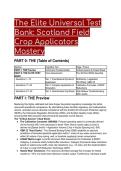
The Elite Universal Test
Bank: Scotland Field
Crop Applicators
Mastery
PART 0: THE (Table of Contents)
Section Cognitive Tier Page / Focus
PART I: THE Preview Command Fundamentals Critical Axioms & Cheat Sheet
PART II: THE ELITE TEST Core Assessment The 30-Point MCQ Gauntlet
BANK
- Questions 1–10 Tier 1: Foundational Syntax & Definitions, Legislation
Application (PA1/PA2), GBR 23
- Questions 11–20 Tier 2: Complex Application & Calibration Formulas, LERAP
Simulation Reductions
- Questions 21–30 Tier 3: Grandmaster Synthesis High-Stakes Troubleshooting,
SQC Audits
PART I: THE Preview
Mastering this highly calibrated test bank forges theoretical regulatory knowledge into lethal,
real-world operational competence. By internalizing these Scottish regulatory and mathematical
axioms, operators secure absolute compliance with the Scottish Environment Protection Agency
(SEPA), the Chemicals Regulation Directorate (CRD), and Scottish Quality Crops (SQC),
ensuring elite field execution that permanently bypasses novice failures.
The "Critical Axioms" Cheat Sheet:
● The Calibration Constants (360/600): Forward operating speed is universally derived
via the formula 360 / time (seconds) to travel 100m. Boom nozzle output (L/min) is
derived via [Speed (km/h) × Application Volume (L/ha) × Nozzle Spacing (m)] / 600.
● GBR 23 "Hard Decks": The General Binding Rules (GBR) establish an absolute
prohibition of terrestrial pesticide application within 1 meter of any water environment, and
within 50 meters of any spring, well, or borehole supplying human consumption.
● LERAP Matrix Logic: Local Environment Risk Assessment for Pesticides (LERAP)
Category A products strictly forbid buffer reductions. Category B products allow reductions
based on watercourse width, dose rate reductions (e.g., 1/4 rate), and the implementation
of 3-star or 4-star Drift Reduction Technology (DRT).
● Nozzle Wear Tolerances: The maximum permitted average flow increase for tested
nozzles is +10% of a brand-new reference nozzle's output. Furthermore, individual nozzle
, deviation across a boom section must remain within +/- 5% of the calculated average flow.
● Scottish Quality Crops (SQC) Baseline: Assurance compliance mandates an annual
Integrated Pest Management (IPM) plan, continuous professional development (CPD) via
NRoSO or BASIS, and soil tests every five years capturing pH, Phosphate (P), Potash
(K), and Soil Carbon metrics.
PART II: THE ELITE TEST BANK
Tier 1 - Foundational Syntax & Application
Q1: A newly hired agricultural contractor is tasked with applying a selective herbicide using a
tractor-mounted horizontal boom sprayer on a 20-hectare winter wheat field in Scotland. Based
on the certification mandates following the expiration of "Grandfather Rights," which qualification
matrix is the MINIMUM legal requirement for the operator? A) NPTC PA1 only, provided the
operator has a documented history of spraying on their employer's land prior to November 2015.
B) NPTC PA1 (Foundation) and NPTC PA6 (Hand-Held Equipment). C) NPTC PA1 (Foundation)
and NPTC PA2 (Mounted/Trailed Boom Sprayers). D) A valid Scottish Quality Crops (SQC)
membership passport and an annual IPM plan.
● The Answer: C (NPTC PA1 (Foundation) and NPTC PA2 (Mounted/Trailed Boom
Sprayers).)
● Distractor Analysis:
○ A is incorrect: "Grandfather Rights" expired universally on November 26, 2015; all
operators now require valid certificates of competence regardless of prior
experience.
○ B is incorrect: The PA6 certification strictly covers hand-held equipment (e.g.,
knapsacks) and does not legally qualify an operator to engage tractor-mounted
boom sprayers.
○ D is incorrect: SQC membership dictates farm assurance, crop traceability, and
market access, not the statutory legal capability to physically operate spray
machinery.
The Mentor's Analysis: Statutory compliance requires strict, modular certification. The PA1
Foundation module provides the legal and theoretical baseline for all pesticide applications,
while the PA2 module grants the specific operational authority for mechanized boom equipment.
NPTC Module Equipment Authorization Scope
PA1 Foundation Theory (Mandatory prerequisite for
all modules)
PA2 Self-Propelled, Mounted, or Trailed Horizontal
Boom Sprayers
PA6 Hand-Held Equipment (e.g., Knapsack
sprayers)
Professional/Academic Intuition: Never conflate assurance scheme requirements with
statutory pesticide law; holding PA1 and PA2 is the absolute, non-negotiable legal key to
the tractor cab.
Q2: When reviewing a pesticide label for a field bordering a 4-meter wide flowing burn, the
operator notes the product is designated as "LERAP Category A." Based on the regulatory
framework governing the protection of the aquatic environment, what is the MOST ACCURATE
buffer zone protocol? A) The buffer zone must be maintained at exactly 5 meters, with no
, reductions permitted under any circumstances. B) The buffer zone can be reduced to 1 meter if
the operator utilizes 3-star rated Drift Reduction Technology (DRT) nozzles. C) The buffer zone
is legally required to be extended to 10 meters under General Binding Rule (GBR) 23 for flowing
waterbodies. D) The buffer zone can be reduced to 2 meters if the dose rate is cut to 25% of the
maximum label rate.
● The Answer: A (The buffer zone must be maintained at exactly 5 meters, with no
reductions permitted under any circumstances.)
● Distractor Analysis:
○ B is incorrect: Buffer zone reductions utilizing 3-star DRT nozzles are exclusively
reserved for LERAP Category B products or Interim Scheme products with buffers
of 5m or less.
○ C is incorrect: GBR 23 mandates a baseline 1-meter no-spray zone for all water
environments; however, specific label requirements (such as 5m for LERAP A)
supersede baseline rules when they are more stringent.
○ D is incorrect: Dose rate reductions are a valid mitigation tactic, but this flexibility
applies strictly to LERAP Category B products, not Category A.
The Mentor's Analysis: The LERAP A designation represents an inflexible legislative boundary
designed to protect highly sensitive aquatic ecosystems from acutely toxic active ingredients. To
attempt a LERAP reduction on a Category A product represents a direct statutory violation,
highlighting a fundamental misunderstanding of chemical risk profiles. Professional/Academic
Intuition: LERAP A signifies absolute restriction. If the label stipulates "Category A," the
5-meter boundary cannot be manipulated by technology or mathematics.
Q3: Under the Scottish Environment Protection Agency's (SEPA) General Binding Rule (GBR)
23, an operator is preparing to spray a field adjacent to an uncapped private borehole actively
used for human water consumption. What is the MINIMUM legal distance the terrestrial
pesticide application must be kept from this borehole? A) 5 meters B) 10 meters C) 30 meters
D) 50 meters
● The Answer: D (50 meters)
● Distractor Analysis:
○ A is incorrect: 5 meters applies to LERAP boom sprayer surface water buffers, not
subterranean human drinking water sources.
○ B is incorrect: 10 meters applies to the geographical placement of mixing and filling
operations away from surface water or drains.
○ C is incorrect: 30 meters dictates the secondary boundary for DRT LERAP
schemes, which is entirely unrelated to groundwater protection parameters.
The Mentor's Analysis: Groundwater contamination via uncapped boreholes presents an
immediate, catastrophic risk to human health, as it bypasses surface filtration. GBR 23
acknowledges this severe vulnerability by enforcing a massive exclusionary zone, prioritizing
human biosecurity over agricultural yield.
GBR 23 Vulnerability Minimum Legal Distance
Surface Water (Rivers, Burns, Ditches) 1 meter (unless superseded by label)
Mixing / Filling Operations 10 meters from water environment
Human Consumption Spring/Borehole 50 meters
Professional/Academic Intuition: Human consumption dictates maximum environmental
restriction. A 50-meter radius around any uncapped spring, well, or borehole is strictly
off-limits.
Q4: A field crop applicator is analyzing weather conditions before executing a broadcast
Bank: Scotland Field
Crop Applicators
Mastery
PART 0: THE (Table of Contents)
Section Cognitive Tier Page / Focus
PART I: THE Preview Command Fundamentals Critical Axioms & Cheat Sheet
PART II: THE ELITE TEST Core Assessment The 30-Point MCQ Gauntlet
BANK
- Questions 1–10 Tier 1: Foundational Syntax & Definitions, Legislation
Application (PA1/PA2), GBR 23
- Questions 11–20 Tier 2: Complex Application & Calibration Formulas, LERAP
Simulation Reductions
- Questions 21–30 Tier 3: Grandmaster Synthesis High-Stakes Troubleshooting,
SQC Audits
PART I: THE Preview
Mastering this highly calibrated test bank forges theoretical regulatory knowledge into lethal,
real-world operational competence. By internalizing these Scottish regulatory and mathematical
axioms, operators secure absolute compliance with the Scottish Environment Protection Agency
(SEPA), the Chemicals Regulation Directorate (CRD), and Scottish Quality Crops (SQC),
ensuring elite field execution that permanently bypasses novice failures.
The "Critical Axioms" Cheat Sheet:
● The Calibration Constants (360/600): Forward operating speed is universally derived
via the formula 360 / time (seconds) to travel 100m. Boom nozzle output (L/min) is
derived via [Speed (km/h) × Application Volume (L/ha) × Nozzle Spacing (m)] / 600.
● GBR 23 "Hard Decks": The General Binding Rules (GBR) establish an absolute
prohibition of terrestrial pesticide application within 1 meter of any water environment, and
within 50 meters of any spring, well, or borehole supplying human consumption.
● LERAP Matrix Logic: Local Environment Risk Assessment for Pesticides (LERAP)
Category A products strictly forbid buffer reductions. Category B products allow reductions
based on watercourse width, dose rate reductions (e.g., 1/4 rate), and the implementation
of 3-star or 4-star Drift Reduction Technology (DRT).
● Nozzle Wear Tolerances: The maximum permitted average flow increase for tested
nozzles is +10% of a brand-new reference nozzle's output. Furthermore, individual nozzle
, deviation across a boom section must remain within +/- 5% of the calculated average flow.
● Scottish Quality Crops (SQC) Baseline: Assurance compliance mandates an annual
Integrated Pest Management (IPM) plan, continuous professional development (CPD) via
NRoSO or BASIS, and soil tests every five years capturing pH, Phosphate (P), Potash
(K), and Soil Carbon metrics.
PART II: THE ELITE TEST BANK
Tier 1 - Foundational Syntax & Application
Q1: A newly hired agricultural contractor is tasked with applying a selective herbicide using a
tractor-mounted horizontal boom sprayer on a 20-hectare winter wheat field in Scotland. Based
on the certification mandates following the expiration of "Grandfather Rights," which qualification
matrix is the MINIMUM legal requirement for the operator? A) NPTC PA1 only, provided the
operator has a documented history of spraying on their employer's land prior to November 2015.
B) NPTC PA1 (Foundation) and NPTC PA6 (Hand-Held Equipment). C) NPTC PA1 (Foundation)
and NPTC PA2 (Mounted/Trailed Boom Sprayers). D) A valid Scottish Quality Crops (SQC)
membership passport and an annual IPM plan.
● The Answer: C (NPTC PA1 (Foundation) and NPTC PA2 (Mounted/Trailed Boom
Sprayers).)
● Distractor Analysis:
○ A is incorrect: "Grandfather Rights" expired universally on November 26, 2015; all
operators now require valid certificates of competence regardless of prior
experience.
○ B is incorrect: The PA6 certification strictly covers hand-held equipment (e.g.,
knapsacks) and does not legally qualify an operator to engage tractor-mounted
boom sprayers.
○ D is incorrect: SQC membership dictates farm assurance, crop traceability, and
market access, not the statutory legal capability to physically operate spray
machinery.
The Mentor's Analysis: Statutory compliance requires strict, modular certification. The PA1
Foundation module provides the legal and theoretical baseline for all pesticide applications,
while the PA2 module grants the specific operational authority for mechanized boom equipment.
NPTC Module Equipment Authorization Scope
PA1 Foundation Theory (Mandatory prerequisite for
all modules)
PA2 Self-Propelled, Mounted, or Trailed Horizontal
Boom Sprayers
PA6 Hand-Held Equipment (e.g., Knapsack
sprayers)
Professional/Academic Intuition: Never conflate assurance scheme requirements with
statutory pesticide law; holding PA1 and PA2 is the absolute, non-negotiable legal key to
the tractor cab.
Q2: When reviewing a pesticide label for a field bordering a 4-meter wide flowing burn, the
operator notes the product is designated as "LERAP Category A." Based on the regulatory
framework governing the protection of the aquatic environment, what is the MOST ACCURATE
buffer zone protocol? A) The buffer zone must be maintained at exactly 5 meters, with no
, reductions permitted under any circumstances. B) The buffer zone can be reduced to 1 meter if
the operator utilizes 3-star rated Drift Reduction Technology (DRT) nozzles. C) The buffer zone
is legally required to be extended to 10 meters under General Binding Rule (GBR) 23 for flowing
waterbodies. D) The buffer zone can be reduced to 2 meters if the dose rate is cut to 25% of the
maximum label rate.
● The Answer: A (The buffer zone must be maintained at exactly 5 meters, with no
reductions permitted under any circumstances.)
● Distractor Analysis:
○ B is incorrect: Buffer zone reductions utilizing 3-star DRT nozzles are exclusively
reserved for LERAP Category B products or Interim Scheme products with buffers
of 5m or less.
○ C is incorrect: GBR 23 mandates a baseline 1-meter no-spray zone for all water
environments; however, specific label requirements (such as 5m for LERAP A)
supersede baseline rules when they are more stringent.
○ D is incorrect: Dose rate reductions are a valid mitigation tactic, but this flexibility
applies strictly to LERAP Category B products, not Category A.
The Mentor's Analysis: The LERAP A designation represents an inflexible legislative boundary
designed to protect highly sensitive aquatic ecosystems from acutely toxic active ingredients. To
attempt a LERAP reduction on a Category A product represents a direct statutory violation,
highlighting a fundamental misunderstanding of chemical risk profiles. Professional/Academic
Intuition: LERAP A signifies absolute restriction. If the label stipulates "Category A," the
5-meter boundary cannot be manipulated by technology or mathematics.
Q3: Under the Scottish Environment Protection Agency's (SEPA) General Binding Rule (GBR)
23, an operator is preparing to spray a field adjacent to an uncapped private borehole actively
used for human water consumption. What is the MINIMUM legal distance the terrestrial
pesticide application must be kept from this borehole? A) 5 meters B) 10 meters C) 30 meters
D) 50 meters
● The Answer: D (50 meters)
● Distractor Analysis:
○ A is incorrect: 5 meters applies to LERAP boom sprayer surface water buffers, not
subterranean human drinking water sources.
○ B is incorrect: 10 meters applies to the geographical placement of mixing and filling
operations away from surface water or drains.
○ C is incorrect: 30 meters dictates the secondary boundary for DRT LERAP
schemes, which is entirely unrelated to groundwater protection parameters.
The Mentor's Analysis: Groundwater contamination via uncapped boreholes presents an
immediate, catastrophic risk to human health, as it bypasses surface filtration. GBR 23
acknowledges this severe vulnerability by enforcing a massive exclusionary zone, prioritizing
human biosecurity over agricultural yield.
GBR 23 Vulnerability Minimum Legal Distance
Surface Water (Rivers, Burns, Ditches) 1 meter (unless superseded by label)
Mixing / Filling Operations 10 meters from water environment
Human Consumption Spring/Borehole 50 meters
Professional/Academic Intuition: Human consumption dictates maximum environmental
restriction. A 50-meter radius around any uncapped spring, well, or borehole is strictly
off-limits.
Q4: A field crop applicator is analyzing weather conditions before executing a broadcast


