
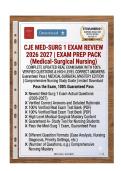
,CJE Med-Surg 1 Exam Review 2026 2027|
Complete Updated Real Exam Bank With
100% Verified Questions & High Level
Correct Answers | Guaranteed Pass
Medical-Surgical Mastery Edition
Section 1: Prioritization, Safety, & Infection Control (Questions 1-
50)
1. The nurse is caring for four patients. Which patient should the nurse assess first?
A. A patient with pneumonia who has a fever of 101.2°F and is requesting pain
medication.
B. A patient with heart failure who has 2+ pitting edema and a weight gain of 2 pounds
since yesterday.
C. A patient post-total knee replacement who reports sudden onset of shortness of
breath and chest pain.
D. A patient with diabetes who has a blood glucose of 180 mg/dL and is requesting a
snack.
Correct Answer: C. A patient post-total knee replacement who reports sudden
onset of shortness of breath and chest pain.
Rationale: This patient is at high risk for a pulmonary embolism, a life-threatening
emergency. The ABCs (Airway, Breathing, Circulation) are the priority. This patient
requires immediate assessment and intervention.
2. A patient is placed on fall precautions. Which intervention is most important to
include in the plan of care?
A. Keep the bed in the lowest position with the side rails up.
B. Place the call light within the patient's reach.
,C. Encourage the patient to use the bathroom independently.
D. Restrain the patient to prevent falls.
Correct Answer: B. Place the call light within the patient's reach.
Rationale: Ensuring the call light is within reach promotes patient safety and
independence by allowing the patient to call for assistance. Side rails should be assessed
per protocol, and restraints should only be used as a last resort with a provider's order.
3. The nurse is preparing to administer a medication to a patient. Which action is
essential for safe medication administration?
A. Verify the patient's identity using two patient identifiers.
B. Ask the patient if they know what the medication is for.
C. Check the medication label three times before administration.
D. Both A and C.
Correct Answer: D. Both A and C.
Rationale: The "Rights" of medication administration include verifying the patient's
identity with two identifiers and checking the medication label three times. These are
fundamental safety checks to prevent medication errors.
4. A patient is diagnosed with a urinary tract infection (UTI) and has a new order
for an antibiotic. Which action should the nurse take before administering the first
dose?
A. Obtain a urine culture and sensitivity specimen.
B. Administer the antibiotic with a full glass of water.
C. Monitor the patient's temperature.
D. Assess the patient for allergies.
Correct Answer: A. Obtain a urine culture and sensitivity specimen.
Rationale: A urine culture should be obtained before the first dose of an antibiotic to
identify the causative organism and ensure the appropriate antibiotic is used. Starting the
antibiotic before the culture can lead to false-negative results.
, 5. A patient is on contact precautions for a wound infection with MRSA. Which
personal protective equipment (PPE) is essential for the nurse to wear when
entering the room?
A. Gloves and a gown.
B. Gloves, gown, and a mask.
C. Gloves, gown, mask, and eye protection.
D. Gloves only.
Correct Answer: A. Gloves and a gown.
Rationale: Contact precautions require the use of gloves and a gown. A mask and eye
protection are not typically required unless there is a risk of splashes. The gown prevents
contamination of clothing.
6. The nurse is educating a patient about infection prevention. Which statement
by the patient indicates a need for further teaching?
A. "I should cover my mouth when I cough."
B. "It's okay to share my toothbrush with my spouse."
C. "I should wash my hands after using the bathroom."
D. "I should keep my vaccinations up to date."
Correct Answer: B. "It's okay to share my toothbrush with my spouse."
Rationale: Sharing personal items like toothbrushes can spread bacteria and viruses.
Patients should be taught to use their own personal care items to prevent infection
transmission.
7. A patient is prescribed a medication that is a high-alert medication. What does
this mean for the nurse?
A. The medication has a low risk of causing harm.
B. The medication requires special safeguards to reduce the risk of errors.
C. The medication can be administered without a second nurse verifying the dose.
D. The medication is only available in a generic form.
Correct Answer: B. The medication requires special safeguards to reduce the risk of
errors.
Rationale: High-alert medications are those that bear a heightened risk of causing
Complete Updated Real Exam Bank With
100% Verified Questions & High Level
Correct Answers | Guaranteed Pass
Medical-Surgical Mastery Edition
Section 1: Prioritization, Safety, & Infection Control (Questions 1-
50)
1. The nurse is caring for four patients. Which patient should the nurse assess first?
A. A patient with pneumonia who has a fever of 101.2°F and is requesting pain
medication.
B. A patient with heart failure who has 2+ pitting edema and a weight gain of 2 pounds
since yesterday.
C. A patient post-total knee replacement who reports sudden onset of shortness of
breath and chest pain.
D. A patient with diabetes who has a blood glucose of 180 mg/dL and is requesting a
snack.
Correct Answer: C. A patient post-total knee replacement who reports sudden
onset of shortness of breath and chest pain.
Rationale: This patient is at high risk for a pulmonary embolism, a life-threatening
emergency. The ABCs (Airway, Breathing, Circulation) are the priority. This patient
requires immediate assessment and intervention.
2. A patient is placed on fall precautions. Which intervention is most important to
include in the plan of care?
A. Keep the bed in the lowest position with the side rails up.
B. Place the call light within the patient's reach.
,C. Encourage the patient to use the bathroom independently.
D. Restrain the patient to prevent falls.
Correct Answer: B. Place the call light within the patient's reach.
Rationale: Ensuring the call light is within reach promotes patient safety and
independence by allowing the patient to call for assistance. Side rails should be assessed
per protocol, and restraints should only be used as a last resort with a provider's order.
3. The nurse is preparing to administer a medication to a patient. Which action is
essential for safe medication administration?
A. Verify the patient's identity using two patient identifiers.
B. Ask the patient if they know what the medication is for.
C. Check the medication label three times before administration.
D. Both A and C.
Correct Answer: D. Both A and C.
Rationale: The "Rights" of medication administration include verifying the patient's
identity with two identifiers and checking the medication label three times. These are
fundamental safety checks to prevent medication errors.
4. A patient is diagnosed with a urinary tract infection (UTI) and has a new order
for an antibiotic. Which action should the nurse take before administering the first
dose?
A. Obtain a urine culture and sensitivity specimen.
B. Administer the antibiotic with a full glass of water.
C. Monitor the patient's temperature.
D. Assess the patient for allergies.
Correct Answer: A. Obtain a urine culture and sensitivity specimen.
Rationale: A urine culture should be obtained before the first dose of an antibiotic to
identify the causative organism and ensure the appropriate antibiotic is used. Starting the
antibiotic before the culture can lead to false-negative results.
, 5. A patient is on contact precautions for a wound infection with MRSA. Which
personal protective equipment (PPE) is essential for the nurse to wear when
entering the room?
A. Gloves and a gown.
B. Gloves, gown, and a mask.
C. Gloves, gown, mask, and eye protection.
D. Gloves only.
Correct Answer: A. Gloves and a gown.
Rationale: Contact precautions require the use of gloves and a gown. A mask and eye
protection are not typically required unless there is a risk of splashes. The gown prevents
contamination of clothing.
6. The nurse is educating a patient about infection prevention. Which statement
by the patient indicates a need for further teaching?
A. "I should cover my mouth when I cough."
B. "It's okay to share my toothbrush with my spouse."
C. "I should wash my hands after using the bathroom."
D. "I should keep my vaccinations up to date."
Correct Answer: B. "It's okay to share my toothbrush with my spouse."
Rationale: Sharing personal items like toothbrushes can spread bacteria and viruses.
Patients should be taught to use their own personal care items to prevent infection
transmission.
7. A patient is prescribed a medication that is a high-alert medication. What does
this mean for the nurse?
A. The medication has a low risk of causing harm.
B. The medication requires special safeguards to reduce the risk of errors.
C. The medication can be administered without a second nurse verifying the dose.
D. The medication is only available in a generic form.
Correct Answer: B. The medication requires special safeguards to reduce the risk of
errors.
Rationale: High-alert medications are those that bear a heightened risk of causing


