

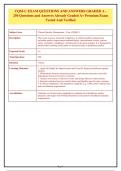
CQM-C EXAM QUESTIONS AND ANSWERS GRADED A -
250 Questions and Answers Already Graded A+ Premium Exam
Tested And Verified
Subject Area Clinical Quality Management - Core (CQM-C)
Description This exam assesses advanced competency in clinical quality management,
including quality improvement methodologies, measurement science, patient
safety, regulatory compliance, and data-driven decision-making. It is designed for
professionals seeking certification or advanced study in healthcare quality.
Expected Grade A+
Total Questions 250
Duration 3 hours
Learning Outcomes 1. Apply the Model for Improvement and Lean Six Sigma to healthcare quality
projects.
2. Differentiate between structural, process, and outcome measures and select
appropriate measures for given scenarios.
3. Analyze root causes of adverse events and design effective interventions.
4. Interpret statistical process control charts and identify special cause variation.
5. Evaluate compliance with regulatory standards (e.g., CMS, Joint Commission)
and accreditation requirements.
Accreditation Conforms to US university standards for graduate-level healthcare quality
programs and aligns with NAHQ (National Association for Healthcare Quality)
competencies.
Page 1
,1. A quality team is implementing a project to reduce hospital-acquired pressure
injuries. They hypothesize that using a new risk assessment tool will decrease
incidence. Which of the following study designs is most appropriate to evaluate this
intervention while minimizing bias?
A. Pre-post design with no control group
B. Interrupted time series with multiple data points before and after implementation
C. Randomized controlled trial with individual patient randomization
D. Case-control study comparing patients with and without pressure injuries
Answer: B. Interrupted time series with multiple data points before and after
implementation
Interrupted time series is robust for quality improvement evaluations as it controls for
secular trends and can detect changes attributable to the intervention. Randomized
controlled trials are often impractical in QI due to contamination and ethical concerns.
Pre-post designs lack a control for external factors, and case-control studies are prone
to selection bias.
2. A hospital's central line-associated bloodstream infection (CLABSI) rate has been
above the national benchmark for six months. After implementing a standardized
insertion bundle, the SPC chart shows seven consecutive points below the centerline.
What is the most appropriate interpretation?
A. Common cause variation is present; no action needed
B. Special cause variation indicating a significant improvement
C. The process is out of control due to random fluctuation
D. The data should be recalculated to adjust for seasonality
Answer: B. Special cause variation indicating a significant improvement
Seven consecutive points on one side of the centerline is a Western Electric rule for
detecting special cause variation, indicating a non-random pattern. This suggests the
intervention likely caused a true improvement. Common cause variation would show
random fluctuation around the centerline.
Page 2
,3. A quality manager is selecting measures for a diabetes care improvement project.
Which of the following is a process measure?
A. Percentage of patients with HbA1c > 9%
B. Rate of annual foot exams performed
C. Average HbA1c level among patients
D. Number of diabetes-related hospitalizations
Answer: B. Rate of annual foot exams performed
Process measures assess whether specific care activities are performed correctly.
Annual foot exam rate measures a clinical action. Options A and C are intermediate
outcome measures, and D is an outcome measure.
4. A root cause analysis (RCA) is conducted after a medication error where a patient
received a tenfold overdose of heparin. The investigation reveals that the pharmacy
label listed the concentration in mg/mL rather than units/mL, and the nurse did not
verify the dose with a second nurse. Which of the following is the most effective
system-level intervention to prevent recurrence?
A. Retrain all nursing staff on proper dose verification
B. Reprimand the pharmacist who created the label
C. Standardize concentration labeling across all high-alert medications using only units
D. Implement a barcode scanning system that alerts if dose exceeds a predefined threshold
Answer: D. Implement a barcode scanning system that alerts if dose exceeds a
predefined threshold
Barcode scanning with dose alerts is a forcing function that prevents administration of
an incorrect dose regardless of labeling errors. Retraining and reprimand are
person-focused and less reliable. Standardizing labeling is helpful but does not prevent
a nurse from misreading the label.
Page 3
, 5. In a Lean process improvement project, the value stream map reveals that patient
discharge takes an average of 4 hours, with only 30 minutes of value-added time. The
team identifies that the longest delay is waiting for discharge prescriptions from the
pharmacy. Which Lean tool should be applied first?
A. Kanban system for pharmacy inventory
B. 5S to organize the pharmacy workspace
C. Kaizen event focused on the discharge prescription process
D. Poka-yoke to prevent prescription errors
Answer: C. Kaizen event focused on the discharge prescription process
A Kaizen event is a rapid improvement workshop targeting a specific process
bottleneck. Here, the prescription delay is the largest non-value-added step, so a
focused improvement event is appropriate. Kanban and 5S address inventory and
organization, not the workflow bottleneck. Poka-yoke prevents errors, not delays.
6. A hospital is preparing for a Joint Commission survey. The quality director is
reviewing the requirements for the National Patient Safety Goals (NPSGs). Which of
the following is an accurate requirement for the NPSG on clinical alarm safety?
A. All alarms must be silenced during nighttime hours to reduce noise
B. Alarm parameters should be set to default manufacturer settings at all times
C. The hospital must establish policies for alarm management and educate staff on alarm
response
D. Only critical alarms should be monitored; non-critical alarms can be disabled
Answer: C. The hospital must establish policies for alarm management and
educate staff on alarm response
The NPSG on alarm safety requires hospitals to establish policies, educate staff, and
manage alarms to reduce false alarms and ensure timely response. Silencing alarms or
disabling non-critical ones could compromise safety. Default settings may not be
appropriate for all patients.
Page 4
250 Questions and Answers Already Graded A+ Premium Exam
Tested And Verified
Subject Area Clinical Quality Management - Core (CQM-C)
Description This exam assesses advanced competency in clinical quality management,
including quality improvement methodologies, measurement science, patient
safety, regulatory compliance, and data-driven decision-making. It is designed for
professionals seeking certification or advanced study in healthcare quality.
Expected Grade A+
Total Questions 250
Duration 3 hours
Learning Outcomes 1. Apply the Model for Improvement and Lean Six Sigma to healthcare quality
projects.
2. Differentiate between structural, process, and outcome measures and select
appropriate measures for given scenarios.
3. Analyze root causes of adverse events and design effective interventions.
4. Interpret statistical process control charts and identify special cause variation.
5. Evaluate compliance with regulatory standards (e.g., CMS, Joint Commission)
and accreditation requirements.
Accreditation Conforms to US university standards for graduate-level healthcare quality
programs and aligns with NAHQ (National Association for Healthcare Quality)
competencies.
Page 1
,1. A quality team is implementing a project to reduce hospital-acquired pressure
injuries. They hypothesize that using a new risk assessment tool will decrease
incidence. Which of the following study designs is most appropriate to evaluate this
intervention while minimizing bias?
A. Pre-post design with no control group
B. Interrupted time series with multiple data points before and after implementation
C. Randomized controlled trial with individual patient randomization
D. Case-control study comparing patients with and without pressure injuries
Answer: B. Interrupted time series with multiple data points before and after
implementation
Interrupted time series is robust for quality improvement evaluations as it controls for
secular trends and can detect changes attributable to the intervention. Randomized
controlled trials are often impractical in QI due to contamination and ethical concerns.
Pre-post designs lack a control for external factors, and case-control studies are prone
to selection bias.
2. A hospital's central line-associated bloodstream infection (CLABSI) rate has been
above the national benchmark for six months. After implementing a standardized
insertion bundle, the SPC chart shows seven consecutive points below the centerline.
What is the most appropriate interpretation?
A. Common cause variation is present; no action needed
B. Special cause variation indicating a significant improvement
C. The process is out of control due to random fluctuation
D. The data should be recalculated to adjust for seasonality
Answer: B. Special cause variation indicating a significant improvement
Seven consecutive points on one side of the centerline is a Western Electric rule for
detecting special cause variation, indicating a non-random pattern. This suggests the
intervention likely caused a true improvement. Common cause variation would show
random fluctuation around the centerline.
Page 2
,3. A quality manager is selecting measures for a diabetes care improvement project.
Which of the following is a process measure?
A. Percentage of patients with HbA1c > 9%
B. Rate of annual foot exams performed
C. Average HbA1c level among patients
D. Number of diabetes-related hospitalizations
Answer: B. Rate of annual foot exams performed
Process measures assess whether specific care activities are performed correctly.
Annual foot exam rate measures a clinical action. Options A and C are intermediate
outcome measures, and D is an outcome measure.
4. A root cause analysis (RCA) is conducted after a medication error where a patient
received a tenfold overdose of heparin. The investigation reveals that the pharmacy
label listed the concentration in mg/mL rather than units/mL, and the nurse did not
verify the dose with a second nurse. Which of the following is the most effective
system-level intervention to prevent recurrence?
A. Retrain all nursing staff on proper dose verification
B. Reprimand the pharmacist who created the label
C. Standardize concentration labeling across all high-alert medications using only units
D. Implement a barcode scanning system that alerts if dose exceeds a predefined threshold
Answer: D. Implement a barcode scanning system that alerts if dose exceeds a
predefined threshold
Barcode scanning with dose alerts is a forcing function that prevents administration of
an incorrect dose regardless of labeling errors. Retraining and reprimand are
person-focused and less reliable. Standardizing labeling is helpful but does not prevent
a nurse from misreading the label.
Page 3
, 5. In a Lean process improvement project, the value stream map reveals that patient
discharge takes an average of 4 hours, with only 30 minutes of value-added time. The
team identifies that the longest delay is waiting for discharge prescriptions from the
pharmacy. Which Lean tool should be applied first?
A. Kanban system for pharmacy inventory
B. 5S to organize the pharmacy workspace
C. Kaizen event focused on the discharge prescription process
D. Poka-yoke to prevent prescription errors
Answer: C. Kaizen event focused on the discharge prescription process
A Kaizen event is a rapid improvement workshop targeting a specific process
bottleneck. Here, the prescription delay is the largest non-value-added step, so a
focused improvement event is appropriate. Kanban and 5S address inventory and
organization, not the workflow bottleneck. Poka-yoke prevents errors, not delays.
6. A hospital is preparing for a Joint Commission survey. The quality director is
reviewing the requirements for the National Patient Safety Goals (NPSGs). Which of
the following is an accurate requirement for the NPSG on clinical alarm safety?
A. All alarms must be silenced during nighttime hours to reduce noise
B. Alarm parameters should be set to default manufacturer settings at all times
C. The hospital must establish policies for alarm management and educate staff on alarm
response
D. Only critical alarms should be monitored; non-critical alarms can be disabled
Answer: C. The hospital must establish policies for alarm management and
educate staff on alarm response
The NPSG on alarm safety requires hospitals to establish policies, educate staff, and
manage alarms to reduce false alarms and ensure timely response. Silencing alarms or
disabling non-critical ones could compromise safety. Default settings may not be
appropriate for all patients.
Page 4


