

WEB WOC WOUND CARE EXAM STUDYGUIDE
EXAM WITH CORRECT ACTUAL QUESTIONS
AND CORRECTLY WELL DEFINED ANSWERS
LATEST ALREADY GRADED A+
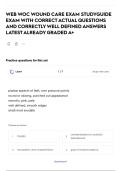
Practice questions for this set
Learn 1 /7 Study with Learn
plantar aspects of feet, over pressure points
round or oblong, punched out appearance
necrotic, pink, pale
well defined, smooth edges
small-mod exudate
Choose an answer
contraindications to autolytic
1 TIMERS 2
debridement
3 neuropathic ulcer characteristics 4 goal of moisture balance
Don't know?
,Terms in this set (143)
TIMERS Tissue management
Inflammation/infection control
Moisture balance
Edge/epithelial advancement
Regeneration/repair of tissue
Social/patient related factors
Framework used to provide an TIMERS
optimal physiologic wound
environment that is conducive to
healing
Goal of tissue management to remove non-viable, necrotic tissue as well as
non-functional tissue such as hypergranulation
goal of inflammation or infection eliminate infection and control bioburden
control
, goal of moisture balance not too wet and not too dry
provide moist wound therapy, absorb excess
drainage, control odor, fill dead space, control
swelling, protect periwound
goal of epithelial/edge keep wound edged open, address epibole and
advancement undermining, remove callous, protect periwound
skin
goal of regeneration/repair of cellular products, tissue based products,
tissue advanced therapies such as hyperbaric treatment
of NPWT
goal of social/patient related develop a patient-centers POC, patient
factors engagement, holistic assessment
why use debridement? to remove necrotic tissue or debris, remove and
reduce biofilm, remove infected tissues, in
palliative care to control odor, to facilitate wound
visualization, in chronic wounds to convert to
acute wound to promote healing
autolytic debridement a type of non-instrumental debridement that uses
the body's own WBCs, enzymes, and moisture to
re-hydrate, soften, and liquify hard eschar and
slough
benefits of autolytic debridement painless, easily done with moisture retentive
dressings, aides in combination debridement
methods
disadvantages of autolytic takes times, may be aesthetically displeasing to
debridement the patient if using a transparent dressing
EXAM WITH CORRECT ACTUAL QUESTIONS
AND CORRECTLY WELL DEFINED ANSWERS
LATEST ALREADY GRADED A+
Practice questions for this set
Learn 1 /7 Study with Learn
plantar aspects of feet, over pressure points
round or oblong, punched out appearance
necrotic, pink, pale
well defined, smooth edges
small-mod exudate
Choose an answer
contraindications to autolytic
1 TIMERS 2
debridement
3 neuropathic ulcer characteristics 4 goal of moisture balance
Don't know?
,Terms in this set (143)
TIMERS Tissue management
Inflammation/infection control
Moisture balance
Edge/epithelial advancement
Regeneration/repair of tissue
Social/patient related factors
Framework used to provide an TIMERS
optimal physiologic wound
environment that is conducive to
healing
Goal of tissue management to remove non-viable, necrotic tissue as well as
non-functional tissue such as hypergranulation
goal of inflammation or infection eliminate infection and control bioburden
control
, goal of moisture balance not too wet and not too dry
provide moist wound therapy, absorb excess
drainage, control odor, fill dead space, control
swelling, protect periwound
goal of epithelial/edge keep wound edged open, address epibole and
advancement undermining, remove callous, protect periwound
skin
goal of regeneration/repair of cellular products, tissue based products,
tissue advanced therapies such as hyperbaric treatment
of NPWT
goal of social/patient related develop a patient-centers POC, patient
factors engagement, holistic assessment
why use debridement? to remove necrotic tissue or debris, remove and
reduce biofilm, remove infected tissues, in
palliative care to control odor, to facilitate wound
visualization, in chronic wounds to convert to
acute wound to promote healing
autolytic debridement a type of non-instrumental debridement that uses
the body's own WBCs, enzymes, and moisture to
re-hydrate, soften, and liquify hard eschar and
slough
benefits of autolytic debridement painless, easily done with moisture retentive
dressings, aides in combination debridement
methods
disadvantages of autolytic takes times, may be aesthetically displeasing to
debridement the patient if using a transparent dressing


