

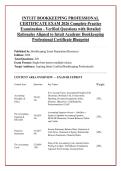
INTUIT BOOKKEEPING PROFESSIONAL
CERTIFICATE EXAM 2026 Complete Practice
Examination - Verified Questions with Detailed
Rationales Aligned to Intuit Academy Bookkeeping
Professional Certificate Blueprint
Published by: Bookkeeping Exam Preparation Resources
Edition: 2026
Total Questions: 220
Exam Format: Single-best-answer multiple-choice
Target Audience: Aspiring Intuit Certified Bookkeeping Professionals
CONTENT AREA OVERVIEW — EXAM BLUEPRINT
Content Area Questions Key Topics Weight
Five Account Types, Accounting Principles (Full
Accounting Disclosure, Monetary Unit, Conservatism,
28 (Q1-
Principles &
28)
Matching, Revenue Recognition), Ethics 13%
Ethics (Honesty, Objectivity, Confidentiality,
Professionalism), GAAP
Accounting Equation (Assets = Liabilities +
The Accounting
28 (Q29- Equity), Expanded Accounting Equation,
Equation &
56) DEALER Mnemonic, Normal Balances, Debits
13%
DEALER
and Credits
Income Statement, Balance Sheet, Statement of
Financial 32 (Q57-
Statements 88)
Cash Flows, Statement of Equity, Relationship 14%
Between Statements, Financial Ratios
Steps of the Accounting Cycle, Journal Entries,
The Accounting 32 (Q89-
Cycle 120)
Posting to Ledger, Trial Balance (Unadjusted, 14%
Adjusted, Post-Closing), Closing Entries
,Content Area Questions Key Topics Weight
Cash Basis Accounting, Accrual Basis
Cash vs.
24 (Q121- Accounting, Revenue Recognition Principle,
Accrual
144) Matching Principle, Adjusting Entries (Accruals,
11%
Accounting
Deferrals, Depreciation)
Account Types Asset Accounts, Liability Accounts, Equity
24 (Q145-
& Transaction
168)
Accounts, Revenue Accounts, Expense Accounts, 11%
Analysis Transaction Effects on the Accounting Equation
Internal
Internal Controls, Segregation of Duties, Bank
Controls & 20 (Q169-
Fraud 188)
Reconciliation, Petty Cash, Fraud Prevention, 9%
Documentation
Prevention
Payroll, Sales Payroll Accounting, Sales Tax, Depreciation
32 (Q189-
Tax & Special
220)
Methods, Inventory Methods (FIFO, LIFO), 14%
Topics Loans and Interest, Financial Analysis
SECTION 1: ACCOUNTING PRINCIPLES & ETHICS
Questions 1-28
1. What are the five account types in accounting?
A. Income, Expenses, Assets, Liabilities, Equity
B. Assets, Liabilities, Equity, Revenue, Expenses
C. Assets, Liabilities, Equity, Income, Costs
D. Revenue, Expenses, Gains, Losses, Equity
Correct Answer: B
Rationale: The five account types are Assets, Liabilities, Equity, Revenue, and
Expenses. Assets represent what the company owns, liabilities represent what it
owes, equity is the owner's stake, revenue is income from operations, and expenses
are costs incurred to generate revenue.
,2. What is the fundamental accounting equation?
A. Assets = Liabilities – Equity
B. Assets = Liabilities + Equity
C. Assets + Liabilities = Equity
D. Revenue – Expenses = Equity
Correct Answer: B
Rationale: The accounting equation (Assets = Liabilities + Equity) is the
foundation of double-entry bookkeeping. It must always balance, reflecting that
everything the company owns is financed either by debt (liabilities) or by the
owner's investment (equity).
3. What does DEALER stand for in accounting?
A. Debits Expenses and Assets; Liabilities, Equity, Revenue
B. Debits Equity and Assets; Liabilities, Expenses, Revenue
C. Debits Expenses and Liabilities; Assets, Equity, Revenue
D. Debits Assets and Revenue; Liabilities, Equity, Expenses
Correct Answer: A
Rationale: DEALER is a mnemonic for remembering which accounts increase
with debits and credits:
• Debit (increase): Expenses, Assets
• Credit (increase): Liabilities, Equity, Revenue
4. What are the four key elements of bookkeeping ethics?
A. Honesty, Integrity, Confidentiality, Professionalism
B. Honesty, Objectivity, Confidentiality, Professionalism
C. Integrity, Objectivity, Transparency, Confidentiality
D. Honesty, Fairness, Confidentiality, Professionalism
Correct Answer: B
, Rationale: The four key elements of bookkeeping ethics are Honesty, Objectivity,
Confidentiality, and Professionalism. These principles guide bookkeepers in
maintaining trust and integrity in financial reporting.
5. Which accounting principle states that a business is separate from its
owners?
A. Monetary Unit Principle
B. Economic Entity Principle
C. Full Disclosure Principle
D. Conservatism Principle
Correct Answer: B
Rationale: The Economic Entity Principle requires that business transactions be
kept separate from the personal transactions of the owners. This ensures that
financial statements reflect only the business's activities.
6. Which accounting principle requires that all relevant financial information
be disclosed?
A. Monetary Unit Principle
B. Conservatism Principle
C. Full Disclosure Principle
D. Matching Principle
Correct Answer: C
Rationale: The Full Disclosure Principle requires that all information that could
affect the decisions of financial statement users be disclosed in the financial
statements or accompanying notes.
7. Which accounting principle states that only transactions that can be
expressed in monetary terms should be recorded?
A. Economic Entity Principle
B. Monetary Unit Principle
CERTIFICATE EXAM 2026 Complete Practice
Examination - Verified Questions with Detailed
Rationales Aligned to Intuit Academy Bookkeeping
Professional Certificate Blueprint
Published by: Bookkeeping Exam Preparation Resources
Edition: 2026
Total Questions: 220
Exam Format: Single-best-answer multiple-choice
Target Audience: Aspiring Intuit Certified Bookkeeping Professionals
CONTENT AREA OVERVIEW — EXAM BLUEPRINT
Content Area Questions Key Topics Weight
Five Account Types, Accounting Principles (Full
Accounting Disclosure, Monetary Unit, Conservatism,
28 (Q1-
Principles &
28)
Matching, Revenue Recognition), Ethics 13%
Ethics (Honesty, Objectivity, Confidentiality,
Professionalism), GAAP
Accounting Equation (Assets = Liabilities +
The Accounting
28 (Q29- Equity), Expanded Accounting Equation,
Equation &
56) DEALER Mnemonic, Normal Balances, Debits
13%
DEALER
and Credits
Income Statement, Balance Sheet, Statement of
Financial 32 (Q57-
Statements 88)
Cash Flows, Statement of Equity, Relationship 14%
Between Statements, Financial Ratios
Steps of the Accounting Cycle, Journal Entries,
The Accounting 32 (Q89-
Cycle 120)
Posting to Ledger, Trial Balance (Unadjusted, 14%
Adjusted, Post-Closing), Closing Entries
,Content Area Questions Key Topics Weight
Cash Basis Accounting, Accrual Basis
Cash vs.
24 (Q121- Accounting, Revenue Recognition Principle,
Accrual
144) Matching Principle, Adjusting Entries (Accruals,
11%
Accounting
Deferrals, Depreciation)
Account Types Asset Accounts, Liability Accounts, Equity
24 (Q145-
& Transaction
168)
Accounts, Revenue Accounts, Expense Accounts, 11%
Analysis Transaction Effects on the Accounting Equation
Internal
Internal Controls, Segregation of Duties, Bank
Controls & 20 (Q169-
Fraud 188)
Reconciliation, Petty Cash, Fraud Prevention, 9%
Documentation
Prevention
Payroll, Sales Payroll Accounting, Sales Tax, Depreciation
32 (Q189-
Tax & Special
220)
Methods, Inventory Methods (FIFO, LIFO), 14%
Topics Loans and Interest, Financial Analysis
SECTION 1: ACCOUNTING PRINCIPLES & ETHICS
Questions 1-28
1. What are the five account types in accounting?
A. Income, Expenses, Assets, Liabilities, Equity
B. Assets, Liabilities, Equity, Revenue, Expenses
C. Assets, Liabilities, Equity, Income, Costs
D. Revenue, Expenses, Gains, Losses, Equity
Correct Answer: B
Rationale: The five account types are Assets, Liabilities, Equity, Revenue, and
Expenses. Assets represent what the company owns, liabilities represent what it
owes, equity is the owner's stake, revenue is income from operations, and expenses
are costs incurred to generate revenue.
,2. What is the fundamental accounting equation?
A. Assets = Liabilities – Equity
B. Assets = Liabilities + Equity
C. Assets + Liabilities = Equity
D. Revenue – Expenses = Equity
Correct Answer: B
Rationale: The accounting equation (Assets = Liabilities + Equity) is the
foundation of double-entry bookkeeping. It must always balance, reflecting that
everything the company owns is financed either by debt (liabilities) or by the
owner's investment (equity).
3. What does DEALER stand for in accounting?
A. Debits Expenses and Assets; Liabilities, Equity, Revenue
B. Debits Equity and Assets; Liabilities, Expenses, Revenue
C. Debits Expenses and Liabilities; Assets, Equity, Revenue
D. Debits Assets and Revenue; Liabilities, Equity, Expenses
Correct Answer: A
Rationale: DEALER is a mnemonic for remembering which accounts increase
with debits and credits:
• Debit (increase): Expenses, Assets
• Credit (increase): Liabilities, Equity, Revenue
4. What are the four key elements of bookkeeping ethics?
A. Honesty, Integrity, Confidentiality, Professionalism
B. Honesty, Objectivity, Confidentiality, Professionalism
C. Integrity, Objectivity, Transparency, Confidentiality
D. Honesty, Fairness, Confidentiality, Professionalism
Correct Answer: B
, Rationale: The four key elements of bookkeeping ethics are Honesty, Objectivity,
Confidentiality, and Professionalism. These principles guide bookkeepers in
maintaining trust and integrity in financial reporting.
5. Which accounting principle states that a business is separate from its
owners?
A. Monetary Unit Principle
B. Economic Entity Principle
C. Full Disclosure Principle
D. Conservatism Principle
Correct Answer: B
Rationale: The Economic Entity Principle requires that business transactions be
kept separate from the personal transactions of the owners. This ensures that
financial statements reflect only the business's activities.
6. Which accounting principle requires that all relevant financial information
be disclosed?
A. Monetary Unit Principle
B. Conservatism Principle
C. Full Disclosure Principle
D. Matching Principle
Correct Answer: C
Rationale: The Full Disclosure Principle requires that all information that could
affect the decisions of financial statement users be disclosed in the financial
statements or accompanying notes.
7. Which accounting principle states that only transactions that can be
expressed in monetary terms should be recorded?
A. Economic Entity Principle
B. Monetary Unit Principle


