

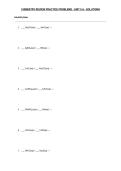
CHEMISTRY REVIEW PRACTICE PROBLEMS - UNIT 6 A - SOLUTIONS
Solubility Rules
1. ___ Na₂SO₄(aq) + ___ BaCl₂(aq) →
2. ___ AgNO₃(aq) + ___ KBr(aq) →
3. ___ CuCl₂(aq) + ___ Na₂CO₃(aq) →
4. ___ Ca(NO₃)₂(aq) + ___ K₃PO₄(aq) →
5. ___ Pb(NO₃)₂(aq) + ___ NaI(aq) →
6. ___ FeSO₄(aq) + ___ LiOH(aq) →
7. ___ NH₄Cl(aq) + ___ Na₂S(aq) →
, CHEMISTRY REVIEW PRACTICE PROBLEMS - UNIT 6 A - SOLUTIONS
Molar Concentrations
1. A student dissolves 3.60 moles of potassium nitrate (KNO₃) in water to make 4.50 L of solution.
What is the molar concentration of the solution?
2. A solution of calcium bromide (CaBr₂) has a concentration of 0.825 mol/L. If the solution
contains 2.47 moles of CaBr₂. What is the volume of the solution in litres?
3. A student uses 15.0 g of lithium phosphate (Li₃PO₄) to make a solution with a final concentration
of 0.250 mol/L. What volume of solution (in mL) did they prepare?
4. A solution of Na₂SO₄ has a volume of 1.80 L and a concentration of 1.25 mol/L. How many moles
of Na₂SO₄ are present?
5. A student prepares 2.25 L of 0.600 mol/L copper(II) nitrate, Cu(NO₃)₂. How many grams of
Cu(NO₃)₂ does the student need?
6. A lab sample contains 42.0 g of ammonium sulfate, (NH₄)₂SO₄, dissolved to make 3.00 L of
solution. What is the molar concentration of the solution?
7. How many grams of barium hydroxide, Ba(OH)₂, are needed to prepare 1.50 L of 0.350 mol/L
solution?
Solubility Rules
1. ___ Na₂SO₄(aq) + ___ BaCl₂(aq) →
2. ___ AgNO₃(aq) + ___ KBr(aq) →
3. ___ CuCl₂(aq) + ___ Na₂CO₃(aq) →
4. ___ Ca(NO₃)₂(aq) + ___ K₃PO₄(aq) →
5. ___ Pb(NO₃)₂(aq) + ___ NaI(aq) →
6. ___ FeSO₄(aq) + ___ LiOH(aq) →
7. ___ NH₄Cl(aq) + ___ Na₂S(aq) →
, CHEMISTRY REVIEW PRACTICE PROBLEMS - UNIT 6 A - SOLUTIONS
Molar Concentrations
1. A student dissolves 3.60 moles of potassium nitrate (KNO₃) in water to make 4.50 L of solution.
What is the molar concentration of the solution?
2. A solution of calcium bromide (CaBr₂) has a concentration of 0.825 mol/L. If the solution
contains 2.47 moles of CaBr₂. What is the volume of the solution in litres?
3. A student uses 15.0 g of lithium phosphate (Li₃PO₄) to make a solution with a final concentration
of 0.250 mol/L. What volume of solution (in mL) did they prepare?
4. A solution of Na₂SO₄ has a volume of 1.80 L and a concentration of 1.25 mol/L. How many moles
of Na₂SO₄ are present?
5. A student prepares 2.25 L of 0.600 mol/L copper(II) nitrate, Cu(NO₃)₂. How many grams of
Cu(NO₃)₂ does the student need?
6. A lab sample contains 42.0 g of ammonium sulfate, (NH₄)₂SO₄, dissolved to make 3.00 L of
solution. What is the molar concentration of the solution?
7. How many grams of barium hydroxide, Ba(OH)₂, are needed to prepare 1.50 L of 0.350 mol/L
solution?


