

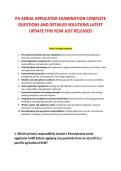
PA AERIAL APPLICATOR EXAMINATION COMPLETE
QUESTIONS AND DETAILED SOLUTIONS LATEST
UPDATE THIS YEAR JUST RELEASED
Exam Coverage Summary
1. Pennsylvania pesticide laws and regulations governing commercial pesticide application,
licensing, certification, and enforcement.
2. Aerial application requirements including aircraft operations, application equipment, pilot
responsibilities, and applicator qualifications.
3. Pesticide labels and labeling with emphasis on legally enforceable directions, restrictions, rates,
and application methods.
4. Environmental protection involving drift prevention, sensitive areas, water resources,
endangered species, and protection of non-target organisms.
5. Weather and atmospheric conditions affecting spray drift, evaporation, inversion conditions,
wind speed, and application safety.
6. Aerial application equipment including aircraft calibration, nozzles, booms, pressure, droplet
size, swath width, and application uniformity.
7. Pesticide formulation and mixing principles including compatibility, adjuvants, tank mixing,
loading procedures, and spill response.
8. Integrated pest management and pest identification with emphasis on selecting appropriate
treatments and applying pesticides only when justified.
9. Worker, public, and applicator safety including personal protective equipment, exposure
prevention, emergency procedures, and communication.
10. Recordkeeping and operational responsibilities including application records, restricted-use
pesticides, complaints, incident reporting, and compliance documentation.
1. Which primary responsibility should a Pennsylvania aerial
applicator fulfill before applying any pesticide from an aircraft to a
specific agricultural field?
,A. Select the highest available application rate to ensure complete pest
elimination
B. Review the pesticide label, confirm legal use, evaluate conditions,
and plan the application
C. Begin spraying immediately after loading because aerial applications
are inherently efficient
D. Apply according to the aircraft owner's preferred operating
procedure regardless of label directions
Answer: B
Rationale: Aerial pesticide applications require careful pre-application
planning. The applicator must verify the label, target pest, site, rate,
weather, equipment, and environmental conditions before application.
2. Why is the pesticide product label considered one of the most
important legal documents for aerial pesticide application?
A. It provides optional recommendations that applicators may ignore
when experienced
B. It establishes legally enforceable directions and restrictions
governing lawful pesticide use
C. It applies only to ground applications and does not govern aerial
applications
D. It primarily provides marketing information rather than safety or
application requirements
Answer: B
,Rationale: Pesticide labels contain legally enforceable directions,
including application rates, approved sites, required precautions, and
restrictions. Applicators must follow the label.
3. Before conducting an aerial pesticide application, which
combination of conditions should an applicator evaluate most
carefully?
A. Wind, temperature, humidity, inversion potential, nearby sensitive
areas, and target location
B. Aircraft paint color, pilot's preferred music, and the number of
workers at headquarters
C. Fuel price, field ownership history, and the age of the pesticide
storage building
D. Only the current wind direction because all other environmental
factors are irrelevant
Answer: A
Rationale: Weather and surrounding conditions strongly influence drift,
deposition, evaporation, and off-target movement. Aerial applicators
must evaluate all relevant conditions before spraying.
4. What is the primary reason aerial applicators should be particularly
concerned about pesticide spray drift?
A. Aircraft always produce larger droplets than ground equipment
B. Aerial applications can potentially affect areas outside the target site
because pesticides are released above ground
, C. Drift only affects the aircraft's fuel consumption
D. Drift is primarily a concern when applying fertilizers rather than
pesticides
Answer: B
Rationale: Aerial applications can produce significant off-target
movement if poorly planned or conducted. Drift can injure crops,
contaminate water, affect wildlife, and expose people.
5. Which weather condition generally presents a heightened risk of
pesticide drift during an aerial application?
A. Appropriate steady winds blowing toward the intended target
B. Calm conditions associated with a temperature inversion
C. Moderate humidity with predictable atmospheric mixing
D. Light winds moving consistently across the treatment area
Answer: B
Rationale: Temperature inversions can suspend fine droplets in stable
air, allowing them to move laterally over considerable distances and
increasing off-target exposure.
6. What is a temperature inversion in the context of pesticide
application and spray drift?
A. A condition where air temperature increases with altitude near the
ground, creating atmospheric stability
QUESTIONS AND DETAILED SOLUTIONS LATEST
UPDATE THIS YEAR JUST RELEASED
Exam Coverage Summary
1. Pennsylvania pesticide laws and regulations governing commercial pesticide application,
licensing, certification, and enforcement.
2. Aerial application requirements including aircraft operations, application equipment, pilot
responsibilities, and applicator qualifications.
3. Pesticide labels and labeling with emphasis on legally enforceable directions, restrictions, rates,
and application methods.
4. Environmental protection involving drift prevention, sensitive areas, water resources,
endangered species, and protection of non-target organisms.
5. Weather and atmospheric conditions affecting spray drift, evaporation, inversion conditions,
wind speed, and application safety.
6. Aerial application equipment including aircraft calibration, nozzles, booms, pressure, droplet
size, swath width, and application uniformity.
7. Pesticide formulation and mixing principles including compatibility, adjuvants, tank mixing,
loading procedures, and spill response.
8. Integrated pest management and pest identification with emphasis on selecting appropriate
treatments and applying pesticides only when justified.
9. Worker, public, and applicator safety including personal protective equipment, exposure
prevention, emergency procedures, and communication.
10. Recordkeeping and operational responsibilities including application records, restricted-use
pesticides, complaints, incident reporting, and compliance documentation.
1. Which primary responsibility should a Pennsylvania aerial
applicator fulfill before applying any pesticide from an aircraft to a
specific agricultural field?
,A. Select the highest available application rate to ensure complete pest
elimination
B. Review the pesticide label, confirm legal use, evaluate conditions,
and plan the application
C. Begin spraying immediately after loading because aerial applications
are inherently efficient
D. Apply according to the aircraft owner's preferred operating
procedure regardless of label directions
Answer: B
Rationale: Aerial pesticide applications require careful pre-application
planning. The applicator must verify the label, target pest, site, rate,
weather, equipment, and environmental conditions before application.
2. Why is the pesticide product label considered one of the most
important legal documents for aerial pesticide application?
A. It provides optional recommendations that applicators may ignore
when experienced
B. It establishes legally enforceable directions and restrictions
governing lawful pesticide use
C. It applies only to ground applications and does not govern aerial
applications
D. It primarily provides marketing information rather than safety or
application requirements
Answer: B
,Rationale: Pesticide labels contain legally enforceable directions,
including application rates, approved sites, required precautions, and
restrictions. Applicators must follow the label.
3. Before conducting an aerial pesticide application, which
combination of conditions should an applicator evaluate most
carefully?
A. Wind, temperature, humidity, inversion potential, nearby sensitive
areas, and target location
B. Aircraft paint color, pilot's preferred music, and the number of
workers at headquarters
C. Fuel price, field ownership history, and the age of the pesticide
storage building
D. Only the current wind direction because all other environmental
factors are irrelevant
Answer: A
Rationale: Weather and surrounding conditions strongly influence drift,
deposition, evaporation, and off-target movement. Aerial applicators
must evaluate all relevant conditions before spraying.
4. What is the primary reason aerial applicators should be particularly
concerned about pesticide spray drift?
A. Aircraft always produce larger droplets than ground equipment
B. Aerial applications can potentially affect areas outside the target site
because pesticides are released above ground
, C. Drift only affects the aircraft's fuel consumption
D. Drift is primarily a concern when applying fertilizers rather than
pesticides
Answer: B
Rationale: Aerial applications can produce significant off-target
movement if poorly planned or conducted. Drift can injure crops,
contaminate water, affect wildlife, and expose people.
5. Which weather condition generally presents a heightened risk of
pesticide drift during an aerial application?
A. Appropriate steady winds blowing toward the intended target
B. Calm conditions associated with a temperature inversion
C. Moderate humidity with predictable atmospheric mixing
D. Light winds moving consistently across the treatment area
Answer: B
Rationale: Temperature inversions can suspend fine droplets in stable
air, allowing them to move laterally over considerable distances and
increasing off-target exposure.
6. What is a temperature inversion in the context of pesticide
application and spray drift?
A. A condition where air temperature increases with altitude near the
ground, creating atmospheric stability


