

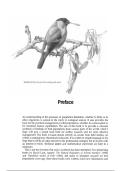
Bullfinch Pyrrula pyrrhula eating ash seed.
Preface
An understanding of the processes of population limitation, whether in birds or in
other organisms, is central in the study of ecological science. It also provides the
basis for the practical management of wild populations, whether for conservation or
for sustained human exploitation. The aim of this book is to provide a coherent
synthesis of findings on bird populations from various parts of the world, which I
hope will give a sound basis both for further research and for more effective
management. The book is based almost entirely on results from field studies, set
within a contemporary theoretical framework. It is written in simple language in the
hope that it will be of value not only to the professional ecologist, but to anyone with
an interest in birds. Technical jargon and mathematical expression are kept to a
minimum.
This is not the first time that such a synthesis has been attempted. Two pioneering
books by David Lack, namely 'The Natural Regulation of Animal Numbers' (1954)
and 'Population studies of birds' (1966), did much to stimulate research on bird
populations years ago. Since these books were written, much new information and
,X Preface — ^ ^ ^ ^ ^ ^ ^ ^ ^ ^ ^ ^ ^ ^ ^ ^ ^ ^ ^ — ^ ^ ^ ^ ^ ^ ^ ^ ^ ^ ^ ^ ^
some new ideas have emerged, so a reassessment of the issues seems timely. The
emphasis throughout this book is on density limitation, and larger scale aspects,
such as migration and geographical range, will be discussed in a later volume.
Furthermore, only the minimum of detail on field and analytical methodology is
given, as these aspects have been treated in depth by other authors elsewhere.
The scientific literature on bird populations is now so vast, in the English-speaking
world alone, that no one person can expect to have seen it all, let alone to have read
it. Inevitably, then, I have had to refer selectively to this literature. For important
points, on which a crucial argument depends, I have tabulated a large number of
relevant studies, but for more firmly established points I have given only a few
examples, referring wherever possible to review articles that themselves quote more
original sources. Despite these attempts at curtailment, the reference list at the end
still contains more than 1800 titles, extending up to 1996 (with a few later ones). I am
well aware, however, that many relevant studies have necessarily been excluded.
The book begins with a preview, in which the scope and general conceptual
framework are laid out. The rest is arranged in three main parts, each comprising
several chapters. The first part deals with the role of behaviour in density regulation,
the second with the effects of various external limiting factors, such as food,
predators and parasites, and the third with the effects of various human impacts,
such as hunting, pesticide use and pollution. A final chapter deals with extinction.
With this form of treatment, some topics inevitably arise in more than one chapter,
but I have tried to keep the repetition to a minimum, and to cross refer wherever
possible. Because so many species are mentioned, from diverse parts of the globe,
scientific names are given at the first mention in every chapter, and elsewhere if
confusion would otherwise be likely.
Many of the diagrams in this book are redrawn from previously published
sources, as acknowledged in the captions. For permission to reproduce this subject
matter, I am grateful to Academic Press, Blackwell Scientific Publications, British
Ecological Society (Journal of Animal Ecology, Journal of Applied Ecology), British Trust
for Ornithology (Bird Study), The Game Conservancy Trust, Oxford University
Press, The Royal Society (Proceedings: Biological Sciences) and the Peregrine Fund.
As in any active field of science, individuals differ in their interpretation of some
of the same data, and hold different views about the importance of different
processes in the dynamics of bird populations. This book naturally reflects my own
views, although I have tried throughout to present as objective and balanced a
picture as possible. On particular issues, I have benefited greatly over the years from
discussion with friends and colleagues, in particular with M.P. Harris, D. Jenkins, M.
Marquiss, C M . Perrins and P. Rothery, and I would like to thank them all, together
with the following, for commenting helpfully on particular chapters: J.P Dempster
(5), S. Kinsley (2, 3, 6, 16), R.E. Kenward (10), K. Lakhani (5), M. Marquiss (10, 13),
R.E. Newton (10), S. Redpath (8,14), T. Royama (5) and P Rothery (5). In addition, I
owe a special debt to David Jenkins, who has read and commented critically on the
whole book in draft. However, neither he nor any other colleagues are in any way
responsible for its shortcomings.
In addition, I am grateful to Doreen Wade for typing the manuscript many times
over, as well as to Lois Dale for help in producing the diagrams and to Keith Brockie
for his beautiful illustrations. Finally, I thank my wife, Halina, for encouragement
throughout, and for checking the whole book in draft.
, White Storks Ciconia ciconia.
Chapter 1
Preview
This book is about bird numbers, and about why these numbers vary in the way
they do, from year to year or from place to place. It is therefore concerned with the
various factors that influence bird numbers: with the role of food-supplies and other
resources, of predators, parasites and pathogens, and of various human impacts.
These are all matters of fundamental interest to ecologists, including those involved
with the management of bird populations, whether for conservation, crop protection
or sport-hunting. Although birds form a tiny fraction of all animal species - perhaps
less than 0.2% of the total - we have no reason to suppose that the numbers of birds
are limited in ways different from those of other animals. Yet for some aspects of
study birds offer distinct advantages.
In the first place, most bird species are diurnal, and can be readily distinguished
from one another in the field. This makes them easy to watch and to count. Indeed,
in the breeding season many species obligingly force themselves upon our attention
by singing their species-specific songs. Secondly, most birds can be trapped and
, 2 Preview - ^ - - ^ ^ - ^ ^ ^ ^ ^ ^ ^ ~ ^ ^ ^ — ^ ^ — ^ ^ ^ ^ ^ ^ ^ ^ ^ ^ ^ ^ ^ ^ ^ - ^
marked with leg rings or other tags. Such marked birds then remain as identifiable
individuals throughout their lives, enabling their movements and life-histories to be
followed. Many species, too, are large enough to carry radio-transmitters, facili-
tating detailed studies of their day-to-day activities. Thirdly, most bird species raise
their young in discrete nests. Their individual reproductive rates can therefore be
measured in a way that is not possible for most other creatures with no parental care,
and in which the young from different parents soon intermingle. Fourthly, the
highly developed social structure of birds has enabled the role of territorial and
other dominance behaviour in population regulation to be studied in greater detail
than for most other animals. All these features combine to make birds popular with
their human observers. In some parts of the world, through the combined efforts of
birdwatchers, changes in the numbers and distributions of birds have been
monitored with precision over long periods and wide geographical areas. For these
various reasons, then, the population ecology of birds is perhaps better known than
that of any other group of organisms, and the general principles that have emerged
have much wider relevance in the science of ecology.
The aim of this book, as stated in the Preface, is to review current ideas on
population limitation of birds, illustrating the issues involved with examples from
different species and from different regions of the world. For the most part, different
aspects of the subject are covered in different chapters. The purpose of this
introductory chapter is to provide a preview, outlining the scope and conceptual
framework within which subsequent chapters lie.
BIRD NUMBERS
Compared with many other organisms, birds are well-known taxonomically. On
recent estimates, there are about 9672 known species of birds in the world (Sibley &
Monroe 1990). Each decade, usually through human action, a few species may
become extinct, while a similar number of previously undescribed species may
come to light.
These bird species vary from extremely widespread and abundant, numbering
many millions of individuals, to extremely localised and rare, consisting of a few
individuals on the verge of oblivion. Among landbirds, the most numerous species
probably include the House Sparrow Passer domesticus and European Starling
Sturnus vulgaris, both of which are widespread in the Old World and, through
introductions, in the New World too. They also include the Red-billed Quelea Quelea
quelea, a seed-eating weaver bird which breeds over much of Africa south of the
Sahara. The total populations of all these species have been estimated at more than
500 millions. Nightly roosts of more than a million individuals are regular in Quelea
and Starlings, as well as in Sand Martins Riparia riparia in Europe and Red-winged
Blackbirds Agelaius phoeniceus in North America. The record for individual roosts,
however, is probably held by the Brambling Fringilla montifringilla, whose nightly
gatherings in areas of good Beech Fagus sylvatica crops in central Europe have
sometimes numbered more than 20 million individuals, as noted at least from the
15th century onwards (Jenni 1987).
Many species of seabirds range widely over the oceans, but while nesting gather
in vast colonies at traditional locations, where they can be counted. Perhaps the most
Preface
An understanding of the processes of population limitation, whether in birds or in
other organisms, is central in the study of ecological science. It also provides the
basis for the practical management of wild populations, whether for conservation or
for sustained human exploitation. The aim of this book is to provide a coherent
synthesis of findings on bird populations from various parts of the world, which I
hope will give a sound basis both for further research and for more effective
management. The book is based almost entirely on results from field studies, set
within a contemporary theoretical framework. It is written in simple language in the
hope that it will be of value not only to the professional ecologist, but to anyone with
an interest in birds. Technical jargon and mathematical expression are kept to a
minimum.
This is not the first time that such a synthesis has been attempted. Two pioneering
books by David Lack, namely 'The Natural Regulation of Animal Numbers' (1954)
and 'Population studies of birds' (1966), did much to stimulate research on bird
populations years ago. Since these books were written, much new information and
,X Preface — ^ ^ ^ ^ ^ ^ ^ ^ ^ ^ ^ ^ ^ ^ ^ ^ ^ ^ ^ — ^ ^ ^ ^ ^ ^ ^ ^ ^ ^ ^ ^ ^
some new ideas have emerged, so a reassessment of the issues seems timely. The
emphasis throughout this book is on density limitation, and larger scale aspects,
such as migration and geographical range, will be discussed in a later volume.
Furthermore, only the minimum of detail on field and analytical methodology is
given, as these aspects have been treated in depth by other authors elsewhere.
The scientific literature on bird populations is now so vast, in the English-speaking
world alone, that no one person can expect to have seen it all, let alone to have read
it. Inevitably, then, I have had to refer selectively to this literature. For important
points, on which a crucial argument depends, I have tabulated a large number of
relevant studies, but for more firmly established points I have given only a few
examples, referring wherever possible to review articles that themselves quote more
original sources. Despite these attempts at curtailment, the reference list at the end
still contains more than 1800 titles, extending up to 1996 (with a few later ones). I am
well aware, however, that many relevant studies have necessarily been excluded.
The book begins with a preview, in which the scope and general conceptual
framework are laid out. The rest is arranged in three main parts, each comprising
several chapters. The first part deals with the role of behaviour in density regulation,
the second with the effects of various external limiting factors, such as food,
predators and parasites, and the third with the effects of various human impacts,
such as hunting, pesticide use and pollution. A final chapter deals with extinction.
With this form of treatment, some topics inevitably arise in more than one chapter,
but I have tried to keep the repetition to a minimum, and to cross refer wherever
possible. Because so many species are mentioned, from diverse parts of the globe,
scientific names are given at the first mention in every chapter, and elsewhere if
confusion would otherwise be likely.
Many of the diagrams in this book are redrawn from previously published
sources, as acknowledged in the captions. For permission to reproduce this subject
matter, I am grateful to Academic Press, Blackwell Scientific Publications, British
Ecological Society (Journal of Animal Ecology, Journal of Applied Ecology), British Trust
for Ornithology (Bird Study), The Game Conservancy Trust, Oxford University
Press, The Royal Society (Proceedings: Biological Sciences) and the Peregrine Fund.
As in any active field of science, individuals differ in their interpretation of some
of the same data, and hold different views about the importance of different
processes in the dynamics of bird populations. This book naturally reflects my own
views, although I have tried throughout to present as objective and balanced a
picture as possible. On particular issues, I have benefited greatly over the years from
discussion with friends and colleagues, in particular with M.P. Harris, D. Jenkins, M.
Marquiss, C M . Perrins and P. Rothery, and I would like to thank them all, together
with the following, for commenting helpfully on particular chapters: J.P Dempster
(5), S. Kinsley (2, 3, 6, 16), R.E. Kenward (10), K. Lakhani (5), M. Marquiss (10, 13),
R.E. Newton (10), S. Redpath (8,14), T. Royama (5) and P Rothery (5). In addition, I
owe a special debt to David Jenkins, who has read and commented critically on the
whole book in draft. However, neither he nor any other colleagues are in any way
responsible for its shortcomings.
In addition, I am grateful to Doreen Wade for typing the manuscript many times
over, as well as to Lois Dale for help in producing the diagrams and to Keith Brockie
for his beautiful illustrations. Finally, I thank my wife, Halina, for encouragement
throughout, and for checking the whole book in draft.
, White Storks Ciconia ciconia.
Chapter 1
Preview
This book is about bird numbers, and about why these numbers vary in the way
they do, from year to year or from place to place. It is therefore concerned with the
various factors that influence bird numbers: with the role of food-supplies and other
resources, of predators, parasites and pathogens, and of various human impacts.
These are all matters of fundamental interest to ecologists, including those involved
with the management of bird populations, whether for conservation, crop protection
or sport-hunting. Although birds form a tiny fraction of all animal species - perhaps
less than 0.2% of the total - we have no reason to suppose that the numbers of birds
are limited in ways different from those of other animals. Yet for some aspects of
study birds offer distinct advantages.
In the first place, most bird species are diurnal, and can be readily distinguished
from one another in the field. This makes them easy to watch and to count. Indeed,
in the breeding season many species obligingly force themselves upon our attention
by singing their species-specific songs. Secondly, most birds can be trapped and
, 2 Preview - ^ - - ^ ^ - ^ ^ ^ ^ ^ ^ ^ ~ ^ ^ ^ — ^ ^ — ^ ^ ^ ^ ^ ^ ^ ^ ^ ^ ^ ^ ^ ^ ^ - ^
marked with leg rings or other tags. Such marked birds then remain as identifiable
individuals throughout their lives, enabling their movements and life-histories to be
followed. Many species, too, are large enough to carry radio-transmitters, facili-
tating detailed studies of their day-to-day activities. Thirdly, most bird species raise
their young in discrete nests. Their individual reproductive rates can therefore be
measured in a way that is not possible for most other creatures with no parental care,
and in which the young from different parents soon intermingle. Fourthly, the
highly developed social structure of birds has enabled the role of territorial and
other dominance behaviour in population regulation to be studied in greater detail
than for most other animals. All these features combine to make birds popular with
their human observers. In some parts of the world, through the combined efforts of
birdwatchers, changes in the numbers and distributions of birds have been
monitored with precision over long periods and wide geographical areas. For these
various reasons, then, the population ecology of birds is perhaps better known than
that of any other group of organisms, and the general principles that have emerged
have much wider relevance in the science of ecology.
The aim of this book, as stated in the Preface, is to review current ideas on
population limitation of birds, illustrating the issues involved with examples from
different species and from different regions of the world. For the most part, different
aspects of the subject are covered in different chapters. The purpose of this
introductory chapter is to provide a preview, outlining the scope and conceptual
framework within which subsequent chapters lie.
BIRD NUMBERS
Compared with many other organisms, birds are well-known taxonomically. On
recent estimates, there are about 9672 known species of birds in the world (Sibley &
Monroe 1990). Each decade, usually through human action, a few species may
become extinct, while a similar number of previously undescribed species may
come to light.
These bird species vary from extremely widespread and abundant, numbering
many millions of individuals, to extremely localised and rare, consisting of a few
individuals on the verge of oblivion. Among landbirds, the most numerous species
probably include the House Sparrow Passer domesticus and European Starling
Sturnus vulgaris, both of which are widespread in the Old World and, through
introductions, in the New World too. They also include the Red-billed Quelea Quelea
quelea, a seed-eating weaver bird which breeds over much of Africa south of the
Sahara. The total populations of all these species have been estimated at more than
500 millions. Nightly roosts of more than a million individuals are regular in Quelea
and Starlings, as well as in Sand Martins Riparia riparia in Europe and Red-winged
Blackbirds Agelaius phoeniceus in North America. The record for individual roosts,
however, is probably held by the Brambling Fringilla montifringilla, whose nightly
gatherings in areas of good Beech Fagus sylvatica crops in central Europe have
sometimes numbered more than 20 million individuals, as noted at least from the
15th century onwards (Jenni 1987).
Many species of seabirds range widely over the oceans, but while nesting gather
in vast colonies at traditional locations, where they can be counted. Perhaps the most


