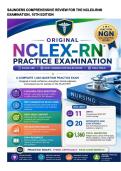
SAUNDERS COMPREHENSIVE REVIEW FOR THE NCLEX-RN®
EXAMINATION, 10TH EDITION
,TABLE OF CONTENTS
Unit Content Area Question Range Total Questions
Unit 1 Examination Strategies, Prioritization & Clinical Judgment 1–80 80
Unit 2 Professional Standards in Nursing 81–160 80
Unit 3 Foundations of Care 161–310 150
Unit 4 Growth & Development Across the Life Span 311–410 100
Unit 5 Maternity Nursing 411–460 50
Unit 6 Pediatric Nursing 461–610 150
Unit 7 Mental Health Nursing 611–710 100
Unit 8 Adult Medical-Surgical Nursing 711–960 250
Unit 9 Pharmacology & IV Therapy 961–1110 150
Unit 10 Leadership, Management & Prioritization 1111–1260 150
Unit 11 Integrated NGN Clinical Judgment Case Studies 1261–1360 100
UNIT 11: INTEGRATED NGN CLINICAL JUDGMENT CASE STUDIES
Case Study Clinical Scenario Question Range
Case Study 1 Acute Heart Failure Exacerbation 1261–1265
Case Study 2 Sepsis With Progressive Shock 1266–1270
Case Study 3 Diabetic Ketoacidosis 1271–1275
Case Study 4 Acute Ischemic Stroke 1276–1280
Case Study 5 Postoperative Pulmonary Embolism 1281–1285
Case Study 6 Upper Gastrointestinal Hemorrhage 1286–1290
Case Study 7 Severe Asthma Exacerbation 1291–1295
Case Study 8 Hyperkalemia in Acute Kidney Injury 1296–1300
Case Study 9 Postpartum Hemorrhage 1301–1305
,Case Study Clinical Scenario Question Range
Case Study 10 Pediatric Dehydration 1306–1310
Case Study 11 Acute Coronary Syndrome 1311–1315
Case Study 12 Bacterial Meningitis 1316–1320
Case Study 13 Severe Preeclampsia and Possible HELLP Syndrome 1321–1325
Case Study 14 Opioid Overdose 1326–1330
Case Study 15 Small-Bowel Obstruction 1331–1335
Case Study 16 Acute Ischemic Stroke With Thrombolytic Consideration 1336–1340
Case Study 17 Acute Pancreatitis With Systemic Complications 1341–1345
Case Study 18 Lithium Toxicity 1346–1350
Case Study 19 Sickle Cell Vaso-Occlusive Crisis 1351–1355
Case Study 20 Myasthenic Crisis 1356–1360
EXAM SUMMARY
Total Units: 11
Total Integrated NGN Case Studies: 20
Total Questions: 1,360
Question Types: Multiple Choice, Select All That Apply, Priority, Delegation, Clinical Judgment and
Unfolding NGN Case Studies
Original NCLEX-RN® Practice Examination
Unit 1: Examination Strategies, Prioritization & Clinical Judgment
Question 1
During morning rounds, the nurse finds a client 6 hours after abdominal surgery who is restless, breathing
rapidly, and has an oxygen saturation of 86% on room air. Which action should the nurse take first?
A. Review the client’s latest hemoglobin result.
B. Assist the client to sit upright and apply supplemental oxygen.
,C. Notify the surgeon about the change in condition.
D. Administer the prescribed opioid analgesic.
Correct Answer: B
Rationale:
The client is demonstrating acute hypoxemia. Positioning the client upright and applying oxygen are immediate
independent nursing interventions that support breathing and reduce the risk of further deterioration.
Why the other options are less appropriate:
• A: Laboratory review may be useful, but it does not correct the immediate oxygenation problem.
• C: The surgeon should be notified after emergency supportive measures begin.
• D: An opioid may worsen respiratory depression.
Clinical Pearl:
When a client is hypoxemic, support oxygenation before investigating the underlying cause.
NCLEX High-Yield Tip:
Do not automatically choose “notify the provider” when the nurse can first perform a safe, immediate
intervention.
Question 2
A graduate nurse is answering a priority question involving four clients. Which client should be assessed
first?
A. A client with chronic obstructive pulmonary disease whose oxygen saturation is 90% on 2 L/min nasal
cannula.
B. A client with diabetes who reports tingling in both feet.
C. A client receiving a blood transfusion who suddenly develops chills and lower back pain.
D. A client with osteoarthritis requesting assistance to the bathroom.
Correct Answer: C
Rationale:
Chills and lower back pain during a blood transfusion suggest an acute transfusion reaction. The nurse must
stop the transfusion immediately and assess the client because the reaction may rapidly become life-
threatening.
Why the other options are less appropriate:
• A: An oxygen saturation of 90% may be expected for some clients with chronic lung disease.
• B: Tingling suggests chronic neuropathy and is not the most urgent finding.
• D: Assistance is needed, but the transfusion reaction takes priority.
, Clinical Pearl:
A new symptom during transfusion should be treated as a reaction until proven otherwise.
NCLEX High-Yield Tip:
Unexpected changes during medication or blood-product administration require immediate action.
Question 3
While reviewing an NCLEX-style question, a student notices that the stem asks for the nurse’s initial action.
Which approach is most appropriate?
A. Choose the intervention that collects essential information before treatment when the client is stable.
B. Select the action that requires collaboration with the healthcare provider.
C. Pick the option that provides the most extensive long-term benefit.
D. Choose the intervention that includes the greatest number of nursing tasks.
Correct Answer: A
Rationale:
When a client is stable and no immediate threat is present, assessment generally precedes intervention. The
nurse should gather relevant information before making a clinical decision.
Why the other options are less appropriate:
• B: Collaboration may be necessary later, but the nurse should first complete appropriate assessment.
• C: Long-term benefit does not determine the initial action.
• D: The number of tasks does not indicate priority.
Clinical Pearl:
Assessment comes first unless delay would place the client at risk.
NCLEX High-Yield Tip:
Ask: “Is the client stable enough to assess, or unstable enough to intervene immediately?”
Question 4
A client admitted with bacterial meningitis is placed on droplet precautions. Which action by the nurse
requires correction?
A. Wearing a surgical mask when entering the room.
B. Placing the client in a private room when available.
C. Removing the mask after leaving the client’s room.
D. Wearing an N95 respirator for every interaction with the client.
Correct Answer: D
, Rationale:
Bacterial meningitis generally requires droplet precautions, for which a surgical mask is appropriate. An N95
respirator is used for airborne precautions, such as tuberculosis, measles, or varicella.
Why the other options are less appropriate:
• A: A surgical mask is appropriate for droplet precautions.
• B: A private room is preferred.
• C: Personal protective equipment should be removed after leaving the room according to facility
procedure.
Clinical Pearl:
Droplet particles travel short distances and require a surgical mask, not an N95 respirator.
NCLEX High-Yield Tip:
Remember airborne precautions with the mnemonic MTV: measles, tuberculosis, and varicella.
Question 5
At the beginning of the shift, which task is most appropriate for the registered nurse to delegate to an
experienced unlicensed assistive personnel?
A. Reinforcing teaching about incentive spirometry.
B. Obtaining routine vital signs for a stable postoperative client.
C. Assessing pain 30 minutes after opioid administration.
D. Evaluating a client’s ability to swallow after a stroke.
Correct Answer: B
Rationale:
Routine vital-sign measurement for a stable client is within the role of trained unlicensed assistive personnel.
The RN remains responsible for interpreting and acting on abnormal findings.
Why the other options are less appropriate:
• A: Teaching and reinforcement require nursing judgment and are usually assigned to licensed
personnel.
• C: Evaluating medication effectiveness is an RN responsibility.
• D: Swallowing assessment requires clinical judgment because aspiration risk is present.
Clinical Pearl:
Delegate tasks, not nursing judgment.
NCLEX High-Yield Tip:
Unlicensed personnel may collect data, but the RN interprets the data.
Question 6
, Shortly after receiving the first dose of an intravenous antibiotic, a client develops wheezing, facial
swelling, and hypotension. Which prescription should the nurse implement first?
A. Administer intramuscular epinephrine.
B. Give oral diphenhydramine.
C. Obtain a 12-lead electrocardiogram.
D. Collect blood for a complete blood count.
Correct Answer: A
Rationale:
The findings indicate anaphylaxis. Epinephrine is the priority medication because it promotes bronchodilation,
supports blood pressure, and reduces airway swelling.
Why the other options are less appropriate:
• B: Diphenhydramine may be used as an adjunct but acts too slowly to replace epinephrine.
• C: Cardiac monitoring may be needed, but it should not delay emergency treatment.
• D: Laboratory testing does not stabilize the airway or circulation.
Clinical Pearl:
Epinephrine is the first-line treatment for anaphylaxis.
NCLEX High-Yield Tip:
When airway swelling and hypotension occur together, think anaphylaxis and act immediately.
Question 7
A pediatric nurse is caring for four children. Which child requires immediate assessment?
A. A child with gastroenteritis who has dry lips and urine output of 1 mL/kg/hr.
B. A child with asthma who is suddenly quiet and has diminished breath sounds.
C. A child with otitis media who is crying and pulling at one ear.
D. A child with a fractured arm who reports pain rated 6/10.
Correct Answer: B
Rationale:
A suddenly quiet child with asthma and diminished breath sounds may have severely reduced airflow and
impending respiratory failure. The absence of wheezing can indicate worsening obstruction rather than
improvement.
Why the other options are less appropriate:
• A: The urine output is acceptable, although hydration should continue to be monitored.
• C: Ear pain is uncomfortable but not life-threatening.
• D: Pain requires treatment, but respiratory compromise takes priority.
, Clinical Pearl:
A “silent chest” in severe asthma is an ominous finding.
NCLEX High-Yield Tip:
Do not assume fewer breath sounds or less wheezing means the client is improving.
Question 8
During labor, the fetal heart rate decreases to 80 beats/min immediately after rupture of membranes.
What should the nurse do first?
A. Document the fetal heart rate pattern.
B. Perform a vaginal examination for possible cord prolapse.
C. Increase the oxytocin infusion rate.
D. Encourage the client to begin pushing.
Correct Answer: B
Rationale:
Sudden fetal bradycardia after rupture of membranes may indicate umbilical cord prolapse. A vaginal
examination should be performed immediately to assess for the cord and guide emergency intervention.
Why the other options are less appropriate:
• A: Documentation should not delay assessment of a fetal emergency.
• C: Oxytocin may worsen fetal compromise by increasing contractions.
• D: Pushing may further compress a prolapsed cord.
Clinical Pearl:
Fetal bradycardia after membrane rupture should raise immediate concern for cord prolapse.
NCLEX High-Yield Tip:
When the fetal heart rate changes suddenly, identify and correct reversible causes rapidly.
Question 9
A client with schizophrenia says, “The television is sending secret instructions directly to me.” Which
response by the nurse is most therapeutic?
A. “That is impossible because televisions cannot communicate personally.”
B. “What instructions is the television giving you?”
C. “I do not hear the television sending messages, but I understand that this feels real to you.”
D. “Try not to focus on the television, and the messages will eventually stop.”
Correct Answer: C
, Rationale:
This response presents reality without arguing and acknowledges the client’s emotional experience. It
supports trust while avoiding reinforcement of the delusion.
Why the other options are less appropriate:
• A: Direct confrontation may increase defensiveness.
• B: Asking for details may unintentionally reinforce the delusion.
• D: Telling the client to ignore the experience minimizes distress.
Clinical Pearl:
Acknowledge the feeling, present reality, and avoid validating false beliefs.
NCLEX High-Yield Tip:
Therapeutic communication does not argue, criticize, or reinforce delusions.
Question 10
Near the end of the shift, the nurse receives four new laboratory results. Which result should be reported
immediately?
A. Sodium level of 133 mEq/L in a client receiving diuretics.
B. Platelet count of 145,000/mm³ in a client with a viral infection.
C. Potassium level of 6.4 mEq/L in a client with kidney failure.
D. Hemoglobin level of 10.8 g/dL in a client with chronic anemia.
Correct Answer: C
Rationale:
Severe hyperkalemia can cause fatal cardiac dysrhythmias and requires immediate intervention. The nurse
should assess the client, review the cardiac rhythm, and notify the appropriate provider promptly.
Why the other options are less appropriate:
• A: Mild hyponatremia requires monitoring but is not the most urgent result.
• B: This platelet count is only slightly below or near the lower reference range.
• D: Mild chronic anemia is generally not immediately life-threatening.
Clinical Pearl:
Potassium abnormalities are especially dangerous because of their effect on cardiac conduction.
NCLEX High-Yield Tip:
Critical electrolyte abnormalities, especially potassium changes, often outrank stable chronic findings.
Question 11
, A nurse receives shift report on four clients assigned to the unit. Which client should the nurse evaluate
immediately?
A. A client with chronic kidney disease whose potassium level increased from 4.8 to 5.3 mEq/L overnight.
B. A client recovering from pneumonia who requests assistance to ambulate for the first time today.
C. A client with heart failure who reports mild ankle swelling after sitting in a chair.
D. A client with chronic obstructive pulmonary disease who becomes increasingly drowsy and is difficult to
arouse.
Correct Answer: D
Rationale:
A client with COPD who develops increasing drowsiness may be experiencing carbon dioxide retention and
impending respiratory failure. Altered mental status is a late and serious sign requiring immediate assessment.
Why the other options are less appropriate:
• A: The potassium is elevated but not the most immediately life-threatening finding.
• B: Ambulation can safely be delayed.
• C: Mild dependent edema is expected in many clients with heart failure and is less urgent.
Clinical Pearl:
In clients with chronic lung disease, a declining level of consciousness may indicate worsening hypercapnia.
NCLEX High-Yield Tip:
Changes in mental status often signal deterioration before complete respiratory collapse.
Question 12
Moments after a blood transfusion begins, a client suddenly reports severe lower back pain, chills, and
chest tightness. Which nursing intervention should occur first?
A. Discontinue the transfusion immediately while maintaining IV access with normal saline using new tubing.
B. Administer the prescribed antihistamine.
C. Send a blood sample to the laboratory.
D. Notify the healthcare provider.
Correct Answer: A
Rationale:
These findings suggest an acute hemolytic transfusion reaction. The nurse's first responsibility is to stop the
transfusion immediately to prevent further exposure while maintaining IV access.
EXAMINATION, 10TH EDITION
,TABLE OF CONTENTS
Unit Content Area Question Range Total Questions
Unit 1 Examination Strategies, Prioritization & Clinical Judgment 1–80 80
Unit 2 Professional Standards in Nursing 81–160 80
Unit 3 Foundations of Care 161–310 150
Unit 4 Growth & Development Across the Life Span 311–410 100
Unit 5 Maternity Nursing 411–460 50
Unit 6 Pediatric Nursing 461–610 150
Unit 7 Mental Health Nursing 611–710 100
Unit 8 Adult Medical-Surgical Nursing 711–960 250
Unit 9 Pharmacology & IV Therapy 961–1110 150
Unit 10 Leadership, Management & Prioritization 1111–1260 150
Unit 11 Integrated NGN Clinical Judgment Case Studies 1261–1360 100
UNIT 11: INTEGRATED NGN CLINICAL JUDGMENT CASE STUDIES
Case Study Clinical Scenario Question Range
Case Study 1 Acute Heart Failure Exacerbation 1261–1265
Case Study 2 Sepsis With Progressive Shock 1266–1270
Case Study 3 Diabetic Ketoacidosis 1271–1275
Case Study 4 Acute Ischemic Stroke 1276–1280
Case Study 5 Postoperative Pulmonary Embolism 1281–1285
Case Study 6 Upper Gastrointestinal Hemorrhage 1286–1290
Case Study 7 Severe Asthma Exacerbation 1291–1295
Case Study 8 Hyperkalemia in Acute Kidney Injury 1296–1300
Case Study 9 Postpartum Hemorrhage 1301–1305
,Case Study Clinical Scenario Question Range
Case Study 10 Pediatric Dehydration 1306–1310
Case Study 11 Acute Coronary Syndrome 1311–1315
Case Study 12 Bacterial Meningitis 1316–1320
Case Study 13 Severe Preeclampsia and Possible HELLP Syndrome 1321–1325
Case Study 14 Opioid Overdose 1326–1330
Case Study 15 Small-Bowel Obstruction 1331–1335
Case Study 16 Acute Ischemic Stroke With Thrombolytic Consideration 1336–1340
Case Study 17 Acute Pancreatitis With Systemic Complications 1341–1345
Case Study 18 Lithium Toxicity 1346–1350
Case Study 19 Sickle Cell Vaso-Occlusive Crisis 1351–1355
Case Study 20 Myasthenic Crisis 1356–1360
EXAM SUMMARY
Total Units: 11
Total Integrated NGN Case Studies: 20
Total Questions: 1,360
Question Types: Multiple Choice, Select All That Apply, Priority, Delegation, Clinical Judgment and
Unfolding NGN Case Studies
Original NCLEX-RN® Practice Examination
Unit 1: Examination Strategies, Prioritization & Clinical Judgment
Question 1
During morning rounds, the nurse finds a client 6 hours after abdominal surgery who is restless, breathing
rapidly, and has an oxygen saturation of 86% on room air. Which action should the nurse take first?
A. Review the client’s latest hemoglobin result.
B. Assist the client to sit upright and apply supplemental oxygen.
,C. Notify the surgeon about the change in condition.
D. Administer the prescribed opioid analgesic.
Correct Answer: B
Rationale:
The client is demonstrating acute hypoxemia. Positioning the client upright and applying oxygen are immediate
independent nursing interventions that support breathing and reduce the risk of further deterioration.
Why the other options are less appropriate:
• A: Laboratory review may be useful, but it does not correct the immediate oxygenation problem.
• C: The surgeon should be notified after emergency supportive measures begin.
• D: An opioid may worsen respiratory depression.
Clinical Pearl:
When a client is hypoxemic, support oxygenation before investigating the underlying cause.
NCLEX High-Yield Tip:
Do not automatically choose “notify the provider” when the nurse can first perform a safe, immediate
intervention.
Question 2
A graduate nurse is answering a priority question involving four clients. Which client should be assessed
first?
A. A client with chronic obstructive pulmonary disease whose oxygen saturation is 90% on 2 L/min nasal
cannula.
B. A client with diabetes who reports tingling in both feet.
C. A client receiving a blood transfusion who suddenly develops chills and lower back pain.
D. A client with osteoarthritis requesting assistance to the bathroom.
Correct Answer: C
Rationale:
Chills and lower back pain during a blood transfusion suggest an acute transfusion reaction. The nurse must
stop the transfusion immediately and assess the client because the reaction may rapidly become life-
threatening.
Why the other options are less appropriate:
• A: An oxygen saturation of 90% may be expected for some clients with chronic lung disease.
• B: Tingling suggests chronic neuropathy and is not the most urgent finding.
• D: Assistance is needed, but the transfusion reaction takes priority.
, Clinical Pearl:
A new symptom during transfusion should be treated as a reaction until proven otherwise.
NCLEX High-Yield Tip:
Unexpected changes during medication or blood-product administration require immediate action.
Question 3
While reviewing an NCLEX-style question, a student notices that the stem asks for the nurse’s initial action.
Which approach is most appropriate?
A. Choose the intervention that collects essential information before treatment when the client is stable.
B. Select the action that requires collaboration with the healthcare provider.
C. Pick the option that provides the most extensive long-term benefit.
D. Choose the intervention that includes the greatest number of nursing tasks.
Correct Answer: A
Rationale:
When a client is stable and no immediate threat is present, assessment generally precedes intervention. The
nurse should gather relevant information before making a clinical decision.
Why the other options are less appropriate:
• B: Collaboration may be necessary later, but the nurse should first complete appropriate assessment.
• C: Long-term benefit does not determine the initial action.
• D: The number of tasks does not indicate priority.
Clinical Pearl:
Assessment comes first unless delay would place the client at risk.
NCLEX High-Yield Tip:
Ask: “Is the client stable enough to assess, or unstable enough to intervene immediately?”
Question 4
A client admitted with bacterial meningitis is placed on droplet precautions. Which action by the nurse
requires correction?
A. Wearing a surgical mask when entering the room.
B. Placing the client in a private room when available.
C. Removing the mask after leaving the client’s room.
D. Wearing an N95 respirator for every interaction with the client.
Correct Answer: D
, Rationale:
Bacterial meningitis generally requires droplet precautions, for which a surgical mask is appropriate. An N95
respirator is used for airborne precautions, such as tuberculosis, measles, or varicella.
Why the other options are less appropriate:
• A: A surgical mask is appropriate for droplet precautions.
• B: A private room is preferred.
• C: Personal protective equipment should be removed after leaving the room according to facility
procedure.
Clinical Pearl:
Droplet particles travel short distances and require a surgical mask, not an N95 respirator.
NCLEX High-Yield Tip:
Remember airborne precautions with the mnemonic MTV: measles, tuberculosis, and varicella.
Question 5
At the beginning of the shift, which task is most appropriate for the registered nurse to delegate to an
experienced unlicensed assistive personnel?
A. Reinforcing teaching about incentive spirometry.
B. Obtaining routine vital signs for a stable postoperative client.
C. Assessing pain 30 minutes after opioid administration.
D. Evaluating a client’s ability to swallow after a stroke.
Correct Answer: B
Rationale:
Routine vital-sign measurement for a stable client is within the role of trained unlicensed assistive personnel.
The RN remains responsible for interpreting and acting on abnormal findings.
Why the other options are less appropriate:
• A: Teaching and reinforcement require nursing judgment and are usually assigned to licensed
personnel.
• C: Evaluating medication effectiveness is an RN responsibility.
• D: Swallowing assessment requires clinical judgment because aspiration risk is present.
Clinical Pearl:
Delegate tasks, not nursing judgment.
NCLEX High-Yield Tip:
Unlicensed personnel may collect data, but the RN interprets the data.
Question 6
, Shortly after receiving the first dose of an intravenous antibiotic, a client develops wheezing, facial
swelling, and hypotension. Which prescription should the nurse implement first?
A. Administer intramuscular epinephrine.
B. Give oral diphenhydramine.
C. Obtain a 12-lead electrocardiogram.
D. Collect blood for a complete blood count.
Correct Answer: A
Rationale:
The findings indicate anaphylaxis. Epinephrine is the priority medication because it promotes bronchodilation,
supports blood pressure, and reduces airway swelling.
Why the other options are less appropriate:
• B: Diphenhydramine may be used as an adjunct but acts too slowly to replace epinephrine.
• C: Cardiac monitoring may be needed, but it should not delay emergency treatment.
• D: Laboratory testing does not stabilize the airway or circulation.
Clinical Pearl:
Epinephrine is the first-line treatment for anaphylaxis.
NCLEX High-Yield Tip:
When airway swelling and hypotension occur together, think anaphylaxis and act immediately.
Question 7
A pediatric nurse is caring for four children. Which child requires immediate assessment?
A. A child with gastroenteritis who has dry lips and urine output of 1 mL/kg/hr.
B. A child with asthma who is suddenly quiet and has diminished breath sounds.
C. A child with otitis media who is crying and pulling at one ear.
D. A child with a fractured arm who reports pain rated 6/10.
Correct Answer: B
Rationale:
A suddenly quiet child with asthma and diminished breath sounds may have severely reduced airflow and
impending respiratory failure. The absence of wheezing can indicate worsening obstruction rather than
improvement.
Why the other options are less appropriate:
• A: The urine output is acceptable, although hydration should continue to be monitored.
• C: Ear pain is uncomfortable but not life-threatening.
• D: Pain requires treatment, but respiratory compromise takes priority.
, Clinical Pearl:
A “silent chest” in severe asthma is an ominous finding.
NCLEX High-Yield Tip:
Do not assume fewer breath sounds or less wheezing means the client is improving.
Question 8
During labor, the fetal heart rate decreases to 80 beats/min immediately after rupture of membranes.
What should the nurse do first?
A. Document the fetal heart rate pattern.
B. Perform a vaginal examination for possible cord prolapse.
C. Increase the oxytocin infusion rate.
D. Encourage the client to begin pushing.
Correct Answer: B
Rationale:
Sudden fetal bradycardia after rupture of membranes may indicate umbilical cord prolapse. A vaginal
examination should be performed immediately to assess for the cord and guide emergency intervention.
Why the other options are less appropriate:
• A: Documentation should not delay assessment of a fetal emergency.
• C: Oxytocin may worsen fetal compromise by increasing contractions.
• D: Pushing may further compress a prolapsed cord.
Clinical Pearl:
Fetal bradycardia after membrane rupture should raise immediate concern for cord prolapse.
NCLEX High-Yield Tip:
When the fetal heart rate changes suddenly, identify and correct reversible causes rapidly.
Question 9
A client with schizophrenia says, “The television is sending secret instructions directly to me.” Which
response by the nurse is most therapeutic?
A. “That is impossible because televisions cannot communicate personally.”
B. “What instructions is the television giving you?”
C. “I do not hear the television sending messages, but I understand that this feels real to you.”
D. “Try not to focus on the television, and the messages will eventually stop.”
Correct Answer: C
, Rationale:
This response presents reality without arguing and acknowledges the client’s emotional experience. It
supports trust while avoiding reinforcement of the delusion.
Why the other options are less appropriate:
• A: Direct confrontation may increase defensiveness.
• B: Asking for details may unintentionally reinforce the delusion.
• D: Telling the client to ignore the experience minimizes distress.
Clinical Pearl:
Acknowledge the feeling, present reality, and avoid validating false beliefs.
NCLEX High-Yield Tip:
Therapeutic communication does not argue, criticize, or reinforce delusions.
Question 10
Near the end of the shift, the nurse receives four new laboratory results. Which result should be reported
immediately?
A. Sodium level of 133 mEq/L in a client receiving diuretics.
B. Platelet count of 145,000/mm³ in a client with a viral infection.
C. Potassium level of 6.4 mEq/L in a client with kidney failure.
D. Hemoglobin level of 10.8 g/dL in a client with chronic anemia.
Correct Answer: C
Rationale:
Severe hyperkalemia can cause fatal cardiac dysrhythmias and requires immediate intervention. The nurse
should assess the client, review the cardiac rhythm, and notify the appropriate provider promptly.
Why the other options are less appropriate:
• A: Mild hyponatremia requires monitoring but is not the most urgent result.
• B: This platelet count is only slightly below or near the lower reference range.
• D: Mild chronic anemia is generally not immediately life-threatening.
Clinical Pearl:
Potassium abnormalities are especially dangerous because of their effect on cardiac conduction.
NCLEX High-Yield Tip:
Critical electrolyte abnormalities, especially potassium changes, often outrank stable chronic findings.
Question 11
, A nurse receives shift report on four clients assigned to the unit. Which client should the nurse evaluate
immediately?
A. A client with chronic kidney disease whose potassium level increased from 4.8 to 5.3 mEq/L overnight.
B. A client recovering from pneumonia who requests assistance to ambulate for the first time today.
C. A client with heart failure who reports mild ankle swelling after sitting in a chair.
D. A client with chronic obstructive pulmonary disease who becomes increasingly drowsy and is difficult to
arouse.
Correct Answer: D
Rationale:
A client with COPD who develops increasing drowsiness may be experiencing carbon dioxide retention and
impending respiratory failure. Altered mental status is a late and serious sign requiring immediate assessment.
Why the other options are less appropriate:
• A: The potassium is elevated but not the most immediately life-threatening finding.
• B: Ambulation can safely be delayed.
• C: Mild dependent edema is expected in many clients with heart failure and is less urgent.
Clinical Pearl:
In clients with chronic lung disease, a declining level of consciousness may indicate worsening hypercapnia.
NCLEX High-Yield Tip:
Changes in mental status often signal deterioration before complete respiratory collapse.
Question 12
Moments after a blood transfusion begins, a client suddenly reports severe lower back pain, chills, and
chest tightness. Which nursing intervention should occur first?
A. Discontinue the transfusion immediately while maintaining IV access with normal saline using new tubing.
B. Administer the prescribed antihistamine.
C. Send a blood sample to the laboratory.
D. Notify the healthcare provider.
Correct Answer: A
Rationale:
These findings suggest an acute hemolytic transfusion reaction. The nurse's first responsibility is to stop the
transfusion immediately to prevent further exposure while maintaining IV access.