

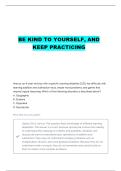
Marcus, an 8-year-old boy with a specific learning disability (SLD), has difficulty with
learning addition and subtraction facts, simple word problems, and games that
require logical reasoning. Which of the following disorders is described above?
A. Dysgraphia
B. Dyslexia
C. Dyspraxia
D. Dyscalculia
Give this one a try later!
Option (D) is correct. This question tests knowledge of different learning
disabilities. This answer is correct because dyscalculia involves the inability
to understand the meaning of numbers and quantities. Students with
dyscalculia cannot understand basic operations of addition and
subtraction. They may not understand complex problems such as
multiplication, division, and more abstract problems. Because they do not
understand math concepts, they do not remember and cannot build on
them to master more complex problems.
,Which of the following are characteristics commonly exhibited by students who have
acquired a traumatic brain injury (TBI)?
Select all that apply.
A. Pronounced inconsistencies in performance
B. Responsiveness to incentive-based behavioral plans
C. Inappropriate responses in social situations
D. Deficits in problem solving and abstract thinking
Give this one a try later!
Options (A), (C), and (D) are correct. Children who sustain TBI may
experience a complex array of problems, including the following:
pronounced inconsistencies in performance, inappropriate responses in
social situations, and deficits in problem solving and abstract thinking.
A history class in the resource room is studying ancient Egypt. The students are
building pyramids and rectangles out of gelatin blocks to investigate which shape is
stronger. Which of the following intelligences does the lesson address?
A.Auditory-musical
B.Visual-spatial
C.Intrapersonal
D.Naturalist
Give this one a try later!
Correct Answer: B
Option (B) is correct. The question addresses understanding of teaching
strategies using Howard Gardner's theory of multiple intelligences. Building
models out of gelatin blocks stimulates spatial intelligence.
,Which of the following will best motivate a student with a specific learning disability
(SLD) in an inclusive eighth-grade history class in which students are beginning to
learn about the Second World War?
A.Showing Hawaii on a map and pictures from the events at Pearl Harbor
B.Asking students to summarize the events from the Second World War
C.Assigning students to identify key terminology that was used at Pearl Harbor
D.Having students construct a timeline for the Second World War
Give this one a try later!
Option (A) is correct. The question addresses elements of a lesson plan.
Activating prior knowledge motivates students with a specific learning
disability (SLD) and encourages their interest in the lesson.
Jill is a four-year-old child. Her mother has taught her how to brush her hair. Today, her
mother gave her a new brush and told Jill it was for her hair. Jill immediately began to
brush her hair.Jill's action is best described as an
A. accommodation
B. appropriation
C. assimilation
D. initiation
Give this one a try later!
Option (C) is correct. Assimilation takes new information or experiences
and incorporates them into our existing ideas.
Sarah, a third-grade student, has been arguing with her teacher and occasionally
throwing objects at her classmates. Sarah's teacher talks to her to find out the cause of
such behavior in order to help her develop self-control and plan for more
appropriate behaviors in the class.
, Question:Which of the following models would best reflect on this technique to
manage student behavior?
A. Ecological model
B. Biological model
C. Psychoeducational model
D. Humanistic model
Give this one a try later!
Option (C) is correct. The psychoeducational model focuses on how
teachers must understand the causes of negative behavior and how to help
the student acquire self-control through reflection and planning.
Randi is a 12 year old who scores within the average range for her age on a
standardized test but is significantly below grade level in reading and writing and is at
grade level in math. The profile is most consistent with a classification of
A.intellectual disability
B.specific learning disability
C.attention-deficit/hyperactivity disorder
D.autism spectrum disorder
Give this one a try later!
Correct Answer: B
Option (B) is correct. The question tests knowledge of the characteristics of
and the process of identifying disability categories. A discrepancy between
ability and achievement is one of the primary characteristics of a student
with a specific learning disability.
David is a fourth-grade student with a specific learning disability in reading. David has
just completed a set of reading assessments, and his scores indicate that he is reading
at an end-of-first-grade level. He demonstrates strengths in comprehension skills and
uses context clues to help him decode text. His reading fluency is determined to be
learning addition and subtraction facts, simple word problems, and games that
require logical reasoning. Which of the following disorders is described above?
A. Dysgraphia
B. Dyslexia
C. Dyspraxia
D. Dyscalculia
Give this one a try later!
Option (D) is correct. This question tests knowledge of different learning
disabilities. This answer is correct because dyscalculia involves the inability
to understand the meaning of numbers and quantities. Students with
dyscalculia cannot understand basic operations of addition and
subtraction. They may not understand complex problems such as
multiplication, division, and more abstract problems. Because they do not
understand math concepts, they do not remember and cannot build on
them to master more complex problems.
,Which of the following are characteristics commonly exhibited by students who have
acquired a traumatic brain injury (TBI)?
Select all that apply.
A. Pronounced inconsistencies in performance
B. Responsiveness to incentive-based behavioral plans
C. Inappropriate responses in social situations
D. Deficits in problem solving and abstract thinking
Give this one a try later!
Options (A), (C), and (D) are correct. Children who sustain TBI may
experience a complex array of problems, including the following:
pronounced inconsistencies in performance, inappropriate responses in
social situations, and deficits in problem solving and abstract thinking.
A history class in the resource room is studying ancient Egypt. The students are
building pyramids and rectangles out of gelatin blocks to investigate which shape is
stronger. Which of the following intelligences does the lesson address?
A.Auditory-musical
B.Visual-spatial
C.Intrapersonal
D.Naturalist
Give this one a try later!
Correct Answer: B
Option (B) is correct. The question addresses understanding of teaching
strategies using Howard Gardner's theory of multiple intelligences. Building
models out of gelatin blocks stimulates spatial intelligence.
,Which of the following will best motivate a student with a specific learning disability
(SLD) in an inclusive eighth-grade history class in which students are beginning to
learn about the Second World War?
A.Showing Hawaii on a map and pictures from the events at Pearl Harbor
B.Asking students to summarize the events from the Second World War
C.Assigning students to identify key terminology that was used at Pearl Harbor
D.Having students construct a timeline for the Second World War
Give this one a try later!
Option (A) is correct. The question addresses elements of a lesson plan.
Activating prior knowledge motivates students with a specific learning
disability (SLD) and encourages their interest in the lesson.
Jill is a four-year-old child. Her mother has taught her how to brush her hair. Today, her
mother gave her a new brush and told Jill it was for her hair. Jill immediately began to
brush her hair.Jill's action is best described as an
A. accommodation
B. appropriation
C. assimilation
D. initiation
Give this one a try later!
Option (C) is correct. Assimilation takes new information or experiences
and incorporates them into our existing ideas.
Sarah, a third-grade student, has been arguing with her teacher and occasionally
throwing objects at her classmates. Sarah's teacher talks to her to find out the cause of
such behavior in order to help her develop self-control and plan for more
appropriate behaviors in the class.
, Question:Which of the following models would best reflect on this technique to
manage student behavior?
A. Ecological model
B. Biological model
C. Psychoeducational model
D. Humanistic model
Give this one a try later!
Option (C) is correct. The psychoeducational model focuses on how
teachers must understand the causes of negative behavior and how to help
the student acquire self-control through reflection and planning.
Randi is a 12 year old who scores within the average range for her age on a
standardized test but is significantly below grade level in reading and writing and is at
grade level in math. The profile is most consistent with a classification of
A.intellectual disability
B.specific learning disability
C.attention-deficit/hyperactivity disorder
D.autism spectrum disorder
Give this one a try later!
Correct Answer: B
Option (B) is correct. The question tests knowledge of the characteristics of
and the process of identifying disability categories. A discrepancy between
ability and achievement is one of the primary characteristics of a student
with a specific learning disability.
David is a fourth-grade student with a specific learning disability in reading. David has
just completed a set of reading assessments, and his scores indicate that he is reading
at an end-of-first-grade level. He demonstrates strengths in comprehension skills and
uses context clues to help him decode text. His reading fluency is determined to be


