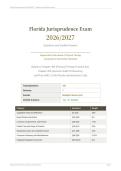
Florida Jurisprudence Exam 2026/2027 - Questions and Verified Answers
Florida Jurisprudence Exam
2026/2027
Questions and Verified Answers
Aligned with Florida Board of Physical Therapy
Jurisprudence Examination Standards
Based on Chapter 486 (Physical Therapy Practice Act),
Chapter 456 (General Health Professions),
and Rule 64B17 of the Florida Administrative Code
Total Questions: 100
Sections: 7
Format: Multiple Choice (A-D)
Verified Answers: Yes - A+ Graded
Category Questions Weight
Legislative Intent and Definitions Q1-Q25 25%
Board Powers and Duties Q26-Q35 5%
Licensure, Endorsement, and Permits Q36-Q45 7.5%
Patient Care and Scope of Practice Q46-Q70 35%
Disciplinary Action and Unlawful Practice Q71-Q85 15%
Consumer Advocacy and Miscellaneous Q86-Q95 12.5%
Integrated Regulatory Scenarios Q96-Q100 N/A
Florida Board of Physical Therapy Laws and Rules Page 1
,Florida Jurisprudence Exam 2026/2027 - Questions and Verified Answers
Section 1: Legislative Intent and Definitions (Q1-Q25)
Q1: According to Chapter 486 of the Florida Statutes, what is the sole purpose in enacting the Physical Therapy
Practice Act?
A. To protect the economic interests of licensed physical therapists in Florida
B. To ensure every physical therapy practitioner in Florida meets minimum requirements for safe practice
[CORRECT]
C. To establish a competitive marketplace for physical therapy services across the state
D. To create a regulatory framework that limits the number of physical therapy licenses issued annually
Correct Answer: B
Rationale: The sole purpose in enacting Chapter 486 is to ensure every physical therapy practitioner in Florida meets
minimum requirements for safe practice. Practitioners who fall below minimum competency or present a danger to the public
shall be prohibited from practicing in this state per s. 486.011. Options A, C, and D are incorrect because the Act does not
address economic interests, market competition, or numerical limitations on licensure.
Q2: How does Chapter 486 treat the terms "physical therapy" and "physiotherapy"?
A. The terms are distinct; "physiotherapy" refers only to electrotherapeutic modalities
B. The terms are deemed identical and interchangeable with each other [CORRECT]
C. "Physical therapy" is the broader term encompassing "physiotherapy" as a subset
D. "Physiotherapy" is the preferred legal term; "physical therapy" is colloquial only
Correct Answer: B
Rationale: Under Chapter 486, Florida Statutes, the terms "physical therapy" and "physiotherapy" are deemed identical and
interchangeable with each other. This statutory equivalence means either term carries the same legal weight. Options A, C,
and D incorrectly suggest a hierarchical or distinct relationship between the two terms.
Q3: Which of the following best defines a "Physical Therapist" under Florida law?
A. Any person who performs therapeutic exercises on patients regardless of licensure status
B. A person who has completed a physical therapy program and works under physician supervision
C. A person who is licensed and who practices physical therapy in accordance with Chapter 486
[CORRECT]
D. A healthcare professional who holds a doctoral degree in physical therapy from any accredited institution
Correct Answer: C
Rationale: Under Chapter 486, a "Physical Therapist" is defined as a person who is licensed and who practices physical
therapy in accordance with Chapter 486. The key elements are active licensure and compliance with the statutory framework.
Option A omits licensure; Option B omits the licensure requirement; Option D incorrectly implies that a degree alone suffices
without licensure.
Q4: What is the definition of a "Physical Therapist Assistant" under Florida law?
A. A person licensed to perform patient-related activities independently in any practice setting
B. An unlicensed individual who assists a physical therapist with administrative and clerical duties
C. A person licensed to perform patient-related activities under the direction of a physical therapist,
whose license is in good standing [CORRECT]
D. A student currently enrolled in an accredited physical therapist assistant education program
Correct Answer: C
Rationale: A Physical Therapist Assistant (PTA) is defined as a person licensed to perform patient-related activities under the
direction of a physical therapist, whose license is in good standing. The critical elements are licensure, direction by a PT, and
good standing. Option A is incorrect because PTAs cannot practice independently. Option B describes unlicensed personnel,
not a PTA. Option D describes a student, not a licensed PTA.
Q5: What is a "License" under the regulatory framework of Chapter 486?
Florida Board of Physical Therapy Laws and Rules Page 2
, Florida Jurisprudence Exam 2026/2027 - Questions and Verified Answers
A. A certificate of completion from an accredited physical therapy education program
B. A voluntary credential issued by a national professional organization for practitioners
C. A document of authorization granted by the board and issued by the Department of Health [CORRECT]
D. A contractual agreement between a physical therapist and a healthcare facility
Correct Answer: C
Rationale: Under Chapter 486, a "License" is a document of authorization granted by the board and issued by the
Department of Health. This is an official governmental authorization, not merely an educational credential (Option A), a
voluntary professional credential (Option B), or a private contract (Option D).
Q6: How is "Endorsement" defined under Florida physical therapy law?
A. Licensure granted by the board pursuant to s. 486.081 or s. 486.107 [CORRECT]
B. A written recommendation from a licensed physical therapist supporting a candidate for licensure
C. An official seal or stamp affixed to a physical therapy license indicating advanced competency
D. A formal agreement between the Florida Board and another state board recognizing mutual licensure
standards
Correct Answer: A
Rationale: "Endorsement" under Chapter 486 means licensure granted by the board pursuant to s. 486.081 or s. 486.107. It
is a specific pathway for out-of-state licensees. Options B, C, and D describe a reference letter, an advanced competency
indicator, and an interstate compact, none of which match the statutory definition.
Q7: Which of the following is included in the definition of "Physical Therapy Assessment" under Florida law?
A. Performing surgical procedures to correct musculoskeletal deformities
B. Prescribing pharmacological interventions for pain management
C. Observational, verbal, or manual determinations of movement system function, including range of
motion, motor power, motor control, posture, biomechanical function, locomotion, or functional abilities
[CORRECT]
D. Diagnosing medical conditions using radiological imaging and laboratory tests
Correct Answer: C
Rationale: Physical Therapy Assessment includes observational, verbal, or manual determinations of movement system
function, including range of motion, motor power, motor control, posture, biomechanical function, locomotion, or functional
abilities. Options A, B, and D describe surgery, pharmacology, and medical diagnosis, all outside the PT scope.
Q8: What constitutes the "Practice of Physical Therapy" under Chapter 486?
A. Performance of physical therapy assessments and treatment of disability, injury, disease, or health
conditions [CORRECT]
B. Any hands-on treatment provided to a patient in a clinical or hospital setting
C. The administration of pharmaceutical agents and performance of minor surgical procedures for rehabilitation
D. The independent diagnosis and treatment of medical diseases without physician involvement
Correct Answer: A
Rationale: The "Practice of Physical Therapy" is defined as the performance of physical therapy assessments and treatment
of disability, injury, disease, or health conditions. This encompasses both evaluative and interventional aspects. Options B, C,
and D either overbroaden the definition or include activities outside PT scope.
Q9: What is "Direct Supervision" as defined under Florida physical therapy regulations?
A. Supervision provided through written correspondence and periodic telephone consultations
B. Requires the physical presence of a licensed physical therapist for consultation and direction, except
in emergency [CORRECT]
C. Supervision by a physician who reviews physical therapy treatment notes on a weekly basis
D. Oversight provided by a senior physical therapist who is available within 30 minutes of a request
Correct Answer: B
Florida Board of Physical Therapy Laws and Rules Page 3