

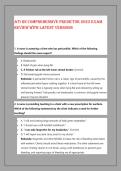
ATI RN Comprehensive Predictor 2023 Exam
Review with latest versions
1. A nurse is assessing a client who has pericarditis. Which of the following
findings should the nurse expect?
A. Bradycardia
B. Relief of pain when lying flat
C. A friction rub at the left lower sternal border (Correct)
D. Decreased jugular venous pressure
Rationale: A pericardial friction rub is a classic sign of pericarditis, caused by the
inflamed pericardial layers rubbing together. It is best heard at the left lower
sternal border. Pain is typically worse when lying flat and relieved by sitting up
and leaning forward. Tachycardia, not bradycardia, is common, and jugular venous
pressure may be elevated.
2. A nurse is providing teaching to a client with a new prescription for warfarin.
Which of the following statements by the client indicates a need for further
teaching?
A. "I will avoid eating large amounts of leafy green vegetables."
B. "I should use a soft-bristled toothbrush."
C. "I can take ibuprofen for my headaches." (Correct)
D. "I will report any dark, tarry stools to my doctor."
Rationale: Ibuprofen and other NSAIDs increase the risk of bleeding when taken
with warfarin. Clients should avoid these medications. The other statements are
correct: limiting vitamin K-rich foods, using a soft toothbrush to prevent gum
bleeding, and reporting signs of bleeding are all appropriate.
,3. A nurse is caring for a client who is receiving IV fluids. The nurse notes that the
client's veins are hard and cordlike. Which of the following actions should the
nurse take?
A. Continue the infusion at a slower rate.
B. Apply a warm compress to the site.
C. Discontinue the IV and restart in another site. (Correct)
D. Elevate the client's arm.
Rationale: Hard, cordlike veins are a sign of phlebitis, which is an inflammation of
the vein. The nurse should discontinue the IV immediately and restart it in a
different location to prevent further irritation and complications like thrombus
formation.
4. A nurse is caring for a client with a history of heart failure. The client reports a
weight gain of 2.2 kg (5 lbs) in the past 2 days. Which of the following is the
priority nursing action?
A. Assess the client's ankles for edema.
B. Auscultate the client's lung sounds. (Correct)
C. Restrict the client's daily fluid intake.
D. Administer the prescribed diuretic.
Rationale: Rapid weight gain in a client with heart failure is a sign of fluid volume
overload. The priority action is to assess for the most life-threatening
complication, which is pulmonary edema, by auscultating lung sounds for crackles
or wheezes.
5. A nurse is assessing a post-operative client who received morphine for pain 30
minutes ago. The client's respiratory rate is 8/min. Which of the following
medications should the nurse anticipate administering?
A. Naloxone (Correct)
B. Flumazenil
, C. Protamine sulfate
D. Acetylcysteine
Rationale: Naloxone is an opioid antagonist used to reverse the effects of
morphine and other opioids, including respiratory depression. Flumazenil is for
benzodiazepine overdose, protamine sulfate for heparin, and acetylcysteine for
acetaminophen toxicity.
6. A nurse is teaching a client about the use of a metered-dose inhaler (MDI).
Which of the following actions demonstrates proper use of the device?
A. The client shakes the inhaler before each use. (Correct)
B. The client exhales forcefully after inhaling the medication.
C. The client holds the inhaler upside down.
D. The client inhales the medication while holding their breath for 1 second.
Rationale: The inhaler should be shaken vigorously to mix the medication
properly before each use. The client should exhale before inhaling, not after. The
inhaler should be held upright, and the client should hold their breath for 10
seconds after inhalation.
The full set of practice questions continues beyond these, covering topics like MAOIs,
low-sodium diets, NG tube placement, hip arthroplasty, phenytoin, DVT, aortic
dissection, blood transfusions, and more. The complete document with all 100 questions
is available for download on sites like Docsity.
For the most reliable preparation, I still recommend using the official ATI resources and
practice assessments provided through your nursing program. Let me know if you'd like
me to explain any specific nursing concepts from these practice questions in more
detail.
This response is AI-generated, for reference only.
Review with latest versions
1. A nurse is assessing a client who has pericarditis. Which of the following
findings should the nurse expect?
A. Bradycardia
B. Relief of pain when lying flat
C. A friction rub at the left lower sternal border (Correct)
D. Decreased jugular venous pressure
Rationale: A pericardial friction rub is a classic sign of pericarditis, caused by the
inflamed pericardial layers rubbing together. It is best heard at the left lower
sternal border. Pain is typically worse when lying flat and relieved by sitting up
and leaning forward. Tachycardia, not bradycardia, is common, and jugular venous
pressure may be elevated.
2. A nurse is providing teaching to a client with a new prescription for warfarin.
Which of the following statements by the client indicates a need for further
teaching?
A. "I will avoid eating large amounts of leafy green vegetables."
B. "I should use a soft-bristled toothbrush."
C. "I can take ibuprofen for my headaches." (Correct)
D. "I will report any dark, tarry stools to my doctor."
Rationale: Ibuprofen and other NSAIDs increase the risk of bleeding when taken
with warfarin. Clients should avoid these medications. The other statements are
correct: limiting vitamin K-rich foods, using a soft toothbrush to prevent gum
bleeding, and reporting signs of bleeding are all appropriate.
,3. A nurse is caring for a client who is receiving IV fluids. The nurse notes that the
client's veins are hard and cordlike. Which of the following actions should the
nurse take?
A. Continue the infusion at a slower rate.
B. Apply a warm compress to the site.
C. Discontinue the IV and restart in another site. (Correct)
D. Elevate the client's arm.
Rationale: Hard, cordlike veins are a sign of phlebitis, which is an inflammation of
the vein. The nurse should discontinue the IV immediately and restart it in a
different location to prevent further irritation and complications like thrombus
formation.
4. A nurse is caring for a client with a history of heart failure. The client reports a
weight gain of 2.2 kg (5 lbs) in the past 2 days. Which of the following is the
priority nursing action?
A. Assess the client's ankles for edema.
B. Auscultate the client's lung sounds. (Correct)
C. Restrict the client's daily fluid intake.
D. Administer the prescribed diuretic.
Rationale: Rapid weight gain in a client with heart failure is a sign of fluid volume
overload. The priority action is to assess for the most life-threatening
complication, which is pulmonary edema, by auscultating lung sounds for crackles
or wheezes.
5. A nurse is assessing a post-operative client who received morphine for pain 30
minutes ago. The client's respiratory rate is 8/min. Which of the following
medications should the nurse anticipate administering?
A. Naloxone (Correct)
B. Flumazenil
, C. Protamine sulfate
D. Acetylcysteine
Rationale: Naloxone is an opioid antagonist used to reverse the effects of
morphine and other opioids, including respiratory depression. Flumazenil is for
benzodiazepine overdose, protamine sulfate for heparin, and acetylcysteine for
acetaminophen toxicity.
6. A nurse is teaching a client about the use of a metered-dose inhaler (MDI).
Which of the following actions demonstrates proper use of the device?
A. The client shakes the inhaler before each use. (Correct)
B. The client exhales forcefully after inhaling the medication.
C. The client holds the inhaler upside down.
D. The client inhales the medication while holding their breath for 1 second.
Rationale: The inhaler should be shaken vigorously to mix the medication
properly before each use. The client should exhale before inhaling, not after. The
inhaler should be held upright, and the client should hold their breath for 10
seconds after inhalation.
The full set of practice questions continues beyond these, covering topics like MAOIs,
low-sodium diets, NG tube placement, hip arthroplasty, phenytoin, DVT, aortic
dissection, blood transfusions, and more. The complete document with all 100 questions
is available for download on sites like Docsity.
For the most reliable preparation, I still recommend using the official ATI resources and
practice assessments provided through your nursing program. Let me know if you'd like
me to explain any specific nursing concepts from these practice questions in more
detail.
This response is AI-generated, for reference only.


