
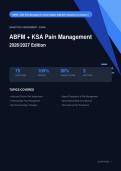
ABFM + KSA Pain Management (Latest Update 2026/2027) Questions & Answers |
OBJECTIVE ASSESSMENT - EXAM
ABFM + KSA Pain Management
2026/2027 Edition
75 100% 80% 5
QUESTIONS VERIFIED PASSING SCORE SECTIONS
TOPICS COVERED
• Acute and Chronic Pain Assessment • Special Populations & Risk Management
• Pharmacologic Pain Management • Opioid Stewardship & Compliance
• Non-Pharmacologic Therapies • Interventional Pain Procedures
COVER PAGE - 1
,ABFM + KSA Pain Management (Latest Update 2026/2027) Questions & Answers | Grade A | 100% CONFIDENTIAL - EXAM MATERIAL
Section 1: Acute and Chronic Pain Assessment
QUESTION 1 ABFM KSA Pain Mgmt 2026/2027
Q1. A 58-year-old warehouse worker presents with persistent low back pain after a lifting injury three months
ago. He rates his pain as 6/10 on the numeric rating scale and reports that it interferes with sleep but not
with basic self-care. Which screening tool is most appropriate to evaluate the biopsychosocial impact of his
chronic pain?
Visual Analog Scale (VAS)
Oswestry Disability Index (ODI)
Brief Pain Inventory (BPI)
Pain Catastrophizing Scale (PCS)
Correct Answer: C
Rationale: The Brief Pain Inventory (BPI) assesses both pain severity and functional interference across multiple domains, making
it ideal for biopsychosocial evaluation. The ODI focuses narrowly on back-specific disability, while the VAS only measures
intensity and the PCS only measures catastrophic thinking.
QUESTION 2 ABFM KSA Pain Mgmt 2026/2027
Q2. A 42-year-old woman with fibromyalgia complains of widespread musculoskeletal pain, fatigue, and
cognitive difficulties. Her tender point count is elevated, and she screens positive for moderate depression
on the PHQ-9. What is the most important next step in her comprehensive pain assessment?
Order an MRI of the cervical spine
Assess for central sensitization and mood comorbidities
Refer immediately to a rheumatologist
Initiate high-dose opioid therapy
Correct Answer: D
Rationale: Fibromyalgia is characterized by central sensitization with frequent comorbid depression and anxiety; assessing these
factors guides multimodal treatment. MRI is rarely indicated in uncomplicated fibromyalgia, and opioids are contraindicated as
first-line therapy.
, ABFM + KSA Pain Management (Latest Update 2026/2027) Questions & Answers | Grade A | 100% CONFIDENTIAL - EXAM MATERIAL
QUESTION 3 ABFM KSA Pain Mgmt 2026/2027
Q3. A 67-year-old man with diabetic peripheral neuropathy describes burning, tingling pain in his feet that
worsens at night. On examination, he has diminished vibratory sense and absent ankle reflexes. Which pain
descriptor most strongly suggests neuropathic rather than nociceptive pain?
Aching and deep pressure pain
Burning, electric, or shooting sensations
Throbbing pain that pulses with heartbeat
Sharp pain localized to a single joint
Correct Answer: B
Rationale: Neuropathic pain is classically described as burning, electric, shooting, or stabbing due to nerve injury or dysfunction.
Aching and throbbing are more typical of nociceptive or inflammatory pain, while localized sharp pain suggests somatic origin.
QUESTION 4 ABFM KSA Pain Mgmt 2026/2027
Q4. A 35-year-old construction worker presents one week after a rotator cuff repair, reporting severe
shoulder pain rated 8/10. He is using a sling and has limited active range of motion. Which assessment
finding would most strongly indicate the need for urgent re-evaluation by his orthopedic surgeon?
Pain rated 8/10 on movement
New onset numbness in the lateral deltoid
Difficulty sleeping on the affected side
Mild swelling around the incision site
Correct Answer: A
Rationale: New numbness in the lateral deltoid suggests axillary nerve injury, a serious postoperative complication requiring
urgent surgical evaluation. Postoperative pain of 8/10, sleep difficulty, and mild swelling are expected findings in the first week
after rotator cuff repair.
QUESTION 5 ABFM KSA Pain Mgmt 2026/2027
Q5. A 71-year-old woman with osteoarthritis of the knees rates her pain as 4/10 at rest but 9/10 with
weight-bearing. She uses a cane and has difficulty climbing stairs. Which functional assessment tool best
captures the activity-limiting impact of her osteoarthritis pain?
Numeric Rating Scale (NRS)
Western Ontario and McMaster Universities Osteoarthritis Index (WOMAC)
McGill Pain Questionnaire (MPQ)
Faces Pain Scale-Revised (FPS-R)
Correct Answer: B
Rationale: The WOMAC specifically evaluates pain, stiffness, and physical function in hip and knee osteoarthritis, making it the
most appropriate choice. The NRS and FPS-R measure only intensity, while the MPQ focuses on sensory and affective
descriptors without functional assessment.
OBJECTIVE ASSESSMENT - EXAM
ABFM + KSA Pain Management
2026/2027 Edition
75 100% 80% 5
QUESTIONS VERIFIED PASSING SCORE SECTIONS
TOPICS COVERED
• Acute and Chronic Pain Assessment • Special Populations & Risk Management
• Pharmacologic Pain Management • Opioid Stewardship & Compliance
• Non-Pharmacologic Therapies • Interventional Pain Procedures
COVER PAGE - 1
,ABFM + KSA Pain Management (Latest Update 2026/2027) Questions & Answers | Grade A | 100% CONFIDENTIAL - EXAM MATERIAL
Section 1: Acute and Chronic Pain Assessment
QUESTION 1 ABFM KSA Pain Mgmt 2026/2027
Q1. A 58-year-old warehouse worker presents with persistent low back pain after a lifting injury three months
ago. He rates his pain as 6/10 on the numeric rating scale and reports that it interferes with sleep but not
with basic self-care. Which screening tool is most appropriate to evaluate the biopsychosocial impact of his
chronic pain?
Visual Analog Scale (VAS)
Oswestry Disability Index (ODI)
Brief Pain Inventory (BPI)
Pain Catastrophizing Scale (PCS)
Correct Answer: C
Rationale: The Brief Pain Inventory (BPI) assesses both pain severity and functional interference across multiple domains, making
it ideal for biopsychosocial evaluation. The ODI focuses narrowly on back-specific disability, while the VAS only measures
intensity and the PCS only measures catastrophic thinking.
QUESTION 2 ABFM KSA Pain Mgmt 2026/2027
Q2. A 42-year-old woman with fibromyalgia complains of widespread musculoskeletal pain, fatigue, and
cognitive difficulties. Her tender point count is elevated, and she screens positive for moderate depression
on the PHQ-9. What is the most important next step in her comprehensive pain assessment?
Order an MRI of the cervical spine
Assess for central sensitization and mood comorbidities
Refer immediately to a rheumatologist
Initiate high-dose opioid therapy
Correct Answer: D
Rationale: Fibromyalgia is characterized by central sensitization with frequent comorbid depression and anxiety; assessing these
factors guides multimodal treatment. MRI is rarely indicated in uncomplicated fibromyalgia, and opioids are contraindicated as
first-line therapy.
, ABFM + KSA Pain Management (Latest Update 2026/2027) Questions & Answers | Grade A | 100% CONFIDENTIAL - EXAM MATERIAL
QUESTION 3 ABFM KSA Pain Mgmt 2026/2027
Q3. A 67-year-old man with diabetic peripheral neuropathy describes burning, tingling pain in his feet that
worsens at night. On examination, he has diminished vibratory sense and absent ankle reflexes. Which pain
descriptor most strongly suggests neuropathic rather than nociceptive pain?
Aching and deep pressure pain
Burning, electric, or shooting sensations
Throbbing pain that pulses with heartbeat
Sharp pain localized to a single joint
Correct Answer: B
Rationale: Neuropathic pain is classically described as burning, electric, shooting, or stabbing due to nerve injury or dysfunction.
Aching and throbbing are more typical of nociceptive or inflammatory pain, while localized sharp pain suggests somatic origin.
QUESTION 4 ABFM KSA Pain Mgmt 2026/2027
Q4. A 35-year-old construction worker presents one week after a rotator cuff repair, reporting severe
shoulder pain rated 8/10. He is using a sling and has limited active range of motion. Which assessment
finding would most strongly indicate the need for urgent re-evaluation by his orthopedic surgeon?
Pain rated 8/10 on movement
New onset numbness in the lateral deltoid
Difficulty sleeping on the affected side
Mild swelling around the incision site
Correct Answer: A
Rationale: New numbness in the lateral deltoid suggests axillary nerve injury, a serious postoperative complication requiring
urgent surgical evaluation. Postoperative pain of 8/10, sleep difficulty, and mild swelling are expected findings in the first week
after rotator cuff repair.
QUESTION 5 ABFM KSA Pain Mgmt 2026/2027
Q5. A 71-year-old woman with osteoarthritis of the knees rates her pain as 4/10 at rest but 9/10 with
weight-bearing. She uses a cane and has difficulty climbing stairs. Which functional assessment tool best
captures the activity-limiting impact of her osteoarthritis pain?
Numeric Rating Scale (NRS)
Western Ontario and McMaster Universities Osteoarthritis Index (WOMAC)
McGill Pain Questionnaire (MPQ)
Faces Pain Scale-Revised (FPS-R)
Correct Answer: B
Rationale: The WOMAC specifically evaluates pain, stiffness, and physical function in hip and knee osteoarthritis, making it the
most appropriate choice. The NRS and FPS-R measure only intensity, while the MPQ focuses on sensory and affective
descriptors without functional assessment.


