

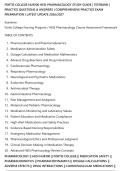
FORTIS COLLEGE NUR100 HESI PHARMACOLOGY STUDY GUIDE | TESTBANK |
PRACTICE QUESTIONS & ANSWERS | COMPREHENSIVE PRACTICE EXAM
PREPARATION | LATEST UPDATE 2026/2027
Examiner:
Fortis College Nursing Program / HESI Pharmacology Course Assessment Framework
TABLE OF CONTENTS
1. Pharmacokinetics and Pharmacodynamics
2. Medication Administration Safety
3. Dosage Calculations and Medication Mathematics
4. Adverse Drug Reactions and Drug Interactions
5. Cardiovascular Pharmacology
6. Respiratory Pharmacology
7. Neurological and Psychiatric Medications
8. Endocrine Pharmacology
9. Antimicrobial Therapy
10. Gastrointestinal Pharmacology
11. Pain Management and Analgesics
12. Maternal and Pediatric Pharmacology
13. Medication Monitoring and Laboratory Values
14. Patient Education and Medication Compliance
15. High-Alert Medications and Safety Practices
16. Evidence-Based Nursing Responsibilities
17. Emergency Medication Management
18. Pharmacological Ethics and Professional Judgment
19. Clinical Decision-Making in Medication Therapy
20. Advanced HESI Pharmacology Review Concepts
PHARMACOLOGY || HESI NUR100 || FORTIS COLLEGE || MEDICATION SAFETY ||
PHARMACOKINETICS || PHARMACODYNAMICS || DOSAGE CALCULATIONS ||
ADVERSE EFFECTS || DRUG INTERACTIONS || CARDIOVASCULAR MEDICATIONS ||
,ANTIBIOTICS || INSULIN THERAPY || NURSING RESPONSIBILITIES || HIGH ALERT
MEDICATIONS || PATIENT EDUCATION || CLINICAL JUDGMENT || SAFE
ADMINISTRATION || THERAPEUTIC MONITORING || COMPREHENSIVE REVIEW ||
EXAM PREPARATION
QUESTION 1.
A nurse is caring for a patient who has been prescribed a medication with a narrow
therapeutic index. The patient's serum drug concentration is slightly above the
therapeutic range, but the patient currently has no symptoms of toxicity. Which
nursing action is the priority?
A. Administer the next scheduled dose because no adverse effects are present
B. Hold the medication and notify the healthcare provider for further evaluation
C. Increase oral fluid intake to accelerate renal elimination of the medication
D. Document the finding as expected because narrow therapeutic drugs fluctuate
frequently
🔴 Correct Answer: B. Hold the medication and notify the healthcare provider for
further evaluation
🔵 Explanation: Medications with a narrow therapeutic index require careful
monitoring because small increases above the therapeutic range may result in serious
toxicity. Holding the medication prevents additional accumulation while the provider
determines whether dosage adjustment is necessary. Administering the medication or
ignoring elevated levels may increase the risk of harm.
QUESTION 2.
A nurse administers a medication that undergoes extensive first-pass metabolism in
the liver. Which pharmacological principle should the nurse consider when evaluating
the medication's effectiveness?
A. Oral administration may produce a lower bioavailable dose than intravenous
administration
B. The medication will have a faster onset when administered orally
,C. The medication will remain unchanged because metabolism occurs after
absorption
D. The medication will achieve identical blood concentrations regardless of route
🔴 Correct Answer: A. Oral administration may produce a lower bioavailable dose
than intravenous administration
🔵 Explanation: First-pass metabolism reduces the amount of medication that reaches
systemic circulation after oral administration. Medications affected by this process may
require different dosing depending on the route of administration. Intravenous
medications bypass first-pass metabolism and generally provide complete
bioavailability.
QUESTION 3.
A patient taking warfarin reports starting an over-the-counter herbal supplement.
The nurse recognizes that the greatest concern is related to which potential
outcome?
A. Reduced medication absorption causing treatment failure
B. Increased vitamin K production causing severe bleeding
C. Altered anticoagulant effect increasing risk for hemorrhage or clot formation
D. Immediate allergic reaction requiring emergency treatment
🔴 Correct Answer: C. Altered anticoagulant effect increasing risk for hemorrhage
or clot formation
🔵 Explanation: Herbal products can interact with warfarin and alter anticoagulant
effectiveness. Some supplements increase bleeding risk while others decrease
therapeutic effects, creating risk for hemorrhage or thrombosis. The nurse should assess
the specific supplement and communicate concerns to the healthcare provider.
QUESTION 4.
A nurse prepares to administer digoxin to an adult patient with heart failure. The
patient's apical pulse is 54 beats/minute. Which action should the nurse take first?
, A. Administer the medication with food to reduce gastrointestinal effects
B. Recheck the pulse after ambulation to verify accuracy
C. Administer the medication and monitor for therapeutic response
D. Withhold the medication and notify the healthcare provider
🔴 Correct Answer: D. Withhold the medication and notify the healthcare provider
🔵 Explanation: Digoxin can decrease heart rate, and bradycardia may indicate
excessive therapeutic effect or toxicity. The medication should be withheld according to
nursing safety standards when the pulse is below the prescribed parameter. Further
evaluation is required before administration.
QUESTION 5.
A nurse is teaching a patient prescribed levothyroxine therapy. Which statement by
the patient indicates correct understanding of medication administration?
A. "I will take this medication with calcium supplements to improve absorption."
B. "I will take this medication consistently on an empty stomach."
C. "I will stop taking the medication once my symptoms improve."
D. "I should take this medication only when I feel fatigued."
🔴 Correct Answer: B. "I will take this medication consistently on an empty
stomach."
🔵 Explanation: Levothyroxine absorption is improved when taken consistently on an
empty stomach, usually before breakfast. Calcium and iron supplements can decrease
absorption and should be separated from administration. Thyroid replacement therapy
typically requires long-term adherence and should not be stopped based only on
symptom improvement.
QUESTION 6.
A nurse is caring for a patient receiving intravenous vancomycin. The patient
develops flushing and hypotension during infusion. Which interpretation is most
appropriate?
PRACTICE QUESTIONS & ANSWERS | COMPREHENSIVE PRACTICE EXAM
PREPARATION | LATEST UPDATE 2026/2027
Examiner:
Fortis College Nursing Program / HESI Pharmacology Course Assessment Framework
TABLE OF CONTENTS
1. Pharmacokinetics and Pharmacodynamics
2. Medication Administration Safety
3. Dosage Calculations and Medication Mathematics
4. Adverse Drug Reactions and Drug Interactions
5. Cardiovascular Pharmacology
6. Respiratory Pharmacology
7. Neurological and Psychiatric Medications
8. Endocrine Pharmacology
9. Antimicrobial Therapy
10. Gastrointestinal Pharmacology
11. Pain Management and Analgesics
12. Maternal and Pediatric Pharmacology
13. Medication Monitoring and Laboratory Values
14. Patient Education and Medication Compliance
15. High-Alert Medications and Safety Practices
16. Evidence-Based Nursing Responsibilities
17. Emergency Medication Management
18. Pharmacological Ethics and Professional Judgment
19. Clinical Decision-Making in Medication Therapy
20. Advanced HESI Pharmacology Review Concepts
PHARMACOLOGY || HESI NUR100 || FORTIS COLLEGE || MEDICATION SAFETY ||
PHARMACOKINETICS || PHARMACODYNAMICS || DOSAGE CALCULATIONS ||
ADVERSE EFFECTS || DRUG INTERACTIONS || CARDIOVASCULAR MEDICATIONS ||
,ANTIBIOTICS || INSULIN THERAPY || NURSING RESPONSIBILITIES || HIGH ALERT
MEDICATIONS || PATIENT EDUCATION || CLINICAL JUDGMENT || SAFE
ADMINISTRATION || THERAPEUTIC MONITORING || COMPREHENSIVE REVIEW ||
EXAM PREPARATION
QUESTION 1.
A nurse is caring for a patient who has been prescribed a medication with a narrow
therapeutic index. The patient's serum drug concentration is slightly above the
therapeutic range, but the patient currently has no symptoms of toxicity. Which
nursing action is the priority?
A. Administer the next scheduled dose because no adverse effects are present
B. Hold the medication and notify the healthcare provider for further evaluation
C. Increase oral fluid intake to accelerate renal elimination of the medication
D. Document the finding as expected because narrow therapeutic drugs fluctuate
frequently
🔴 Correct Answer: B. Hold the medication and notify the healthcare provider for
further evaluation
🔵 Explanation: Medications with a narrow therapeutic index require careful
monitoring because small increases above the therapeutic range may result in serious
toxicity. Holding the medication prevents additional accumulation while the provider
determines whether dosage adjustment is necessary. Administering the medication or
ignoring elevated levels may increase the risk of harm.
QUESTION 2.
A nurse administers a medication that undergoes extensive first-pass metabolism in
the liver. Which pharmacological principle should the nurse consider when evaluating
the medication's effectiveness?
A. Oral administration may produce a lower bioavailable dose than intravenous
administration
B. The medication will have a faster onset when administered orally
,C. The medication will remain unchanged because metabolism occurs after
absorption
D. The medication will achieve identical blood concentrations regardless of route
🔴 Correct Answer: A. Oral administration may produce a lower bioavailable dose
than intravenous administration
🔵 Explanation: First-pass metabolism reduces the amount of medication that reaches
systemic circulation after oral administration. Medications affected by this process may
require different dosing depending on the route of administration. Intravenous
medications bypass first-pass metabolism and generally provide complete
bioavailability.
QUESTION 3.
A patient taking warfarin reports starting an over-the-counter herbal supplement.
The nurse recognizes that the greatest concern is related to which potential
outcome?
A. Reduced medication absorption causing treatment failure
B. Increased vitamin K production causing severe bleeding
C. Altered anticoagulant effect increasing risk for hemorrhage or clot formation
D. Immediate allergic reaction requiring emergency treatment
🔴 Correct Answer: C. Altered anticoagulant effect increasing risk for hemorrhage
or clot formation
🔵 Explanation: Herbal products can interact with warfarin and alter anticoagulant
effectiveness. Some supplements increase bleeding risk while others decrease
therapeutic effects, creating risk for hemorrhage or thrombosis. The nurse should assess
the specific supplement and communicate concerns to the healthcare provider.
QUESTION 4.
A nurse prepares to administer digoxin to an adult patient with heart failure. The
patient's apical pulse is 54 beats/minute. Which action should the nurse take first?
, A. Administer the medication with food to reduce gastrointestinal effects
B. Recheck the pulse after ambulation to verify accuracy
C. Administer the medication and monitor for therapeutic response
D. Withhold the medication and notify the healthcare provider
🔴 Correct Answer: D. Withhold the medication and notify the healthcare provider
🔵 Explanation: Digoxin can decrease heart rate, and bradycardia may indicate
excessive therapeutic effect or toxicity. The medication should be withheld according to
nursing safety standards when the pulse is below the prescribed parameter. Further
evaluation is required before administration.
QUESTION 5.
A nurse is teaching a patient prescribed levothyroxine therapy. Which statement by
the patient indicates correct understanding of medication administration?
A. "I will take this medication with calcium supplements to improve absorption."
B. "I will take this medication consistently on an empty stomach."
C. "I will stop taking the medication once my symptoms improve."
D. "I should take this medication only when I feel fatigued."
🔴 Correct Answer: B. "I will take this medication consistently on an empty
stomach."
🔵 Explanation: Levothyroxine absorption is improved when taken consistently on an
empty stomach, usually before breakfast. Calcium and iron supplements can decrease
absorption and should be separated from administration. Thyroid replacement therapy
typically requires long-term adherence and should not be stopped based only on
symptom improvement.
QUESTION 6.
A nurse is caring for a patient receiving intravenous vancomycin. The patient
develops flushing and hypotension during infusion. Which interpretation is most
appropriate?


