

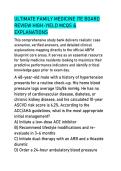
ULTIMATE FAMILY MEDICINE ITE BOARD
REVIEW HIGH-YIELD MCQS &
EXPLANATIONS
This comprehensive study bank delivers realistic case
scenarios, verified answers, and detailed clinical
explanations mapping directly to the official ABFM
blueprint core areas. It serves as an essential resource
for family medicine residents looking to maximize their
predictive performance indicators and identify critical
knowledge gaps prior to exam day.
A 48-year-old male with a history of hypertension
presents for a routine check-up. His home blood
pressure logs average 134/86 mmHg. He has no
history of cardiovascular disease, diabetes, or
chronic kidney disease, and his calculated 10-year
ASCVD risk score is 6.2%. According to the
ACC/AHA guidelines, what is the most appropriate
initial management?
A) Initiate a low-dose ACE inhibitor
B) Recommend lifestyle modifications and re-
evaluate in 3–6 months
C) Initiate dual-therapy with an ARB and a thiazide
diuretic
D) Order a 24-hour ambulatory blood pressure
,monitor and hold all interventions
Answer: B
Rationale: This patient has Stage 1 hypertension
(systolic 130–139 or diastolic 80–89 mmHg). For
patients with Stage 1 hypertension and a 10-year
ASCVD risk below 10%, the current guidelines
recommend lifestyle modifications alone for the
first 3 to 6 months before initiating
pharmacotherapy.
1. A 64-year-old female presents with a 4-month
history of persistent, non-bloody, watery
diarrhea. She reports having 5–6 episodes daily,
accompanied by mild abdominal cramping.
Routine laboratory workup, including a CBC,
metabolic panel, and celiac serologies, is
completely normal. Stool cultures and parasite
exams are negative. What is the most
appropriate next step to confirm a diagnosis?
A) Empirical trial of a gluten-free diet
B) Hydrogen breath testing for lactose
intolerance
C) Colonoscopy with mucosal biopsies
D) Stool elastase testing for pancreatic
insufficiency
, Answer: C
Rationale: In an older patient presenting with
chronic, watery diarrhea and an otherwise
negative standard metabolic and infectious
workup, microscopic colitis (lymphocytic or
collagenous) must be strongly suspected. This
diagnosis can only be confirmed via histological
evaluation of mucosal biopsies obtained during
a colonoscopy.
2. A 2-month-old female infant is brought to the
clinic for a well-child exam. She was born via
frank breech presentation at 38 weeks
gestation. Physical examination reveals equal
leg lengths, symmetric skin folds, and negative
Barlow and Ortolani maneuvers. What is the
most appropriate next step in screening this
infant for developmental dysplasia of the hip
(DDH)?
A) Reassure the parents and re-examine at the
4-month visit
B) Order a plain radiograph of the pelvis and
bilateral hips
C) Order an ultrasound of the bilateral hips
D) Refer immediately to pediatric orthopedics
, for Pavlik harness fitting
Answer: C
Rationale: Breech presentation in the third
trimester is a major risk factor for
developmental dysplasia of the hip (DDH).
Current screening guidelines recommend
performing a screening hip ultrasound at 4 to 6
weeks of adjusted age for all female infants
born in the breech position, even if the physical
examination is completely normal.
3. A 54-year-old male presents to discuss lung
cancer screening. He has an active 25 pack-
year smoking history and no respiratory
symptoms. According to the United States
Preventive Services Task Force (USPSTF)
screening guidelines, what is the most
appropriate recommendation?
A) Annual screening with a chest X-ray
B) Annual screening with low-dose computed
tomography (LDCT)
C) One-time screening with high-resolution CT
(HRCT)
D) No screening is indicated unless he develops
a chronic cough
REVIEW HIGH-YIELD MCQS &
EXPLANATIONS
This comprehensive study bank delivers realistic case
scenarios, verified answers, and detailed clinical
explanations mapping directly to the official ABFM
blueprint core areas. It serves as an essential resource
for family medicine residents looking to maximize their
predictive performance indicators and identify critical
knowledge gaps prior to exam day.
A 48-year-old male with a history of hypertension
presents for a routine check-up. His home blood
pressure logs average 134/86 mmHg. He has no
history of cardiovascular disease, diabetes, or
chronic kidney disease, and his calculated 10-year
ASCVD risk score is 6.2%. According to the
ACC/AHA guidelines, what is the most appropriate
initial management?
A) Initiate a low-dose ACE inhibitor
B) Recommend lifestyle modifications and re-
evaluate in 3–6 months
C) Initiate dual-therapy with an ARB and a thiazide
diuretic
D) Order a 24-hour ambulatory blood pressure
,monitor and hold all interventions
Answer: B
Rationale: This patient has Stage 1 hypertension
(systolic 130–139 or diastolic 80–89 mmHg). For
patients with Stage 1 hypertension and a 10-year
ASCVD risk below 10%, the current guidelines
recommend lifestyle modifications alone for the
first 3 to 6 months before initiating
pharmacotherapy.
1. A 64-year-old female presents with a 4-month
history of persistent, non-bloody, watery
diarrhea. She reports having 5–6 episodes daily,
accompanied by mild abdominal cramping.
Routine laboratory workup, including a CBC,
metabolic panel, and celiac serologies, is
completely normal. Stool cultures and parasite
exams are negative. What is the most
appropriate next step to confirm a diagnosis?
A) Empirical trial of a gluten-free diet
B) Hydrogen breath testing for lactose
intolerance
C) Colonoscopy with mucosal biopsies
D) Stool elastase testing for pancreatic
insufficiency
, Answer: C
Rationale: In an older patient presenting with
chronic, watery diarrhea and an otherwise
negative standard metabolic and infectious
workup, microscopic colitis (lymphocytic or
collagenous) must be strongly suspected. This
diagnosis can only be confirmed via histological
evaluation of mucosal biopsies obtained during
a colonoscopy.
2. A 2-month-old female infant is brought to the
clinic for a well-child exam. She was born via
frank breech presentation at 38 weeks
gestation. Physical examination reveals equal
leg lengths, symmetric skin folds, and negative
Barlow and Ortolani maneuvers. What is the
most appropriate next step in screening this
infant for developmental dysplasia of the hip
(DDH)?
A) Reassure the parents and re-examine at the
4-month visit
B) Order a plain radiograph of the pelvis and
bilateral hips
C) Order an ultrasound of the bilateral hips
D) Refer immediately to pediatric orthopedics
, for Pavlik harness fitting
Answer: C
Rationale: Breech presentation in the third
trimester is a major risk factor for
developmental dysplasia of the hip (DDH).
Current screening guidelines recommend
performing a screening hip ultrasound at 4 to 6
weeks of adjusted age for all female infants
born in the breech position, even if the physical
examination is completely normal.
3. A 54-year-old male presents to discuss lung
cancer screening. He has an active 25 pack-
year smoking history and no respiratory
symptoms. According to the United States
Preventive Services Task Force (USPSTF)
screening guidelines, what is the most
appropriate recommendation?
A) Annual screening with a chest X-ray
B) Annual screening with low-dose computed
tomography (LDCT)
C) One-time screening with high-resolution CT
(HRCT)
D) No screening is indicated unless he develops
a chronic cough


