

POLI 201 Exam 1 UofSC
Study online at https://quizlet.com/_elcpfs
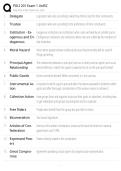
1. Delegate Legislators who vote according to what they think is best for their constituents.
2. Trustee Legislators who vote according to the preferences of their constituents.
3. Institution - Ex- Exogenous institutions are institutions whos rules are fixed by an outside source.
ogenous and En- Endogenous institutions are institutions whos rules are crafted by the members of
dogenous that institution.
4. Moral Hazard Arises when people behave recklessly because they know they will be saved if
things go wrong.
5. Principal-Agent The relationship between a principal (such as a citizen) and an agent (such as an
Relationship elected official), in which the agent is expected to act on the principal's behalf.
6. Public Goods Access cannot be denied. When consumed, it is not used up.
7. Instrumental Ac- A situation in which a goal is pursued after it has been evaluated in relation to other
tion goals and after thorough consideration of the various means to achieve it.
8. Collective Action How groups form and organize to pursue their goals or objectives, including how
to get individuals and groups to participate and to cooperate.
9. Free Riders People who benefit from the group but give little in return.
10. Bicameralism Two house legislature.
11. Articles of Con- America's first written constitution; served as the basis for America's national
federation government until 1789.
12. Expressed Pow- Powers directly stated in the constitution.
ers
13. Great Compro- Agreement providing a dual system of congressional representation.
mise
1/7
, POLI 201 Exam 1 UofSC
Study online at https://quizlet.com/_elcpfs
14. Virginia Plan Proportional representation based on population - benefitted large states.
15. New Jersey Plan Fixed representation by state - benefitted smaller states.
16. Implied Powers Powers implied from the Constitution that stem from the "rights, duties, and
obligations" of the presidency.
17. Impeachment A formal document charging a public official with misconduct in office.
18. Reserved Powers Powers given to the state government alone.
19. Separation of Constitutional division of powers among the legislative, executive, and judicial
Powers branches.
20. Checks and Bal- A system that allows each branch of government to limit the powers of the other
ances branches in order to prevent abuse of power.
21. Supremacy Article VI of the Constitution, which makes the Constitution, national laws, and
Clause treaties supreme over state laws when the national government is acting within
its constitutional limits.
22. The Electoral Col- A group of people named by each state legislature to select the president and vice
lege president.
23. Transaction Costs The costs that parties incur in the process of agreeing to and following through on
a bargain.
24. Elastic Clause Allows Congress to make all laws that are "necessary and proper" to carry out the
(Necessary and powers of the Constitution.
Proper Clause)
25. Shared Powers Legislative powers not completely separated between the branches of govern-
ment.
26.
2/7
Study online at https://quizlet.com/_elcpfs
1. Delegate Legislators who vote according to what they think is best for their constituents.
2. Trustee Legislators who vote according to the preferences of their constituents.
3. Institution - Ex- Exogenous institutions are institutions whos rules are fixed by an outside source.
ogenous and En- Endogenous institutions are institutions whos rules are crafted by the members of
dogenous that institution.
4. Moral Hazard Arises when people behave recklessly because they know they will be saved if
things go wrong.
5. Principal-Agent The relationship between a principal (such as a citizen) and an agent (such as an
Relationship elected official), in which the agent is expected to act on the principal's behalf.
6. Public Goods Access cannot be denied. When consumed, it is not used up.
7. Instrumental Ac- A situation in which a goal is pursued after it has been evaluated in relation to other
tion goals and after thorough consideration of the various means to achieve it.
8. Collective Action How groups form and organize to pursue their goals or objectives, including how
to get individuals and groups to participate and to cooperate.
9. Free Riders People who benefit from the group but give little in return.
10. Bicameralism Two house legislature.
11. Articles of Con- America's first written constitution; served as the basis for America's national
federation government until 1789.
12. Expressed Pow- Powers directly stated in the constitution.
ers
13. Great Compro- Agreement providing a dual system of congressional representation.
mise
1/7
, POLI 201 Exam 1 UofSC
Study online at https://quizlet.com/_elcpfs
14. Virginia Plan Proportional representation based on population - benefitted large states.
15. New Jersey Plan Fixed representation by state - benefitted smaller states.
16. Implied Powers Powers implied from the Constitution that stem from the "rights, duties, and
obligations" of the presidency.
17. Impeachment A formal document charging a public official with misconduct in office.
18. Reserved Powers Powers given to the state government alone.
19. Separation of Constitutional division of powers among the legislative, executive, and judicial
Powers branches.
20. Checks and Bal- A system that allows each branch of government to limit the powers of the other
ances branches in order to prevent abuse of power.
21. Supremacy Article VI of the Constitution, which makes the Constitution, national laws, and
Clause treaties supreme over state laws when the national government is acting within
its constitutional limits.
22. The Electoral Col- A group of people named by each state legislature to select the president and vice
lege president.
23. Transaction Costs The costs that parties incur in the process of agreeing to and following through on
a bargain.
24. Elastic Clause Allows Congress to make all laws that are "necessary and proper" to carry out the
(Necessary and powers of the Constitution.
Proper Clause)
25. Shared Powers Legislative powers not completely separated between the branches of govern-
ment.
26.
2/7


