

POLI 201 MIDTERM
Study online at https://quizlet.com/_ixh57t
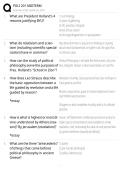
1. What are President Holland's 4 1) our theology
reasons justifying BYU? 2) place of gathering
3) sift, prioritize, integrate
4) test of true church
not for hyperfragmention or specialization
2. What do relativism and scien- they deny that there is any point to thinking or arguing
tism (including scientific special- about moral fundamentals or higher truth, the good has
ization) have in common? no intrinsic value
3. How can the study of political Political Philosophy is tied with the third reason: sift, prior-
philosophy serve the purposes of itize, integrate. Reason is what would allow us to do this.
Pres. Holland's "School in Zion"?
4. How does Leo Strauss describe Revelation: humility, God as personal love, fear and hope in
the basic opposition between a God, good as sacrifice
life guided by revelation and a life
guided by reason? Reason: proud virtue, good as rational impersonal neces-
sity/intellectual possession
*essay
Disagree on what completes morality, what is its ultimate
purpose.
5. How is what is highest or most di- reason: self betterment, intellectual possession vertical to
vine understood by Athens (rea- higher good, transcendence (only available to a few)
son)? By Jerusalem (revelation)? revelation: God, horizontally the value of each person/fam-
ily, ignore excellence (equality by default)
*essay
6. What are the three "antecedents" 1) poetry
of (things that came before) 2) pre-Socratic philosophy
political philosophy in ancient 3) politics (democracy)
Greece?
1/6
, POLI 201 MIDTERM
Study online at https://quizlet.com/_ixh57t
*essay
7. Why did philosophy first arise in 1) greeks first to see the world as a puzzle
ancient Greece? 2) the polis: self-government and striving for excellence
3) Gods: anthropomorphic
4) grammatical fluke, taste for abstraction language
5) geography, commerce, greek diversity
8. According to Pierre Manent, how the greeks had to govern themselves by thinking together,
did Philosophy begin in Greece? debates led to questions of how to live
9. How did Pericles' Funeral Oration The city bragged about democracy - the people can par-
anticipate the emergence of Po- ticipate in, and therefore they need to know what is good.
litical Philosophy? No longer to king. Showed that philosophy can be manly -
contributing member of society.
"We are lovers of nobility without restraint, and lovers of
wisdom without any softening of the character"
10. What was Antigone's best case Antigone: the higher law
against Creon? or Creon's best Creon: the law
case against Antigone?
11. In Aristophanes' The Clouds: justice: the better argument, traditional, no reason
what do we learn from the de- worse: your actions make the case for injustice
bate between the "better" or What is good can't always be argued well.
"stronger" argument and the
"better" or "worse" argument?
12. What does Pheidippides claim there is no wrong or right by nature: it is just tradition
to have learned from Socrates
about the law?
13.
2/6
Study online at https://quizlet.com/_ixh57t
1. What are President Holland's 4 1) our theology
reasons justifying BYU? 2) place of gathering
3) sift, prioritize, integrate
4) test of true church
not for hyperfragmention or specialization
2. What do relativism and scien- they deny that there is any point to thinking or arguing
tism (including scientific special- about moral fundamentals or higher truth, the good has
ization) have in common? no intrinsic value
3. How can the study of political Political Philosophy is tied with the third reason: sift, prior-
philosophy serve the purposes of itize, integrate. Reason is what would allow us to do this.
Pres. Holland's "School in Zion"?
4. How does Leo Strauss describe Revelation: humility, God as personal love, fear and hope in
the basic opposition between a God, good as sacrifice
life guided by revelation and a life
guided by reason? Reason: proud virtue, good as rational impersonal neces-
sity/intellectual possession
*essay
Disagree on what completes morality, what is its ultimate
purpose.
5. How is what is highest or most di- reason: self betterment, intellectual possession vertical to
vine understood by Athens (rea- higher good, transcendence (only available to a few)
son)? By Jerusalem (revelation)? revelation: God, horizontally the value of each person/fam-
ily, ignore excellence (equality by default)
*essay
6. What are the three "antecedents" 1) poetry
of (things that came before) 2) pre-Socratic philosophy
political philosophy in ancient 3) politics (democracy)
Greece?
1/6
, POLI 201 MIDTERM
Study online at https://quizlet.com/_ixh57t
*essay
7. Why did philosophy first arise in 1) greeks first to see the world as a puzzle
ancient Greece? 2) the polis: self-government and striving for excellence
3) Gods: anthropomorphic
4) grammatical fluke, taste for abstraction language
5) geography, commerce, greek diversity
8. According to Pierre Manent, how the greeks had to govern themselves by thinking together,
did Philosophy begin in Greece? debates led to questions of how to live
9. How did Pericles' Funeral Oration The city bragged about democracy - the people can par-
anticipate the emergence of Po- ticipate in, and therefore they need to know what is good.
litical Philosophy? No longer to king. Showed that philosophy can be manly -
contributing member of society.
"We are lovers of nobility without restraint, and lovers of
wisdom without any softening of the character"
10. What was Antigone's best case Antigone: the higher law
against Creon? or Creon's best Creon: the law
case against Antigone?
11. In Aristophanes' The Clouds: justice: the better argument, traditional, no reason
what do we learn from the de- worse: your actions make the case for injustice
bate between the "better" or What is good can't always be argued well.
"stronger" argument and the
"better" or "worse" argument?
12. What does Pheidippides claim there is no wrong or right by nature: it is just tradition
to have learned from Socrates
about the law?
13.
2/6


