
LIMITATIONS ON OWNERSHIP 🏁
Limitation of ownership refers to the legal constraints that restrict a landowner’s full
use and enjoyment of property.
Neighbour law & constitutional limitations are the primary sources.
Chapter 6 of the prescribed textbook and the listed case law illustrate these
limits.
CONSTITUTIONAL LIMITATIONS – S 25 📜
Section 25 of the Constitution defines property and sets out the conditions for its
deprivation or expropriation.
S 25(4) expands “property” beyond land to include other assets.
Any interference must comply with S 36 (the limitation clause).
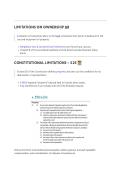
Shows the three constitutional prerequisites: public purpose, just and equitable
compensation, and consideration of relevant circumstances.
,DEPRIVATION 🛑
Deprivation is the state’s seizure of property without compensation, executed under a
law of general application.
Must be published, clear, and non‑arbitrary.
The test asks whether there is a rational connection between the legitimate
purpose and the means used.
Highlights the need for the state’s action to be distinguishable from arbitrary interference.
NOT ARBITRARY – RATIONAL CONNECTION
Purpose of the infringement
Law creating the infringement
Extent of the infringement
Affected property/owner
These factors overlap with the proportionality test in S 36 (necessary, appropriate,
moderate)..
EXPROPRIATION 🏛️
Expropriation is the taking of property without consent for a public purpose,
accompanied by just and equitable compensation.
Governed by S 25(2)–(3) and S 26(2)(b).
Compensation factors:
1. Current use
2. History of the property
3. Market value
4. State investment
5. Purpose of expropriation
The state’s eminent domain power allows it to terminate all rights attached to the
property once lawfully expropriated.
,REQUIREMENTS: DEPRIVATIONS VS EXPROPRIATIONS
📊
Aspect Deprivation (s 25(1)) Expropriation
(s 25(2) & (3))
Legal basis Law of general application Public purpose/interest +
law of general application
Arbitrariness Must not be arbitrary Must be justified &
proportionate
Compensation Not required (unless Just & equitable
justified under s 36) compensation required
Relevant circumstances Not applicable Current use, history, market
value, state investment,
purpose
CASE STUDY: First National Bank of SA Ltd t/a Wesbank
v SARS (2002 ZACC)
The court examined a series of questions to determine whether a statutory levy
amounted to a deprivation or an expropriation:
1. Does the levy affect “property” within the meaning of s 25?
2. Is there a deprivation of that property?
3. Does the deprivation contravene s 25(1)?
4. If so, is it justifiable under s 36?
5. Does the deprivation amount to expropriation?
6. If expropriation, does it satisfy s 25(2) & (3)?
7. If not, is it still justifiable under s 36?
These steps illustrate the analytical framework used in constitutional property disputes.
NEIGHBOUR LAW 🌐
Neighbour law balances each owner’s right to use & enjoyment (ius utendi) with the
duty to act reasonably, preventing undue interference with neighbours.
, Visualises the web of obligations and rights linking adjoining owners
OWNERSHIP ENTITLEMENTS – USE & ENJOYMENT
Derived from common law and statutory sources (e.g., planning/zoning
statutes).
Reasonable exercise must avoid unreasonable infringement of neighbours’
similar entitlements.
SOURCES OF NEIGHBOUR LAW
Planning/Zoning Acts (e.g., Spatial Planning and Land Use Management Act 16
of 2013) – municipalities may enforce by‑laws.
National Road Traffic Act – limits speed and licensing.
Other statutes – not an exhaustive list; any legislation affecting land use can
impose limitations by
NUISANCE 🚧
Nuisance is a neighbour‑law limitation where a landowner’s conduct unreasonably
interferes with another’s enjoyment of their property.
NUISANCE IN THE NARROW SENSE
Infringes quality of life: smells, smoke, noise, water, vibrations, fumes.
Plaintiff must prove the conduct is unreasonable and would not be tolerated
by a reasonable person.
NUISANCE IN THE WIDE SENSE
Involves abnormal or unusual use of land that causes actual damage to a
neighbour’s property.
Remedy is typically an interdict (court order to cease the offending activity).
🏗️
Limitation of ownership refers to the legal constraints that restrict a landowner’s full
use and enjoyment of property.
Neighbour law & constitutional limitations are the primary sources.
Chapter 6 of the prescribed textbook and the listed case law illustrate these
limits.
CONSTITUTIONAL LIMITATIONS – S 25 📜
Section 25 of the Constitution defines property and sets out the conditions for its
deprivation or expropriation.
S 25(4) expands “property” beyond land to include other assets.
Any interference must comply with S 36 (the limitation clause).
Shows the three constitutional prerequisites: public purpose, just and equitable
compensation, and consideration of relevant circumstances.
,DEPRIVATION 🛑
Deprivation is the state’s seizure of property without compensation, executed under a
law of general application.
Must be published, clear, and non‑arbitrary.
The test asks whether there is a rational connection between the legitimate
purpose and the means used.
Highlights the need for the state’s action to be distinguishable from arbitrary interference.
NOT ARBITRARY – RATIONAL CONNECTION
Purpose of the infringement
Law creating the infringement
Extent of the infringement
Affected property/owner
These factors overlap with the proportionality test in S 36 (necessary, appropriate,
moderate)..
EXPROPRIATION 🏛️
Expropriation is the taking of property without consent for a public purpose,
accompanied by just and equitable compensation.
Governed by S 25(2)–(3) and S 26(2)(b).
Compensation factors:
1. Current use
2. History of the property
3. Market value
4. State investment
5. Purpose of expropriation
The state’s eminent domain power allows it to terminate all rights attached to the
property once lawfully expropriated.
,REQUIREMENTS: DEPRIVATIONS VS EXPROPRIATIONS
📊
Aspect Deprivation (s 25(1)) Expropriation
(s 25(2) & (3))
Legal basis Law of general application Public purpose/interest +
law of general application
Arbitrariness Must not be arbitrary Must be justified &
proportionate
Compensation Not required (unless Just & equitable
justified under s 36) compensation required
Relevant circumstances Not applicable Current use, history, market
value, state investment,
purpose
CASE STUDY: First National Bank of SA Ltd t/a Wesbank
v SARS (2002 ZACC)
The court examined a series of questions to determine whether a statutory levy
amounted to a deprivation or an expropriation:
1. Does the levy affect “property” within the meaning of s 25?
2. Is there a deprivation of that property?
3. Does the deprivation contravene s 25(1)?
4. If so, is it justifiable under s 36?
5. Does the deprivation amount to expropriation?
6. If expropriation, does it satisfy s 25(2) & (3)?
7. If not, is it still justifiable under s 36?
These steps illustrate the analytical framework used in constitutional property disputes.
NEIGHBOUR LAW 🌐
Neighbour law balances each owner’s right to use & enjoyment (ius utendi) with the
duty to act reasonably, preventing undue interference with neighbours.
, Visualises the web of obligations and rights linking adjoining owners
OWNERSHIP ENTITLEMENTS – USE & ENJOYMENT
Derived from common law and statutory sources (e.g., planning/zoning
statutes).
Reasonable exercise must avoid unreasonable infringement of neighbours’
similar entitlements.
SOURCES OF NEIGHBOUR LAW
Planning/Zoning Acts (e.g., Spatial Planning and Land Use Management Act 16
of 2013) – municipalities may enforce by‑laws.
National Road Traffic Act – limits speed and licensing.
Other statutes – not an exhaustive list; any legislation affecting land use can
impose limitations by
NUISANCE 🚧
Nuisance is a neighbour‑law limitation where a landowner’s conduct unreasonably
interferes with another’s enjoyment of their property.
NUISANCE IN THE NARROW SENSE
Infringes quality of life: smells, smoke, noise, water, vibrations, fumes.
Plaintiff must prove the conduct is unreasonable and would not be tolerated
by a reasonable person.
NUISANCE IN THE WIDE SENSE
Involves abnormal or unusual use of land that causes actual damage to a
neighbour’s property.
Remedy is typically an interdict (court order to cease the offending activity).
🏗️


