

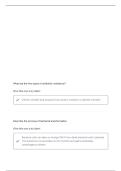
What are the two types of antibiotic resistance?
Give this one a try later!
intrinsic (innate) and acquired (via random mutation or genetic transfer)
Describe the process of bacterial transformation
Give this one a try later!
Bacteria cells can take up foreign DNA from dead bacterial cells' plasmids
The bacterium incorporates sit into its DNA and gains potentially
advantageous alleles
,Describe how decomposers break down plant and animal compounds
Give this one a try later!
- hydrolysis
- enzymes
- produced by saprotrophic microorganisms and excreted
- cellulose broken into B glucose monomers
- starch broken into A glucose monomers
Describe the differences between passive and active immunity
Give this one a try later!
active: exposure, lag phase before protection, long term protection
passive: no exposure or immune response, immediate but short-term
protection
What is meant by 'Immunological Memory'?
Give this one a try later!
after the primary infection and response, memory cells
remain, which can respond quickly to a second invasion
before symptoms or damage is done
the cells produced are higher in number and remain in the
blood for longer to ensure the pathogen is eradicated
, Describe the process of transduction (bacteria)
Give this one a try later!
- bacteriophage attaches to bacterium and inserts genome
into host cell
- viral genome and cell components are replicated with the
bacterial DNA and some of the host cell DNA may
accidentally be incorporated into the viral capsid
- when the viral particles leave the bacterium by lysing the
host cell, they can transport the host DNA to their new host
cells
What is HIV?
Give this one a try later!
human immunodeficiency virus
A retrovirus, that causes AIDS due to a deterioration of the immune system,
transmitted via bodily fluids
Variables of decay of a body
Give this one a try later!
Give this one a try later!
intrinsic (innate) and acquired (via random mutation or genetic transfer)
Describe the process of bacterial transformation
Give this one a try later!
Bacteria cells can take up foreign DNA from dead bacterial cells' plasmids
The bacterium incorporates sit into its DNA and gains potentially
advantageous alleles
,Describe how decomposers break down plant and animal compounds
Give this one a try later!
- hydrolysis
- enzymes
- produced by saprotrophic microorganisms and excreted
- cellulose broken into B glucose monomers
- starch broken into A glucose monomers
Describe the differences between passive and active immunity
Give this one a try later!
active: exposure, lag phase before protection, long term protection
passive: no exposure or immune response, immediate but short-term
protection
What is meant by 'Immunological Memory'?
Give this one a try later!
after the primary infection and response, memory cells
remain, which can respond quickly to a second invasion
before symptoms or damage is done
the cells produced are higher in number and remain in the
blood for longer to ensure the pathogen is eradicated
, Describe the process of transduction (bacteria)
Give this one a try later!
- bacteriophage attaches to bacterium and inserts genome
into host cell
- viral genome and cell components are replicated with the
bacterial DNA and some of the host cell DNA may
accidentally be incorporated into the viral capsid
- when the viral particles leave the bacterium by lysing the
host cell, they can transport the host DNA to their new host
cells
What is HIV?
Give this one a try later!
human immunodeficiency virus
A retrovirus, that causes AIDS due to a deterioration of the immune system,
transmitted via bodily fluids
Variables of decay of a body
Give this one a try later!


