

AWS AI Practitioner Certification
Study online at https://quizlet.com/_i4u131
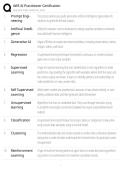
1. Prompt Engi- The process where you guide generative artificial intelligence (generative AI)
neering solutions to generate desired outputs.
2. Artificial Intelli- A field of computer science dedicated to solving cognitive problems commonly
gence associated with human intelligence
3. Generative AI A type of AI that can create new content and ideas, including conversations, stories,
images, videos, and music
4. Regression A supervised learning technique that predicts continuous or numerical values
given one or more input variables.
5. Supervised A type of machine learning that uses labeled data to train algorithms to make
Learning predictions. By providing the algorithm with examples where both the input and
the correct output are known, it learns to identify patterns and relationships to
make predictions on new, unseen data.
6. Self Supervised Works when models are provided vast amounts of raw, almost entirely, or com-
Learning pletely unlabeled data and then generate labels themselves
7. Unsupervised Algorithms that train on unlabeled data. They scan through new data, trying
learning to establish meaningful connections between the inputs and predetermined
outputs.
8. Classification A supervised learning technique that assigns labels or categories to new, previ-
ously unseen data examples using a learned model.
9. Clustering This method divides data into clusters based on similar traits or distances between
data points in order to better understand the characteristics of a particular cluster.
Unsupervised
10. Reinforcement A type of machine learning where an agent learns to make decisions by perform-
Learning ing actions in an environment to maximize cumulative records.
, AWS AI Practitioner Certification
Study online at https://quizlet.com/_i4u131
11. Adaptability It can adapt to a variety of activities and domains by learning from data and
producing material that is suited to specific situations or needs. Because of its
flexibility, generative AI can be applied to a wide number of sectors.
12. Responsiveness It can generate content in real time, resulting in faster reaction times and more
dynamic interactions. This is especially beneficial for chatbots, virtual assistants,
and other interactive applications that demand instant feedback.
13. Data Efficiency It can learn from relatively little quantities of data and produce new samples that
are consistent with the training data. This can be useful when data is limited or
difficult to collect.
14. Factors to consid- There are 5 factors to consider when selecting a model; Performance require-
er when select- ments, Constraints, Capabilities, Compliance, Cost
ing a gen AI mod-
el
15. Personalization It can may develop personalized content based on individual preferences or
attributes, hence improving user experiences and engagement.
16. Amazon Q Busi- It is a generative AI-powered assistant that can answer queries, generate content,
ness provide summaries, and complete tasks based on the data in your organization.
17. Responsible AI It refers to the procedures and principles that ensure AI systems are transparent
and trustworthy while minimizing potential risks and bad effects.
18. Challenges of Toxicity, Hallucinations, Intellectual Property, Plagiarism and Cheating, lastly Dis-
Gen AI ruptions of Nature Work.
19. Multi Modal Can accept a mix of input types such as audio/text and create a mix of output types
Model such as video/image
20. Amazon Sage-
maker
Study online at https://quizlet.com/_i4u131
1. Prompt Engi- The process where you guide generative artificial intelligence (generative AI)
neering solutions to generate desired outputs.
2. Artificial Intelli- A field of computer science dedicated to solving cognitive problems commonly
gence associated with human intelligence
3. Generative AI A type of AI that can create new content and ideas, including conversations, stories,
images, videos, and music
4. Regression A supervised learning technique that predicts continuous or numerical values
given one or more input variables.
5. Supervised A type of machine learning that uses labeled data to train algorithms to make
Learning predictions. By providing the algorithm with examples where both the input and
the correct output are known, it learns to identify patterns and relationships to
make predictions on new, unseen data.
6. Self Supervised Works when models are provided vast amounts of raw, almost entirely, or com-
Learning pletely unlabeled data and then generate labels themselves
7. Unsupervised Algorithms that train on unlabeled data. They scan through new data, trying
learning to establish meaningful connections between the inputs and predetermined
outputs.
8. Classification A supervised learning technique that assigns labels or categories to new, previ-
ously unseen data examples using a learned model.
9. Clustering This method divides data into clusters based on similar traits or distances between
data points in order to better understand the characteristics of a particular cluster.
Unsupervised
10. Reinforcement A type of machine learning where an agent learns to make decisions by perform-
Learning ing actions in an environment to maximize cumulative records.
, AWS AI Practitioner Certification
Study online at https://quizlet.com/_i4u131
11. Adaptability It can adapt to a variety of activities and domains by learning from data and
producing material that is suited to specific situations or needs. Because of its
flexibility, generative AI can be applied to a wide number of sectors.
12. Responsiveness It can generate content in real time, resulting in faster reaction times and more
dynamic interactions. This is especially beneficial for chatbots, virtual assistants,
and other interactive applications that demand instant feedback.
13. Data Efficiency It can learn from relatively little quantities of data and produce new samples that
are consistent with the training data. This can be useful when data is limited or
difficult to collect.
14. Factors to consid- There are 5 factors to consider when selecting a model; Performance require-
er when select- ments, Constraints, Capabilities, Compliance, Cost
ing a gen AI mod-
el
15. Personalization It can may develop personalized content based on individual preferences or
attributes, hence improving user experiences and engagement.
16. Amazon Q Busi- It is a generative AI-powered assistant that can answer queries, generate content,
ness provide summaries, and complete tasks based on the data in your organization.
17. Responsible AI It refers to the procedures and principles that ensure AI systems are transparent
and trustworthy while minimizing potential risks and bad effects.
18. Challenges of Toxicity, Hallucinations, Intellectual Property, Plagiarism and Cheating, lastly Dis-
Gen AI ruptions of Nature Work.
19. Multi Modal Can accept a mix of input types such as audio/text and create a mix of output types
Model such as video/image
20. Amazon Sage-
maker


