

NURS NGN Practice 2024
Study online at https://quizlet.com/_ghxvmv
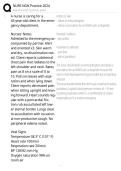
1. A nurse is caring for a Actions to Take
45-year-old client in the emer- - obtain an echocardiogram
gency department. - obtain a prescription for an NSAID such as ibuprofen
Nurses' Notes Potential Condition
Admitted to the emergency ac- - pericarditis
companied by partner. Alert
and oriented x3. Skin warm Parameters to Monitor
and dry, no discoloration not- - pain level
ed. Client reports substernal - pulsus paradoxus
chest pain that radiates to the
The nurse should obtain an echocardiogram and obtain a
left shoulder and neck. Rates
prescription for an NSAID such as ibuprofen because the
pain as 8 on a scale of 0 to
client is most likely experiencing pericarditis due a respiratory
10. Pain increases with aspi-
infection.
ration and when lying down.
The nurse should monitor the client's pain as well as for pulsus
Client reports decreased pain
paradoxus (a systolic blood pressure increase of > 10 mm
when sitting upright and lean-
Hg during inspiration) which is a manifestation of cardiac
ing forward. Heart sounds reg-
tamponade and is a medical emergency.
ular with a pericardial fric-
tion rub auscultated left low-
er sternal border. Lungs clear
to auscultation with occasion-
al non-productive cough. No
peripheral edema noted.
Vital Signs
Temperature 38.3° C (101° F)
Heart rate 100/min
Respiration rate 20/min
BP 128/82 mm Hg
Oxygen saturation 98% on
room air
, NURS NGN Practice 2024
Study online at https://quizlet.com/_ghxvmv
2. A nurse is reviewing the med- Bleeding and infection are correct.
ical record of a client who has Bleeding is one of the major causes of death for clients who
acute leukemia. have acute leukemia. The nurse should note that the client's
Diagnostic Results platelet count has decreased, and the PT, PTT, and INR levels
Month Three: have all increased, which places the client at a high risk for
WBC count 15,500/mm3 bleeding. Infection is also one of the major causes of death
(5,000 to 10,000/mm3) for clients who have acute leukemia. The WBC count can be
RBC count 4.0 million/mm3 low, normal, or high in leukemia, but the cells are small and
(4.2 to 5.4 million/mm3) nonfunctioning. The inability of the client's WBCs to mount
Hemoglobin 11 g/dL (12 to 16 an appropriate protection against invading micro-organisms
g/dL) places the client at a high risk for infection.
Hematocrit 33% (37% to 47%) Fracture and dysrhythmia are incorr
Platelet count 100,000/mm3
(150,000 to 400,000/mm3)
PT 13.5 seconds (11 to 12.5
seconds)
INR 2.2 seconds (0.8 to 1.1 sec-
onds)
PTT 85 seconds (60 to 70 sec-
onds)
Sodium 137 mEq/L (136 to 145
mEq/L)
Potassium 4.5 mEq/L (3.5 to 5
mEq/L)
Glucose 98 mg/dL (74 to 106
mg/dL)
BUN 15 mg/dL (10 to 20
mg/dL)
Creatinine 0.8 mg/dL (0.5 to 1
mg/dL)
Calcium 9.5 mg/dL (9 to 10.5
, NURS NGN Practice 2024
Study online at https://quizlet.com/_ghxvmv
mg/dL)
Vitamin D 65 ng/dL (25 to 80
ng/dL)
Drag words from the choices
below to fill in each blank in
the following sentence.
3. A nurse on a cardiac care unit Hypokalemia is correct. The client is receiving furosemide
is caring for a preschooler. every 6 hr. Furosemide causes potassium depletion. There-
fore, the client is at risk for hypokalemia .
Nurses' Notes
2015: Digitalis toxicity is correct. The client is receiving digitalis every
Increase in dyspnea noted 12 hr. The margin of safety is very small, 0.8 to 2 mcg/L.
with orthopnea. Nasal flar- Therefore, the client is at risk for digitalis toxicity .
ing with respiratory rate of
36/min. Lung sounds with
wheezing noted throughout.
Lower extremity edema 3+ to
bilateral lower extremities. Ex-
tremities cool with decreased
skin pigmentation noted. Pe-
ripheral pulses weak bilat-
eral. Jugular vein distention
noted. Provider notified. Re-
ceived prescription for addi-
tional dose of IV furosemide.
Medication Administration
Record
Hospital Day 1:
Furosemide 40 mg IV every 6
, NURS NGN Practice 2024
Study online at https://quizlet.com/_ghxvmv
hr. Administered at 1755.
Hospital Day 2:
Give digoxin 125 mcg 12 hr af-
ter initial dose. Administered
at 0608.
Give digoxin 125 mcg 12 hr af-
ter second dose. Administered
at 1804.
4. A nurse is caring for a client in Box 1
the labor room. Postpartum hemorrhage is correct. Overdistention of the
uterus during pregnancy can impact the ability of the uterine
Medical History muscles to tightly contract following delivery. This can result in
Gravida 2 Para 1 excessive blood loss following delivery. Clients who have high
38 weeks gestation parity, fetal macrosomia, multiple gestations, and hydramnios
Pregnancy complicated by are more likely to experience uterine atony. Therefore, the
gestational diabetes and hy- client has the greatest risk of developing a postpartum hem-
dramnios. orrhage due to hydramnios.
Spontaneous vaginal delivery
1 year ago. Box 2
No significant past medical Hydramnios is correct. Hydramnios or polyhydramnios is an
history. excessive amount of amniotic fluid that causes overdistention
No history of surgeries. of the uterus. This complication can develop during the third
Spontaneous onset of labor trimester in women who have diabetes mellitus. This can
impair the ability of the uterus to tightly contract.
Nurses Notes
1020:
Client pushing effectively.
Crowning. Provider present at
bedside.
Contraction pattern: occurring
Study online at https://quizlet.com/_ghxvmv
1. A nurse is caring for a Actions to Take
45-year-old client in the emer- - obtain an echocardiogram
gency department. - obtain a prescription for an NSAID such as ibuprofen
Nurses' Notes Potential Condition
Admitted to the emergency ac- - pericarditis
companied by partner. Alert
and oriented x3. Skin warm Parameters to Monitor
and dry, no discoloration not- - pain level
ed. Client reports substernal - pulsus paradoxus
chest pain that radiates to the
The nurse should obtain an echocardiogram and obtain a
left shoulder and neck. Rates
prescription for an NSAID such as ibuprofen because the
pain as 8 on a scale of 0 to
client is most likely experiencing pericarditis due a respiratory
10. Pain increases with aspi-
infection.
ration and when lying down.
The nurse should monitor the client's pain as well as for pulsus
Client reports decreased pain
paradoxus (a systolic blood pressure increase of > 10 mm
when sitting upright and lean-
Hg during inspiration) which is a manifestation of cardiac
ing forward. Heart sounds reg-
tamponade and is a medical emergency.
ular with a pericardial fric-
tion rub auscultated left low-
er sternal border. Lungs clear
to auscultation with occasion-
al non-productive cough. No
peripheral edema noted.
Vital Signs
Temperature 38.3° C (101° F)
Heart rate 100/min
Respiration rate 20/min
BP 128/82 mm Hg
Oxygen saturation 98% on
room air
, NURS NGN Practice 2024
Study online at https://quizlet.com/_ghxvmv
2. A nurse is reviewing the med- Bleeding and infection are correct.
ical record of a client who has Bleeding is one of the major causes of death for clients who
acute leukemia. have acute leukemia. The nurse should note that the client's
Diagnostic Results platelet count has decreased, and the PT, PTT, and INR levels
Month Three: have all increased, which places the client at a high risk for
WBC count 15,500/mm3 bleeding. Infection is also one of the major causes of death
(5,000 to 10,000/mm3) for clients who have acute leukemia. The WBC count can be
RBC count 4.0 million/mm3 low, normal, or high in leukemia, but the cells are small and
(4.2 to 5.4 million/mm3) nonfunctioning. The inability of the client's WBCs to mount
Hemoglobin 11 g/dL (12 to 16 an appropriate protection against invading micro-organisms
g/dL) places the client at a high risk for infection.
Hematocrit 33% (37% to 47%) Fracture and dysrhythmia are incorr
Platelet count 100,000/mm3
(150,000 to 400,000/mm3)
PT 13.5 seconds (11 to 12.5
seconds)
INR 2.2 seconds (0.8 to 1.1 sec-
onds)
PTT 85 seconds (60 to 70 sec-
onds)
Sodium 137 mEq/L (136 to 145
mEq/L)
Potassium 4.5 mEq/L (3.5 to 5
mEq/L)
Glucose 98 mg/dL (74 to 106
mg/dL)
BUN 15 mg/dL (10 to 20
mg/dL)
Creatinine 0.8 mg/dL (0.5 to 1
mg/dL)
Calcium 9.5 mg/dL (9 to 10.5
, NURS NGN Practice 2024
Study online at https://quizlet.com/_ghxvmv
mg/dL)
Vitamin D 65 ng/dL (25 to 80
ng/dL)
Drag words from the choices
below to fill in each blank in
the following sentence.
3. A nurse on a cardiac care unit Hypokalemia is correct. The client is receiving furosemide
is caring for a preschooler. every 6 hr. Furosemide causes potassium depletion. There-
fore, the client is at risk for hypokalemia .
Nurses' Notes
2015: Digitalis toxicity is correct. The client is receiving digitalis every
Increase in dyspnea noted 12 hr. The margin of safety is very small, 0.8 to 2 mcg/L.
with orthopnea. Nasal flar- Therefore, the client is at risk for digitalis toxicity .
ing with respiratory rate of
36/min. Lung sounds with
wheezing noted throughout.
Lower extremity edema 3+ to
bilateral lower extremities. Ex-
tremities cool with decreased
skin pigmentation noted. Pe-
ripheral pulses weak bilat-
eral. Jugular vein distention
noted. Provider notified. Re-
ceived prescription for addi-
tional dose of IV furosemide.
Medication Administration
Record
Hospital Day 1:
Furosemide 40 mg IV every 6
, NURS NGN Practice 2024
Study online at https://quizlet.com/_ghxvmv
hr. Administered at 1755.
Hospital Day 2:
Give digoxin 125 mcg 12 hr af-
ter initial dose. Administered
at 0608.
Give digoxin 125 mcg 12 hr af-
ter second dose. Administered
at 1804.
4. A nurse is caring for a client in Box 1
the labor room. Postpartum hemorrhage is correct. Overdistention of the
uterus during pregnancy can impact the ability of the uterine
Medical History muscles to tightly contract following delivery. This can result in
Gravida 2 Para 1 excessive blood loss following delivery. Clients who have high
38 weeks gestation parity, fetal macrosomia, multiple gestations, and hydramnios
Pregnancy complicated by are more likely to experience uterine atony. Therefore, the
gestational diabetes and hy- client has the greatest risk of developing a postpartum hem-
dramnios. orrhage due to hydramnios.
Spontaneous vaginal delivery
1 year ago. Box 2
No significant past medical Hydramnios is correct. Hydramnios or polyhydramnios is an
history. excessive amount of amniotic fluid that causes overdistention
No history of surgeries. of the uterus. This complication can develop during the third
Spontaneous onset of labor trimester in women who have diabetes mellitus. This can
impair the ability of the uterus to tightly contract.
Nurses Notes
1020:
Client pushing effectively.
Crowning. Provider present at
bedside.
Contraction pattern: occurring


