

Hartman's Nursing Assistant Care: The Basics
Study online at https://quizlet.com/_8el8vi
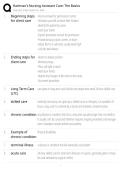
1. Beginning steps -Knock and wait for permission to enter
for client care -Introduce yourself as Nurse Aide Student
-identify the patient by name
-wash your hands
-Explain procedure and ask for permission
-Provide privacy (cutain, screen, or door)
-Adjust bed to a safe level, usually waist high.
-Lock the bed wheels
2. Ending steps for -Return to lowest position
client care -Remove privacy
-Place call light in reach
-wash your hands
-Report any changes in the client to the nurse
-Document procedure
3. Long Term Care care given in long-term care facilities for people who need 24-hour skilled care
(LTC)
4. skilled care medically necessary care given by a skilled nurse or therapist, it is available 24
hours a day, and it is ordered by a doctor and involved a treatment plan
5. chronic condition any disease or condition that lasts a long time (usually longer than six months).
It usually can't be cured and therefore requires ongoing treatment and manage-
ment. Examples include arthritis and asthma.
6. Example of Physical disabilities
chronic condition
7. terminal illness a disease or condition that will eventually cause death
8. acute care 24-hour skilled care for short-term illnesses or injuries; generally given in hospi-
tals and ambulatory surgical centers
, Hartman's Nursing Assistant Care: The Basics
Study online at https://quizlet.com/_8el8vi
9. subacute care care for an illness or condition given to people who need less care than for an
acute (sudden onset, short-term) illness or injury but more than for a chronic
(long-term) illness
10. Example of Heart disease
chronic condition
11. Example of Dementia
chronic condition
12. outpatient care Care given for less than 24 hours for people who have had treatments or surgery
and need short-term skilled care. They do not require an overnight stay in a
hospital or other care facility
13. Rehabilitation Restore or improve function after an illness or injjury
14. hospice care treatment of the terminally ill in their own homes, or in special hospital units or
other facilities, with the goal of helping them to die comfortably, without pain. For
people who have about 6 months or less to live
15. Medicare A federal health insurance program for persons 65 years of age and older
16. Medicaid A medical assistance program that pays for health care services for people who
cannot afford them. For people who have low income, as well as for people with
disabilities.
17. Nursing assis- Insert or remove tubes, give tube feedings, or change sterile dressings
tants are not al-
lowed to
18. Nursing assis- A team of health professionals
tants are part of
19.
, Hartman's Nursing Assistant Care: The Basics
Study online at https://quizlet.com/_8el8vi
assistive or adap- special equipment that helps a person who is ill or disabled perform activities of
tive devices daily living (ex: occupational therapy)
20. occupational assess and plan for the client to regain ADLs, esp motor skills of the upper
therapist extremities; direct care of occupational therapy assistants
21. The chain of com- Liability
mand protects
employees from
22. chain of com- the line of authority that moves from the top of a hierarchy to the lowest level
mand
23. In continence is Not a normal part of aging
24. transmis- CDC precautions used in patients known or suspected to be infected with
sion-based pathogens that can be transmitted by airborne, droplet, or contact routes; used
precautions in addition to standard precautions
25. scope of practice defines the tasks that healthcare providers are legally permitted to perform as
allowed by state or federal law
26. care plan is individualized for each resident. It lists the tasks that team members, including
NAs, must preform.
27. policy Is a course of action that should be taken every time a certain situation occurs
28. procedure a method, or way of doing something
29. Omnibus Bud- Passed in 1987 in response to reports of poor care and aside in long-term care
get Reconcilia- facilities.
tion Act (OBRA)
30.
Study online at https://quizlet.com/_8el8vi
1. Beginning steps -Knock and wait for permission to enter
for client care -Introduce yourself as Nurse Aide Student
-identify the patient by name
-wash your hands
-Explain procedure and ask for permission
-Provide privacy (cutain, screen, or door)
-Adjust bed to a safe level, usually waist high.
-Lock the bed wheels
2. Ending steps for -Return to lowest position
client care -Remove privacy
-Place call light in reach
-wash your hands
-Report any changes in the client to the nurse
-Document procedure
3. Long Term Care care given in long-term care facilities for people who need 24-hour skilled care
(LTC)
4. skilled care medically necessary care given by a skilled nurse or therapist, it is available 24
hours a day, and it is ordered by a doctor and involved a treatment plan
5. chronic condition any disease or condition that lasts a long time (usually longer than six months).
It usually can't be cured and therefore requires ongoing treatment and manage-
ment. Examples include arthritis and asthma.
6. Example of Physical disabilities
chronic condition
7. terminal illness a disease or condition that will eventually cause death
8. acute care 24-hour skilled care for short-term illnesses or injuries; generally given in hospi-
tals and ambulatory surgical centers
, Hartman's Nursing Assistant Care: The Basics
Study online at https://quizlet.com/_8el8vi
9. subacute care care for an illness or condition given to people who need less care than for an
acute (sudden onset, short-term) illness or injury but more than for a chronic
(long-term) illness
10. Example of Heart disease
chronic condition
11. Example of Dementia
chronic condition
12. outpatient care Care given for less than 24 hours for people who have had treatments or surgery
and need short-term skilled care. They do not require an overnight stay in a
hospital or other care facility
13. Rehabilitation Restore or improve function after an illness or injjury
14. hospice care treatment of the terminally ill in their own homes, or in special hospital units or
other facilities, with the goal of helping them to die comfortably, without pain. For
people who have about 6 months or less to live
15. Medicare A federal health insurance program for persons 65 years of age and older
16. Medicaid A medical assistance program that pays for health care services for people who
cannot afford them. For people who have low income, as well as for people with
disabilities.
17. Nursing assis- Insert or remove tubes, give tube feedings, or change sterile dressings
tants are not al-
lowed to
18. Nursing assis- A team of health professionals
tants are part of
19.
, Hartman's Nursing Assistant Care: The Basics
Study online at https://quizlet.com/_8el8vi
assistive or adap- special equipment that helps a person who is ill or disabled perform activities of
tive devices daily living (ex: occupational therapy)
20. occupational assess and plan for the client to regain ADLs, esp motor skills of the upper
therapist extremities; direct care of occupational therapy assistants
21. The chain of com- Liability
mand protects
employees from
22. chain of com- the line of authority that moves from the top of a hierarchy to the lowest level
mand
23. In continence is Not a normal part of aging
24. transmis- CDC precautions used in patients known or suspected to be infected with
sion-based pathogens that can be transmitted by airborne, droplet, or contact routes; used
precautions in addition to standard precautions
25. scope of practice defines the tasks that healthcare providers are legally permitted to perform as
allowed by state or federal law
26. care plan is individualized for each resident. It lists the tasks that team members, including
NAs, must preform.
27. policy Is a course of action that should be taken every time a certain situation occurs
28. procedure a method, or way of doing something
29. Omnibus Bud- Passed in 1987 in response to reports of poor care and aside in long-term care
get Reconcilia- facilities.
tion Act (OBRA)
30.


