

Health Assessment HESI
Study online at https://quizlet.com/_6jekbz
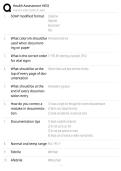
1. SOAP modified format Subjective
Objective
Assessment
Plan
2. What color ink should be Permanent black ink
used when document-
ing on paper
3. What is the correct order T, P, RR, BP, extremity, pt position, SPO2
for vital signs
4. What should be at the Patient initials and date and time of entry
top of every page of doc-
umentation
5. What should be at the Interviewers signature
end of every documen-
tation entry
6. How do you correct a 1) Draw a single line through the incorrect documentation
mistake in documenta- 2) Write error above the entry
tion 3) Initial and date the crossed out entry
7. Documentation tips 1) Avoid complete sentences
2) Do not use A, an, the
3) Do not put opinion in notes
4) Avoid use of normal or within normal limits
8. Normal oral temp range 96.4 - 99.1 F
9. Febrile With fever
10. Afebrile Without fever
, Health Assessment HESI
Study online at https://quizlet.com/_6jekbz
11. Hyperthermia symp- 1) Cessation of shivering
toms 2) Bradycardia
3) Decrease in respiratory minute volume
12. Most common and easy Oral
method of assessing
temperature
13. What methods of assess- 1) Oral
ing temperature reflects 2) Rectal
core temperature 3) Tympanic
4) Temporal Artery
14. What is the least accu- axillary
rate method of assess-
ing temperature
15. Which patients are con- Patients with increased HR
traindicated for rectal
temperature readings
16. Preferred method of tak- Rectal
ing infants and small
children's temperatures
17. Pulse deficit - Difference between apical peripheral pulse
18. Pulse amplitude scale 0 = no pulse
1 = diminished, weak
2 = normal and expected
3 = full or strong
4 = bounding
, Health Assessment HESI
Study online at https://quizlet.com/_6jekbz
19. Which pulses are as- 1) Apical
sessed during a routine 2) Radial
physical assessment? 3) Dorsalis pedis
4) Posterior tibialis
20. Normal heart rate in 60 to 100 bpm
resting adult
21. Well trained athletes Heart rate less than 60 bpm
heart rate
22. When is it normal for Someone with anxiety and right after exercise
someone to have a rapid
heart rate over 100 bpm
23. Eupnea Normal RR, rhythm and depth
24. Normal SPO2 value 95-100%
25. What level is poor oxy- below 90%
genation
26. Systolic BP Maximum pressure on the artery during ventricular contraction
27. Diastolic BP Resting pressure during ventricular filling
28. Pulse pressure Difference between systolic and diastolic
29. Stroke volume Amount of blood ejected with each beat
30. How does age affect BP BP increases with age
31. What BP is pre hyperten- Sustained BP over 120/80
sive?
, Health Assessment HESI
Study online at https://quizlet.com/_6jekbz
32. What extremities should Extremities with IV lines, invasive lines, history of mastectomy/lymph
you avoid taking a BP in node issues
33. Orthostatic hyperten- - Decreased BP with change in position
sion - Drop in SBP of 25 mmHg or DBP of 10 mmHG
- Symptoms
1) Dizziness
2) Weakness
3) Blurred vision
4) Syncope
5) Changes in BP/HR
- Causes
1) Hypovolemia
2) Impaired vasoconstriction
3) Medications
34. Precautions in someone - change positions slowly
with orthostatic hyper- - falls risk
tension - assist back to bed if symptomatic
35. What is the main objec- - To gather accurate information to provide immediate care
tive of the health history - Establish rapport with the client
36. What does establishing 1) courtesy
a positive patient rela- 2) comfort
tionship depend on 3) connection
4) confirmation
5) confidentiality
37. What questions should Open ended questions
you begin with for a
health history interview
Study online at https://quizlet.com/_6jekbz
1. SOAP modified format Subjective
Objective
Assessment
Plan
2. What color ink should be Permanent black ink
used when document-
ing on paper
3. What is the correct order T, P, RR, BP, extremity, pt position, SPO2
for vital signs
4. What should be at the Patient initials and date and time of entry
top of every page of doc-
umentation
5. What should be at the Interviewers signature
end of every documen-
tation entry
6. How do you correct a 1) Draw a single line through the incorrect documentation
mistake in documenta- 2) Write error above the entry
tion 3) Initial and date the crossed out entry
7. Documentation tips 1) Avoid complete sentences
2) Do not use A, an, the
3) Do not put opinion in notes
4) Avoid use of normal or within normal limits
8. Normal oral temp range 96.4 - 99.1 F
9. Febrile With fever
10. Afebrile Without fever
, Health Assessment HESI
Study online at https://quizlet.com/_6jekbz
11. Hyperthermia symp- 1) Cessation of shivering
toms 2) Bradycardia
3) Decrease in respiratory minute volume
12. Most common and easy Oral
method of assessing
temperature
13. What methods of assess- 1) Oral
ing temperature reflects 2) Rectal
core temperature 3) Tympanic
4) Temporal Artery
14. What is the least accu- axillary
rate method of assess-
ing temperature
15. Which patients are con- Patients with increased HR
traindicated for rectal
temperature readings
16. Preferred method of tak- Rectal
ing infants and small
children's temperatures
17. Pulse deficit - Difference between apical peripheral pulse
18. Pulse amplitude scale 0 = no pulse
1 = diminished, weak
2 = normal and expected
3 = full or strong
4 = bounding
, Health Assessment HESI
Study online at https://quizlet.com/_6jekbz
19. Which pulses are as- 1) Apical
sessed during a routine 2) Radial
physical assessment? 3) Dorsalis pedis
4) Posterior tibialis
20. Normal heart rate in 60 to 100 bpm
resting adult
21. Well trained athletes Heart rate less than 60 bpm
heart rate
22. When is it normal for Someone with anxiety and right after exercise
someone to have a rapid
heart rate over 100 bpm
23. Eupnea Normal RR, rhythm and depth
24. Normal SPO2 value 95-100%
25. What level is poor oxy- below 90%
genation
26. Systolic BP Maximum pressure on the artery during ventricular contraction
27. Diastolic BP Resting pressure during ventricular filling
28. Pulse pressure Difference between systolic and diastolic
29. Stroke volume Amount of blood ejected with each beat
30. How does age affect BP BP increases with age
31. What BP is pre hyperten- Sustained BP over 120/80
sive?
, Health Assessment HESI
Study online at https://quizlet.com/_6jekbz
32. What extremities should Extremities with IV lines, invasive lines, history of mastectomy/lymph
you avoid taking a BP in node issues
33. Orthostatic hyperten- - Decreased BP with change in position
sion - Drop in SBP of 25 mmHg or DBP of 10 mmHG
- Symptoms
1) Dizziness
2) Weakness
3) Blurred vision
4) Syncope
5) Changes in BP/HR
- Causes
1) Hypovolemia
2) Impaired vasoconstriction
3) Medications
34. Precautions in someone - change positions slowly
with orthostatic hyper- - falls risk
tension - assist back to bed if symptomatic
35. What is the main objec- - To gather accurate information to provide immediate care
tive of the health history - Establish rapport with the client
36. What does establishing 1) courtesy
a positive patient rela- 2) comfort
tionship depend on 3) connection
4) confirmation
5) confidentiality
37. What questions should Open ended questions
you begin with for a
health history interview


