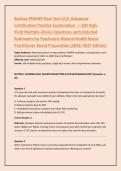
Barkley PMHNP Post-Test v2.0: Advanced
Certification Practice Examination — 100 High-
Yield Multiple-Choice Questions with Detailed
Rationales for Psychiatric-Mental Health Nurse
Practitioner Board Preparation (2026–2027 Edition)
Target Audience: Advanced practice nursing students, PMHNP candidates, and psychiatric nurse
practitioners preparing for ANCC or AANP board certification
Difficulty Level: Advanced/Hard
Format: 100 multiple-choice questions, single best answer, with comprehensive rationales
SECTION I: NEUROBIOLOGY, NEUROTRANSMITTERS & PSYCHOPHARMACOLOGY (Questions 1–
20)
Question 1
A 32-year-old male with treatment-resistant schizophrenia has been on clozapine for 6 months.
His absolute neutrophil count (ANC) drops to 800/µL. What is the most appropriate next step?
A. Continue clozapine and monitor ANC weekly
B. Reduce clozapine dose by 50%
C. Immediately discontinue clozapine and initiate ANC monitoring
D. Add granulocyte colony-stimulating factor (G-CSF)
Correct Answer: C
Rationale: Clozapine-induced neutropenia requires immediate discontinuation when ANC falls
below 1000/µL (or 500/µL in benign ethnic neutropenia). Daily ANC monitoring is required until
recovery. G-CSF may be considered but does not replace the need for discontinuation.
Question 2
Which cytochrome P450 enzyme is primarily responsible for the metabolism of most SSRIs, and
what is the clinical significance of genetic polymorphisms affecting this enzyme?
,A. CYP2D6; poor metabolizers may require lower doses
B. CYP3A4; extensive metabolizers require higher doses
C. CYP1A2; inhibitors require dose reduction
D. CYP2C19; inducers require dose adjustment
Correct Answer: A
Rationale: CYP2D6 is the primary enzyme metabolizing SSRIs like fluoxetine, paroxetine, and
fluvoxamine. Poor metabolizers have reduced clearance and may experience more side effects
or toxicity at standard doses.
Question 3
A 55-year-old patient with bipolar I disorder is started on lamotrigine for maintenance therapy.
What is the most important counseling point regarding lamotrigine titration?
A. The medication should be taken with food to enhance absorption
B. The dose should be titrated slowly over 6–8 weeks to reduce rash risk
C. The medication should be taken at bedtime to minimize sedation
D. Blood levels should be monitored weekly
Correct Answer: B
Rationale: Lamotrigine requires slow titration (starting at 25 mg daily, increasing by 25–50 mg
every 2 weeks) to minimize the risk of Stevens-Johnson syndrome and other serious rashes. The
FDA recommends a 6–8 week titration period.
Question 4
A patient is prescribed fluvoxamine for obsessive-compulsive disorder. Which of the following
drug interactions is most clinically significant?
A. Increased levels of warfarin
B. Decreased levels of lithium
C. Increased levels of theophylline
D. Decreased levels of valproic acid
Correct Answer: C
Rationale: Fluvoxamine is a potent inhibitor of CYP1A2 and CYP2C19. It significantly increases
theophylline levels, which can lead to toxicity. This interaction is more clinically significant than
others listed.
,Question 5
A 28-year-old female with generalized anxiety disorder is prescribed buspirone. Which of the
following statements about buspirone is correct?
A. It is a benzodiazepine with high abuse potential
B. It has an immediate onset of action
C. It may take 2–4 weeks to achieve therapeutic effects
D. It is contraindicated with SSRIs
Correct Answer: C
Rationale: Buspirone is a non-benzodiazepine anxiolytic that acts as a partial 5-HT1A agonist. It
has a delayed onset of action (2–4 weeks) and no known abuse potential, making it suitable for
chronic anxiety treatment.
Question 6
A patient on lithium therapy develops coarse tremor, ataxia, and confusion. Her serum lithium
level is 1.8 mEq/L. What is the priority intervention?
A. Increase lithium dose
B. Administer normal saline and consider hemodialysis
C. Administer sodium bicarbonate
D. Switch to extended-release formulation
Correct Answer: B
Rationale: A lithium level of 1.8 mEq/L with neurological symptoms indicates moderate to
severe lithium toxicity. Treatment includes IV normal saline to enhance excretion and
consideration of hemodialysis, especially in severe cases or renal impairment.
Question 7
Which of the following atypical antipsychotics has the lowest risk of extrapyramidal symptoms
(EPS) and hyperprolactinemia?
A. Risperidone
B. Olanzapine
C. Quetiapine
D. Aripiprazole
, Correct Answer: D
Rationale: Aripiprazole is a partial D2 receptor agonist, which results in the lowest risk of EPS
and hyperprolactinemia among atypical antipsychotics. Risperidone has the highest risk of
hyperprolactinemia.
Question 8
A 45-year-old patient with major depressive disorder is switched from fluoxetine to phenelzine.
What is the minimum washout period required between these medications?
A. 2 weeks
B. 4 weeks
C. 5 weeks
D. 6 weeks
Correct Answer: C
Rationale: Fluoxetine has a long half-life (1–3 days) and its active metabolite norfluoxetine has a
half-life of 7–15 days. A washout period of at least 5 weeks is recommended before starting an
MAOI to avoid serotonin syndrome.
Question 9
A patient with schizophrenia is prescribed haloperidol decanoate. Which of the following is the
most important monitoring parameter?
A. Complete blood count
B. Liver function tests
C. Electrocardiogram (QTc interval)
D. Thyroid function tests
Correct Answer: C
Rationale: Haloperidol is associated with QTc prolongation and risk of torsades de pointes. ECG
monitoring, particularly at baseline and during dose adjustments, is essential.
Question 10
Which of the following medications is a full agonist at GABA-A receptors and is primarily used
for alcohol withdrawal?
Certification Practice Examination — 100 High-
Yield Multiple-Choice Questions with Detailed
Rationales for Psychiatric-Mental Health Nurse
Practitioner Board Preparation (2026–2027 Edition)
Target Audience: Advanced practice nursing students, PMHNP candidates, and psychiatric nurse
practitioners preparing for ANCC or AANP board certification
Difficulty Level: Advanced/Hard
Format: 100 multiple-choice questions, single best answer, with comprehensive rationales
SECTION I: NEUROBIOLOGY, NEUROTRANSMITTERS & PSYCHOPHARMACOLOGY (Questions 1–
20)
Question 1
A 32-year-old male with treatment-resistant schizophrenia has been on clozapine for 6 months.
His absolute neutrophil count (ANC) drops to 800/µL. What is the most appropriate next step?
A. Continue clozapine and monitor ANC weekly
B. Reduce clozapine dose by 50%
C. Immediately discontinue clozapine and initiate ANC monitoring
D. Add granulocyte colony-stimulating factor (G-CSF)
Correct Answer: C
Rationale: Clozapine-induced neutropenia requires immediate discontinuation when ANC falls
below 1000/µL (or 500/µL in benign ethnic neutropenia). Daily ANC monitoring is required until
recovery. G-CSF may be considered but does not replace the need for discontinuation.
Question 2
Which cytochrome P450 enzyme is primarily responsible for the metabolism of most SSRIs, and
what is the clinical significance of genetic polymorphisms affecting this enzyme?
,A. CYP2D6; poor metabolizers may require lower doses
B. CYP3A4; extensive metabolizers require higher doses
C. CYP1A2; inhibitors require dose reduction
D. CYP2C19; inducers require dose adjustment
Correct Answer: A
Rationale: CYP2D6 is the primary enzyme metabolizing SSRIs like fluoxetine, paroxetine, and
fluvoxamine. Poor metabolizers have reduced clearance and may experience more side effects
or toxicity at standard doses.
Question 3
A 55-year-old patient with bipolar I disorder is started on lamotrigine for maintenance therapy.
What is the most important counseling point regarding lamotrigine titration?
A. The medication should be taken with food to enhance absorption
B. The dose should be titrated slowly over 6–8 weeks to reduce rash risk
C. The medication should be taken at bedtime to minimize sedation
D. Blood levels should be monitored weekly
Correct Answer: B
Rationale: Lamotrigine requires slow titration (starting at 25 mg daily, increasing by 25–50 mg
every 2 weeks) to minimize the risk of Stevens-Johnson syndrome and other serious rashes. The
FDA recommends a 6–8 week titration period.
Question 4
A patient is prescribed fluvoxamine for obsessive-compulsive disorder. Which of the following
drug interactions is most clinically significant?
A. Increased levels of warfarin
B. Decreased levels of lithium
C. Increased levels of theophylline
D. Decreased levels of valproic acid
Correct Answer: C
Rationale: Fluvoxamine is a potent inhibitor of CYP1A2 and CYP2C19. It significantly increases
theophylline levels, which can lead to toxicity. This interaction is more clinically significant than
others listed.
,Question 5
A 28-year-old female with generalized anxiety disorder is prescribed buspirone. Which of the
following statements about buspirone is correct?
A. It is a benzodiazepine with high abuse potential
B. It has an immediate onset of action
C. It may take 2–4 weeks to achieve therapeutic effects
D. It is contraindicated with SSRIs
Correct Answer: C
Rationale: Buspirone is a non-benzodiazepine anxiolytic that acts as a partial 5-HT1A agonist. It
has a delayed onset of action (2–4 weeks) and no known abuse potential, making it suitable for
chronic anxiety treatment.
Question 6
A patient on lithium therapy develops coarse tremor, ataxia, and confusion. Her serum lithium
level is 1.8 mEq/L. What is the priority intervention?
A. Increase lithium dose
B. Administer normal saline and consider hemodialysis
C. Administer sodium bicarbonate
D. Switch to extended-release formulation
Correct Answer: B
Rationale: A lithium level of 1.8 mEq/L with neurological symptoms indicates moderate to
severe lithium toxicity. Treatment includes IV normal saline to enhance excretion and
consideration of hemodialysis, especially in severe cases or renal impairment.
Question 7
Which of the following atypical antipsychotics has the lowest risk of extrapyramidal symptoms
(EPS) and hyperprolactinemia?
A. Risperidone
B. Olanzapine
C. Quetiapine
D. Aripiprazole
, Correct Answer: D
Rationale: Aripiprazole is a partial D2 receptor agonist, which results in the lowest risk of EPS
and hyperprolactinemia among atypical antipsychotics. Risperidone has the highest risk of
hyperprolactinemia.
Question 8
A 45-year-old patient with major depressive disorder is switched from fluoxetine to phenelzine.
What is the minimum washout period required between these medications?
A. 2 weeks
B. 4 weeks
C. 5 weeks
D. 6 weeks
Correct Answer: C
Rationale: Fluoxetine has a long half-life (1–3 days) and its active metabolite norfluoxetine has a
half-life of 7–15 days. A washout period of at least 5 weeks is recommended before starting an
MAOI to avoid serotonin syndrome.
Question 9
A patient with schizophrenia is prescribed haloperidol decanoate. Which of the following is the
most important monitoring parameter?
A. Complete blood count
B. Liver function tests
C. Electrocardiogram (QTc interval)
D. Thyroid function tests
Correct Answer: C
Rationale: Haloperidol is associated with QTc prolongation and risk of torsades de pointes. ECG
monitoring, particularly at baseline and during dose adjustments, is essential.
Question 10
Which of the following medications is a full agonist at GABA-A receptors and is primarily used
for alcohol withdrawal?