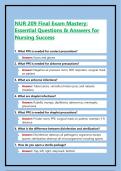
NUR 209 Final Exam Mastery:
Essential Questions & Answers for
Nursing Success
1. What PPE is needed for contact precautions?
• Answer: Gown and gloves
2. What PPE is needed for airborne precautions?
• Answer: Negative air pressure room, N95 respirator, surgical mask
on patient
3. What are airborne infections?
• Answer: Tuberculosis, varicella (chicken pox), and rubeola
(measles)
4. What are droplet infections?
• Answer: Rubella, mumps, diphtheria, adenovirus, meningitis,
pneumonia
5. What PPE is needed for droplet precautions?
• Answer: Private room, PPE, surgical mask on patient, maintain 3 ft
distance
6. What is the difference between disinfection and sterilization?
• Answer: Disinfection destroys all pathogenic organisms except
spores; sterilization destroys all microorganisms including spores
7. How do you open a sterile package?
• Answer: Top, left, right, step back, bottom
,8. What is "strikethrough" in sterile technique?
• Answer: When the sterile field gets wet, allowing microorganisms
underneath to migrate up and contaminate the field
9. What assessments are done when checking restraints?
• Answer: Capillary refill, peripheral pulses, pressure/edema,
numbness, pain
10. What is the purpose of a bed alarm?
• Answer: Uses audible reminders to prevent the patient from
getting up unassisted
11. What tests are used to determine signs of infection?
• Answer: WBC count, sed rate, blood cultures
12. What is the normal WBC count?
• Answer: 5,000 to 10,000/mm³
13. What is the chain of infection?
• Answer: Infectious agent → Reservoir → Portal of exit →
Transmission → Portal of entry → Susceptible host
14. What is the nurse's responsibility regarding informed consent?
• Answer: Witness the patient's signature on the consent form after
the surgeon's explanation
15. How do you clean an open intentional wound?
• Answer: Circles from center outward
Section 2: Vital Signs & Assessment
16. What does a BP cuff that is too large cause?
, • Answer: A falsely low reading
17. What does a BP cuff that is too small cause?
• Answer: A falsely high reading
18. What is used to auscultate and detect blood flow within vessels?
• Answer: Doppler ultrasound
19. What is a normal urine pH?
• Answer: 5-6 (slightly acidic)
20. What is the bladder volume when a patient feels the urge to
void?
• Answer: 150-250 mL
21. What is considered normal residual bladder volume?
• Answer: Less than 50 mL
22. What area is palpated to assess for urinary retention?
• Answer: Suprapubic area
23. What are signs of activity intolerance?
• Answer: Tachycardia, increased respirations and BP, sweating,
vasodilation, syncope (dizziness)
24. Describe "awake and alert" level of consciousness.
• Answer: Fully awake; oriented to person, place, and time; responds
to all stimuli including verbal commands
25. Describe "lethargic" level of consciousness.
• Answer: Appears drowsy or asleep most of the time but makes
spontaneous movements; can be aroused by gentle shaking and
saying patient's name
26. Describe "stuporous" level of consciousness.
Essential Questions & Answers for
Nursing Success
1. What PPE is needed for contact precautions?
• Answer: Gown and gloves
2. What PPE is needed for airborne precautions?
• Answer: Negative air pressure room, N95 respirator, surgical mask
on patient
3. What are airborne infections?
• Answer: Tuberculosis, varicella (chicken pox), and rubeola
(measles)
4. What are droplet infections?
• Answer: Rubella, mumps, diphtheria, adenovirus, meningitis,
pneumonia
5. What PPE is needed for droplet precautions?
• Answer: Private room, PPE, surgical mask on patient, maintain 3 ft
distance
6. What is the difference between disinfection and sterilization?
• Answer: Disinfection destroys all pathogenic organisms except
spores; sterilization destroys all microorganisms including spores
7. How do you open a sterile package?
• Answer: Top, left, right, step back, bottom
,8. What is "strikethrough" in sterile technique?
• Answer: When the sterile field gets wet, allowing microorganisms
underneath to migrate up and contaminate the field
9. What assessments are done when checking restraints?
• Answer: Capillary refill, peripheral pulses, pressure/edema,
numbness, pain
10. What is the purpose of a bed alarm?
• Answer: Uses audible reminders to prevent the patient from
getting up unassisted
11. What tests are used to determine signs of infection?
• Answer: WBC count, sed rate, blood cultures
12. What is the normal WBC count?
• Answer: 5,000 to 10,000/mm³
13. What is the chain of infection?
• Answer: Infectious agent → Reservoir → Portal of exit →
Transmission → Portal of entry → Susceptible host
14. What is the nurse's responsibility regarding informed consent?
• Answer: Witness the patient's signature on the consent form after
the surgeon's explanation
15. How do you clean an open intentional wound?
• Answer: Circles from center outward
Section 2: Vital Signs & Assessment
16. What does a BP cuff that is too large cause?
, • Answer: A falsely low reading
17. What does a BP cuff that is too small cause?
• Answer: A falsely high reading
18. What is used to auscultate and detect blood flow within vessels?
• Answer: Doppler ultrasound
19. What is a normal urine pH?
• Answer: 5-6 (slightly acidic)
20. What is the bladder volume when a patient feels the urge to
void?
• Answer: 150-250 mL
21. What is considered normal residual bladder volume?
• Answer: Less than 50 mL
22. What area is palpated to assess for urinary retention?
• Answer: Suprapubic area
23. What are signs of activity intolerance?
• Answer: Tachycardia, increased respirations and BP, sweating,
vasodilation, syncope (dizziness)
24. Describe "awake and alert" level of consciousness.
• Answer: Fully awake; oriented to person, place, and time; responds
to all stimuli including verbal commands
25. Describe "lethargic" level of consciousness.
• Answer: Appears drowsy or asleep most of the time but makes
spontaneous movements; can be aroused by gentle shaking and
saying patient's name
26. Describe "stuporous" level of consciousness.