

Written by students who passed Immediately available after payment Read online or as PDF Wrong document? Swap it for free 4.6 TrustPilot
logo-home
Document preview thumbnail
Preview 2 out of 13 pages
Exam (elaborations)

WEB WOC Seminars 2026 Certification Exam | 180+ Practice Questions & Verified Answers | Skin Anatomy, Wound Healing, MASD, Nutrition, Dermatology & WOC Nursing | Wound, Ostomy and Continence (WOC)

Document preview thumbnail
Preview 2 out of 13 pages

Prepare for the WEB WOC Seminars 2026 Certification Exam with this comprehensive study guide featuring 180+ verified practice questions and detailed answers covering the essential principles of wound, ostomy, and continence (WOC) nursing, skin anatomy and physiology, wound healing, moisture-associated skin damage (MASD), nutrition, patient education, and dermatologic assessment. This exam preparation resource provides an in-depth review of epidermal and dermal structure, skin cell function, wound healing physiology, nutritional support, dermatologic lesion identification, patient-centered education, and evidence-based WOC nursing interventions. Organized in a structured question-and-answer format, this guide strengthens clinical knowledge, reinforces evidence-based practice, and prepares candidates for success on the WEB WOC Seminars 2026 Certification Examination, WOC specialty education programs, and advanced wound care practice. This study guide comprehensively explores the anatomy and physiology of the skin, including epidermal turnover, keratinocytes, melanocytes, Langerhans cells, Merkel cells, rete ridges, dermal proteins, fibroblasts, immune surveillance cells, skin pH, dermal appendages, emollients, humectants, and skin barrier function. It also provides extensive coverage of Moisture-Associated Skin Damage (MASD), including peristomal MASD (PMASD), periwound MASD (PWMASD), intertriginous dermatitis (ITD), incontinence-associated dermatitis (IAD), and medical adhesive-related skin injury (MARSI). Additional topics include nutritional requirements for wound healing, protein, calorie, and fluid recommendations, micronutrients essential for tissue repair, stool-thickening and stool-loosening diets, OLDCART assessment, health belief model, developmental teaching strategies across the lifespan, PLISSIT communication model, primary and secondary skin lesion identification, vascular skin disorders, chronic venous insufficiency, hypertrophic scars, keloids, wound bed assessment, granulation tissue, hypergranulation, epithelialization, slough, eschar, epibole, and evidence-based patient education strategies for wound, ostomy, and continence care. This resource serves as an excellent review guide for WOC nurses, wound care specialists, ostomy nurses, continence nurses, advanced practice nurses, and healthcare professionals preparing for certification examinations, competency assessments, and specialty clinical practice. The content aligns with internationally recognized wound, ostomy, and continence nursing standards and is supported by authoritative references, including: Wound, Ostomy and Continence Nurses Society™ (WOCN®). Core Curriculum: Wound Management. Wound, Ostomy and Continence Nurses Society™ (WOCN®). Core Curriculum: Ostomy Management. Wound, Ostomy and Continence Nursing Certification Board (WOCNCB®). Certification Examination Content Outline. European Pressure Ulcer Advisory Panel (EPUAP), National Pressure Injury Advisory Panel (NPIAP), and Pan Pacific Pressure Injury Alliance (PPPIA). Prevention and Treatment of Pressure Ulcers/Injuries: Clinical Practice Guideline. National Pressure Injury Advisory Panel (NPIAP). Pressure Injury Prevention and Treatment Guidelines. Bryant RA, Nix DP. Acute and Chronic Wounds: Current Management Concepts. Baranoski S, Ayello EA. Wound Care Essentials: Practice Principles. Gray M, Colwell JC, Doughty D. Evidence-based publications on skin integrity, moisture-associated skin damage, and ostomy care. Academy of Nutrition and Dietetics. Nutrition Guidelines for Wound Healing. Centers for Disease Control and Prevention (CDC). Infection Prevention Guidelines for Healthcare Settings. Relevant Students: WOC Nursing students, Wound Care Nursing students, Ostomy Care Nursing students, Continence Nursing students, Certified Wound Ostomy Continence Nurse (CWOCN) candidates, Certified Wound Care Nurse (CWCN) candidates, Certified Ostomy Care Nurse (COCN) candidates, Registered Nurses (RN), Bachelor of Science in Nursing (BSN) students, Master of Science in Nursing (MSN) students, Advanced Practice Registered Nurse (APRN) students, Nurse Practitioner (NP) students, Medical-Surgical Nursing students, Dermatology Nursing students, Surgical Nursing students, Clinical Nurse Specialists (CNS), WOC certification candidates, Healthcare professionals specializing in wound, ostomy, and continence care. Keywords WEB WOC Seminars, WEB WOC Seminars 2026, WOC Nursing, Wound Care, Ostomy Care, Continence Nursing, CWOCN, CWCN, COCN, Skin Anatomy, Skin Physiology, Epidermis, Dermis, Keratinocytes, Melanocytes, Langerhans Cells, Merkel Cells, Moisture Associated Skin Damage, MASD, PMASD, PWMASD, Intertriginous Dermatitis, Incontinence Associated Dermatitis, IAD, MARSI, Wound Healing, Nutrition for Wound Healing, Protein Requirements, Skin Lesions, Macule, Papule, Vesicle, Plaque, Granulation Tissue, Hypergranulation, Epithelialization, Slough, Eschar, Epibole, Peristomal Skin Care, Dermatology, Practice Questions, Certification Exam, Exam Preparation

Content preview

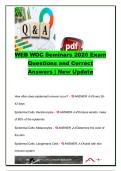
WEB WOC Seminars 2026 Exam
Questions and Correct
Answers | New Update


How often does epidermal turnover occur? - ANSWER ✔✔Every 26-

42 days


Epidermal Cells: Keratinocytes - ANSWER ✔✔Produce keratin, make

of 80% of the epidermis


Epidermal Cells: Melanocytes - ANSWER ✔✔Determine the color of

the skin


Epidermal Cells: Langerhans Cells - ANSWER ✔✔Assist with skin

immune system

, Epidermal Cells: Merkel Cells - ANSWER ✔✔Provide tactile

reception, produce nerve growth factor


Rete Ridges/Pegs - ANSWER ✔✔Fingerlike extensions that anchor

the epidermis to the dermis


Skin pH - ANSWER ✔✔4.5-6.5


Dermal proteins - ANSWER ✔✔Collagen and Elastin


Dermal Cells: Fibroblasts - ANSWER ✔✔Produce collagen and other

proteins


Dermal Cells: Mast cells, Macrophages, & Lymphocytes - ANSWER

✔✔Cells involved in immune surveillance


Dermal appendages - ANSWER ✔✔Hair follicles, sebaceous glands,

sweat glands, nails


Emollients - ANSWER ✔✔soften skin an provide lipids (i.e. silicone,

dimethicone, lanolin, ceramide


Humectants - ANSWER ✔✔add water to skin (i.e. urea, lactic acid,

glycerin)

Document information

Uploaded on
July 20, 2026
Number of pages
13
Written in
2025/2026
Type
Exam (elaborations)
Contains
Questions & answers
$18.99

Wrong document? Swap it for free Within 14 days of purchase and before downloading, you can choose a different document. You can simply spend the amount again.
Written by students who passed
Immediately available after payment
Read online or as PDF

Seller avatar
Reputation scores are based on the amount of documents a seller has sold for a fee and the reviews they have received for those documents. There are three levels: Bronze, Silver and Gold. The better the reputation, the more your can rely on the quality of the sellers work.
JOSHCLAY
3.5
(84)
Sold
392
Followers
15
Items
20549
Last sold
23 hours ago


Why students choose Stuvia

Created by fellow students, verified by reviews

Quality you can trust: written by students who passed their tests and reviewed by others who've used these notes.

Didn't get what you expected? Choose another document

No worries! You can instantly pick a different document that better fits what you're looking for.

Pay as you like, start learning right away

No subscription, no commitments. Pay the way you're used to via credit card and download your PDF document instantly.

Student with book image

“Bought, downloaded, and aced it. It really can be that simple.”

Alisha Student

Working on your references?

Create accurate citations in APA, MLA and Harvard with our free citation generator.

Working on your references?

Frequently asked questions

