
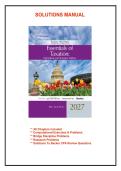
SOLUTIONS MANUAL
** All Chapters included
** Computational Exercises & Problems
** Bridge Discipline Problems
** Research Problems
** Solutions To Becker CPA Review Questions
,Table of Contents are given below
1. Introduction to Taxation.
2. Working with the Tax Law.
3. Taxes in the Financial Statements.
4. Gross Income.
5. Business Deductions.
6. Losses and Loss Limitations.
7. Property Transactions: Basis, Gain and Loss, and Nontaxable Exchanges.
8. Property Transactions: Capital Gains and Losses, Section 1231, and Recapture
Provisions.
9. Individuals as Taxpayers.
10. Individuals: Income, Deductions, and Credits.
11. Individuals as Employees and Proprietors.
12. Corporations: Organization, Capital Structure, and Operating Rules.
13. Corporations: Earnings & Profits and Distributions.
14. Partnerships and Limited Liability Entities.
15. S Corporations.
16. Multijurisdictional Taxation.
17. Business Tax Credits and the Alternative Minimum Tax.
18. Comparative Forms of Doing Business.
, Solution and Answer Guide: Nellen, Cuccia, Persellin, SWFT Essentials of Taxation: Individuals and Business
Entities 2027, 9798214058344; Chapter 1: Introduction to Taxation
Solution and Answer Guide
NELLEN, CUCCIA, PERSELLIN, SWFT ESSENTIALS OF TAXATION: INDIVIDUALS AND BUSINESS
ENTITIES 2027, 9798214058344; CHAPTER 1: INTRODUCTION TO TAXATION
TABLE OF CONTENTS
Problems ................................................................................................................................. 1
Bridge Discipline Problems .................................................................................................. 8
Research Problems ............................................................................................................... 9
Solutions To Becker CPA Review Questions ..................................................................... 11
PROBLEMS
1. (LO 1) Various answers are possible, including using the Key Terms at the end of each
chapter, referring to the Glossary (Appendix C), looking up the footnote resources to
the Internal Revenue Code in Appendix D, using chapter features (e.g., Global Tax
Issues, Ethics & Equity, Tax Planning, and Framework 1040), examining the tax forms
used in the chapters, and completing additional end-of-chapter assignments. All of
these resources will help students engage more deeply with the materials and help
their understanding.
2. (LO 3) If the collection is worth more than $1,000, the mother has probably made a gift
of the excess value to her son. There is a possibility that the transaction could result
in the assessment of a gift tax. Sales or other transactions between related parties are
subject to the arm’s length test. In this case, for example, would the mother have
made this sale for $1,000 if the purchaser had been an unrelated third party?
3. (LO 5, 9) Some tax and nontax considerations James should investigate include the
following:
State and local income taxes.
State and local sales taxes.
State and local property taxes.
Employee implications of the move (Will James lose current employees? Is the
labor market better in the new location? Is cost of living lower or higher in new
location?).
Logistics/transportation of products to customers (specifically document lower
costs).
State infrastructure (better in new location?).
What is the cost of the move? What is the payback period/ROI for the move?
1
, Solution and Answer Guide: Nellen, Cuccia, Persellin, SWFT Essentials of Taxation: Individuals and Business
Entities 2027, 9798214058344; Chapter 1: Introduction to Taxation
What are real estate prices for new facilities in the new location?
Are there any tax incentives from state or local agencies for relocating?
4. (LO 4) A tax is regressive if it represents a larger percentage of the income of a low-
income taxpayer relative to the income of a high-income taxpayer. Examples of
regressive taxes include employment taxes. A tax is progressive if it represents a larger
percentage of the income of a high-income taxpayer relative to the income of
a low-income taxpayer. The Federal income tax covering individuals is an example of a
progressive tax.
5. (LO 4)
a. Per the 2026 Tax Rate Schedule for single taxpayers, Madden faces statutory rates
of 10%, 12%, and 22%.
b. 22%. The marginal tax rate is most relevant for tax planning purposes because it
will indicate the tax effect of Madden’s next dollar of income (or deduction). For
example, if Madden were able to claim a $2,000 deduction for interest expense on
a domestic car loan, his tax savings would be $440 ($2,000 × 22%).
c. 14.8% ($10,970 ÷ $73,900).
d. 10.8% [$10,970 ÷ ($90,000 wages + $12,000 non-taxable fringe benefits)].
6. (LO 4) Tax rates can be measured several ways with each providing different
information.
a. Tax burdens are best measured using the effective rate. First, by taking into
account the taxpayer’s entire tax liability, unlike the marginal or statutory rate, the
effective rate is a more comprehensive measure of tax burden. Second, by
comparing a taxpayer’s tax liability to its ability to pay, the effective rate avoids any
problems with differences in the measure of the tax base across taxpayers.
b. The best rate to use when assessing the return of a new investment is the
marginal rate. The marginal rate focuses only on the tax applicable to a taxpayer’s
additional, or marginal, income, ignoring the tax related to other income the
taxpayer may have.
7. (LO 4) Generally, a tax rate structure is determined by what happens to the tax rate as
the tax base increases. However, tax rates can be measured several ways, potentially
impacting how the rate structure might be viewed.
a. With respect to its marginal rates, a sales tax is proportional. The statutory rate is
the same regardless of the amount of purchases a taxpayer makes.
b. With respect to its average rates, a sales tax is proportional as the percentage of
sales paid in taxes remains the same regardless of the tax base, the amount of
purchases a taxpayer makes.
c. With respect to its effective rates, the sales tax can best be described as
regressive. Taxpayers with higher income and, therefore, ability to pay the tax
typically must spend less of that income with a greater ability to save or invest. By
spending a smaller portion of their income, higher-income taxpayers will pay a
smaller portion of their income in sales taxes.
2
** All Chapters included
** Computational Exercises & Problems
** Bridge Discipline Problems
** Research Problems
** Solutions To Becker CPA Review Questions
,Table of Contents are given below
1. Introduction to Taxation.
2. Working with the Tax Law.
3. Taxes in the Financial Statements.
4. Gross Income.
5. Business Deductions.
6. Losses and Loss Limitations.
7. Property Transactions: Basis, Gain and Loss, and Nontaxable Exchanges.
8. Property Transactions: Capital Gains and Losses, Section 1231, and Recapture
Provisions.
9. Individuals as Taxpayers.
10. Individuals: Income, Deductions, and Credits.
11. Individuals as Employees and Proprietors.
12. Corporations: Organization, Capital Structure, and Operating Rules.
13. Corporations: Earnings & Profits and Distributions.
14. Partnerships and Limited Liability Entities.
15. S Corporations.
16. Multijurisdictional Taxation.
17. Business Tax Credits and the Alternative Minimum Tax.
18. Comparative Forms of Doing Business.
, Solution and Answer Guide: Nellen, Cuccia, Persellin, SWFT Essentials of Taxation: Individuals and Business
Entities 2027, 9798214058344; Chapter 1: Introduction to Taxation
Solution and Answer Guide
NELLEN, CUCCIA, PERSELLIN, SWFT ESSENTIALS OF TAXATION: INDIVIDUALS AND BUSINESS
ENTITIES 2027, 9798214058344; CHAPTER 1: INTRODUCTION TO TAXATION
TABLE OF CONTENTS
Problems ................................................................................................................................. 1
Bridge Discipline Problems .................................................................................................. 8
Research Problems ............................................................................................................... 9
Solutions To Becker CPA Review Questions ..................................................................... 11
PROBLEMS
1. (LO 1) Various answers are possible, including using the Key Terms at the end of each
chapter, referring to the Glossary (Appendix C), looking up the footnote resources to
the Internal Revenue Code in Appendix D, using chapter features (e.g., Global Tax
Issues, Ethics & Equity, Tax Planning, and Framework 1040), examining the tax forms
used in the chapters, and completing additional end-of-chapter assignments. All of
these resources will help students engage more deeply with the materials and help
their understanding.
2. (LO 3) If the collection is worth more than $1,000, the mother has probably made a gift
of the excess value to her son. There is a possibility that the transaction could result
in the assessment of a gift tax. Sales or other transactions between related parties are
subject to the arm’s length test. In this case, for example, would the mother have
made this sale for $1,000 if the purchaser had been an unrelated third party?
3. (LO 5, 9) Some tax and nontax considerations James should investigate include the
following:
State and local income taxes.
State and local sales taxes.
State and local property taxes.
Employee implications of the move (Will James lose current employees? Is the
labor market better in the new location? Is cost of living lower or higher in new
location?).
Logistics/transportation of products to customers (specifically document lower
costs).
State infrastructure (better in new location?).
What is the cost of the move? What is the payback period/ROI for the move?
1
, Solution and Answer Guide: Nellen, Cuccia, Persellin, SWFT Essentials of Taxation: Individuals and Business
Entities 2027, 9798214058344; Chapter 1: Introduction to Taxation
What are real estate prices for new facilities in the new location?
Are there any tax incentives from state or local agencies for relocating?
4. (LO 4) A tax is regressive if it represents a larger percentage of the income of a low-
income taxpayer relative to the income of a high-income taxpayer. Examples of
regressive taxes include employment taxes. A tax is progressive if it represents a larger
percentage of the income of a high-income taxpayer relative to the income of
a low-income taxpayer. The Federal income tax covering individuals is an example of a
progressive tax.
5. (LO 4)
a. Per the 2026 Tax Rate Schedule for single taxpayers, Madden faces statutory rates
of 10%, 12%, and 22%.
b. 22%. The marginal tax rate is most relevant for tax planning purposes because it
will indicate the tax effect of Madden’s next dollar of income (or deduction). For
example, if Madden were able to claim a $2,000 deduction for interest expense on
a domestic car loan, his tax savings would be $440 ($2,000 × 22%).
c. 14.8% ($10,970 ÷ $73,900).
d. 10.8% [$10,970 ÷ ($90,000 wages + $12,000 non-taxable fringe benefits)].
6. (LO 4) Tax rates can be measured several ways with each providing different
information.
a. Tax burdens are best measured using the effective rate. First, by taking into
account the taxpayer’s entire tax liability, unlike the marginal or statutory rate, the
effective rate is a more comprehensive measure of tax burden. Second, by
comparing a taxpayer’s tax liability to its ability to pay, the effective rate avoids any
problems with differences in the measure of the tax base across taxpayers.
b. The best rate to use when assessing the return of a new investment is the
marginal rate. The marginal rate focuses only on the tax applicable to a taxpayer’s
additional, or marginal, income, ignoring the tax related to other income the
taxpayer may have.
7. (LO 4) Generally, a tax rate structure is determined by what happens to the tax rate as
the tax base increases. However, tax rates can be measured several ways, potentially
impacting how the rate structure might be viewed.
a. With respect to its marginal rates, a sales tax is proportional. The statutory rate is
the same regardless of the amount of purchases a taxpayer makes.
b. With respect to its average rates, a sales tax is proportional as the percentage of
sales paid in taxes remains the same regardless of the tax base, the amount of
purchases a taxpayer makes.
c. With respect to its effective rates, the sales tax can best be described as
regressive. Taxpayers with higher income and, therefore, ability to pay the tax
typically must spend less of that income with a greater ability to save or invest. By
spending a smaller portion of their income, higher-income taxpayers will pay a
smaller portion of their income in sales taxes.
2


