

WGU C954 Information Technology Management Objective
Assessment Final Exam 2026/2027 | Verified Questions
Western Governors University (WGU) | Verified Q&A | IT Students and Technology
Professionals
Introduction
This original 75-question practice examination covers IT Governance and Strategic Alignment, IT Service
Management and Operations, IT Project and Change Management, and Information Security and Risk
Management. It reinforces strategic business alignment, service excellence, structured delivery, and proactive risk
mitigation to support course review and exam readiness. Important integrity note: This is independently authored
study material, not an actual WGU objective assessment, does not contain recalled or secure WGU items, and is not
produced, verified, or endorsed by Western Governors University. The user-specified blueprint may differ from the
current official course assessment. No resource can guarantee academic success or a passing result; students should
follow WGU course materials and academic-integrity requirements.
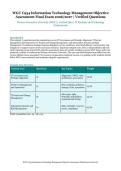
Content Area Overview
Content Area Questions Key Topics Weight
IT Governance and Alignment, COBIT, value,
19 25.3%
Strategic Alignment architecture, governance
IT Service Management ITIL, incidents, problems,
19 25.3%
and Operations changes, SLAs, operations
Life cycles, Agile,
IT Project and Change
18 Waterfall, stakeholders, 24.0%
Management
organizational change
Information Security and Risk, continuity, recovery,
19 25.3%
Risk Management access, compliance
Total: 75 questions (19 + 19 + 18 + 19).
WGU C954 Information Technology Management Objective Assessment Final Exam 2026/2027
,Domain: IT Governance and Strategic Alignment
1. Which statement most accurately describes IT governance purpose in information technology
management?
A. IT governance directs and monitors how technology supports enterprise objectives, delivers value, manages
risk, uses resources, and measures performance.
B. An IT steering committee prioritizes investments, resolves cross-functional tradeoffs, monitors value and risk,
and maintains business accountability for decisions.
C. NPV discounts future cash flows to present value; a positive NPV indicates expected value above the discount
rate under stated assumptions.
D. Data governance establishes ownership, definitions, quality, access, lineage, retention, privacy, and decision
rights for enterprise data.
Answer: A
Rationale: IT governance directs and monitors how technology supports enterprise objectives, delivers value,
manages risk, uses resources, and measures performance. This reflects standard IT governance, service
management, project delivery, and security practice.
2. Which statement most accurately describes governance versus management in information
technology management?
A. A business case compares expected benefits, costs, risks, alternatives, assumptions, dependencies, and
strategic fit to support an investment decision.
B. A KPI is a defined measure tied to a strategic objective, with an owner, data source, target, frequency, and
decision use.
C. Vendor governance defines due diligence, contracts, service performance, security, financial health,
concentration risk, escalation, audit rights, and exit planning.
D. Governance evaluates stakeholder needs, sets direction, and monitors outcomes; management plans, builds,
runs, and monitors activities within that direction.
Answer: D
Rationale: Governance evaluates stakeholder needs, sets direction, and monitors outcomes; management plans,
builds, runs, and monitors activities within that direction. This reflects standard IT governance, service
management, project delivery, and security practice.
3. Which statement most accurately describes strategic alignment in information technology
management?
A. IT portfolio management selects, balances, funds, and monitors initiatives as a group according to value, risk,
capacity, dependencies, and strategic priorities.
B. Leading indicators signal activities or conditions that may influence future results; lagging indicators report
outcomes after they occur.
C. Strategic alignment connects technology investments, capabilities, architecture, and priorities to measurable
business outcomes and operating needs.
D. An outsourcing decision weighs strategic importance, capability, cost, control, security, compliance,
scalability, dependency, and reversibility—not price alone.
Answer: C
Rationale: Strategic alignment connects technology investments, capabilities, architecture, and priorities to
measurable business outcomes and operating needs. This reflects standard IT governance, service management,
project delivery, and security practice.
4. Which statement most accurately describes COBIT objective in information technology
management?
A. TCO includes acquisition plus implementation, integration, licensing, infrastructure, support, training,
security, downtime, upgrades, and retirement costs.
B. COBIT provides an enterprise governance and management framework for information and technology using
objectives, components, performance management, and design factors.
C. Enterprise architecture aligns business, information, application, technology, and security domains to guide
coherent current and future states.
D. Ethical IT leadership considers privacy, accessibility, fairness, transparency, safety, sustainability, labor
impact, and responsible use beyond minimum legal compliance.
Answer: B
Rationale: COBIT provides an enterprise governance and management framework for information and
technology using objectives, components, performance management, and design factors. This reflects standard IT
governance, service management, project delivery, and security practice.
WGU C954 Information Technology Management Objective Assessment Final Exam 2026/2027
, 5. Which statement most accurately describes balanced scorecard in information technology
management?
A. A balanced scorecard translates strategy into linked objectives and measures across financial, customer,
internal-process, and learning or growth perspectives.
B. ROI compares net benefit with investment cost, but decision quality also requires timing, risk, nonfinancial
value, and uncertainty.
C. Data governance establishes ownership, definitions, quality, access, lineage, retention, privacy, and decision
rights for enterprise data.
D. Benefits realization assigns owners, measures outcomes after delivery, manages adoption dependencies, and
verifies whether promised business value actually occurs.
Answer: A
Rationale: A balanced scorecard translates strategy into linked objectives and measures across financial,
customer, internal-process, and learning or growth perspectives. This reflects standard IT governance, service
management, project delivery, and security practice.
6. Which statement most accurately describes IT steering committee in information technology
management?
A. NPV discounts future cash flows to present value; a positive NPV indicates expected value above the discount
rate under stated assumptions.
B. Vendor governance defines due diligence, contracts, service performance, security, financial health,
concentration risk, escalation, audit rights, and exit planning.
C. IT governance directs and monitors how technology supports enterprise objectives, delivers value, manages
risk, uses resources, and measures performance.
D. An IT steering committee prioritizes investments, resolves cross-functional tradeoffs, monitors value and
risk, and maintains business accountability for decisions.
Answer: D
Rationale: An IT steering committee prioritizes investments, resolves cross-functional tradeoffs, monitors value
and risk, and maintains business accountability for decisions. This reflects standard IT governance, service
management, project delivery, and security practice.
7. Which statement most accurately describes business case in information technology
management?
A. A KPI is a defined measure tied to a strategic objective, with an owner, data source, target, frequency, and
decision use.
B. An outsourcing decision weighs strategic importance, capability, cost, control, security, compliance,
scalability, dependency, and reversibility—not price alone.
C. A business case compares expected benefits, costs, risks, alternatives, assumptions, dependencies, and
strategic fit to support an investment decision.
D. Governance evaluates stakeholder needs, sets direction, and monitors outcomes; management plans, builds,
runs, and monitors activities within that direction.
Answer: C
Rationale: A business case compares expected benefits, costs, risks, alternatives, assumptions, dependencies, and
strategic fit to support an investment decision. This reflects standard IT governance, service management, project
delivery, and security practice.
8. Which statement most accurately describes portfolio management in information technology
management?
A. Leading indicators signal activities or conditions that may influence future results; lagging indicators report
outcomes after they occur.
B. IT portfolio management selects, balances, funds, and monitors initiatives as a group according to value, risk,
capacity, dependencies, and strategic priorities.
C. Ethical IT leadership considers privacy, accessibility, fairness, transparency, safety, sustainability, labor
impact, and responsible use beyond minimum legal compliance.
D. Strategic alignment connects technology investments, capabilities, architecture, and priorities to measurable
business outcomes and operating needs.
Answer: B
Rationale: IT portfolio management selects, balances, funds, and monitors initiatives as a group according to
value, risk, capacity, dependencies, and strategic priorities. This reflects standard IT governance, service
management, project delivery, and security practice.
WGU C954 Information Technology Management Objective Assessment Final Exam 2026/2027
Assessment Final Exam 2026/2027 | Verified Questions
Western Governors University (WGU) | Verified Q&A | IT Students and Technology
Professionals
Introduction
This original 75-question practice examination covers IT Governance and Strategic Alignment, IT Service
Management and Operations, IT Project and Change Management, and Information Security and Risk
Management. It reinforces strategic business alignment, service excellence, structured delivery, and proactive risk
mitigation to support course review and exam readiness. Important integrity note: This is independently authored
study material, not an actual WGU objective assessment, does not contain recalled or secure WGU items, and is not
produced, verified, or endorsed by Western Governors University. The user-specified blueprint may differ from the
current official course assessment. No resource can guarantee academic success or a passing result; students should
follow WGU course materials and academic-integrity requirements.
Content Area Overview
Content Area Questions Key Topics Weight
IT Governance and Alignment, COBIT, value,
19 25.3%
Strategic Alignment architecture, governance
IT Service Management ITIL, incidents, problems,
19 25.3%
and Operations changes, SLAs, operations
Life cycles, Agile,
IT Project and Change
18 Waterfall, stakeholders, 24.0%
Management
organizational change
Information Security and Risk, continuity, recovery,
19 25.3%
Risk Management access, compliance
Total: 75 questions (19 + 19 + 18 + 19).
WGU C954 Information Technology Management Objective Assessment Final Exam 2026/2027
,Domain: IT Governance and Strategic Alignment
1. Which statement most accurately describes IT governance purpose in information technology
management?
A. IT governance directs and monitors how technology supports enterprise objectives, delivers value, manages
risk, uses resources, and measures performance.
B. An IT steering committee prioritizes investments, resolves cross-functional tradeoffs, monitors value and risk,
and maintains business accountability for decisions.
C. NPV discounts future cash flows to present value; a positive NPV indicates expected value above the discount
rate under stated assumptions.
D. Data governance establishes ownership, definitions, quality, access, lineage, retention, privacy, and decision
rights for enterprise data.
Answer: A
Rationale: IT governance directs and monitors how technology supports enterprise objectives, delivers value,
manages risk, uses resources, and measures performance. This reflects standard IT governance, service
management, project delivery, and security practice.
2. Which statement most accurately describes governance versus management in information
technology management?
A. A business case compares expected benefits, costs, risks, alternatives, assumptions, dependencies, and
strategic fit to support an investment decision.
B. A KPI is a defined measure tied to a strategic objective, with an owner, data source, target, frequency, and
decision use.
C. Vendor governance defines due diligence, contracts, service performance, security, financial health,
concentration risk, escalation, audit rights, and exit planning.
D. Governance evaluates stakeholder needs, sets direction, and monitors outcomes; management plans, builds,
runs, and monitors activities within that direction.
Answer: D
Rationale: Governance evaluates stakeholder needs, sets direction, and monitors outcomes; management plans,
builds, runs, and monitors activities within that direction. This reflects standard IT governance, service
management, project delivery, and security practice.
3. Which statement most accurately describes strategic alignment in information technology
management?
A. IT portfolio management selects, balances, funds, and monitors initiatives as a group according to value, risk,
capacity, dependencies, and strategic priorities.
B. Leading indicators signal activities or conditions that may influence future results; lagging indicators report
outcomes after they occur.
C. Strategic alignment connects technology investments, capabilities, architecture, and priorities to measurable
business outcomes and operating needs.
D. An outsourcing decision weighs strategic importance, capability, cost, control, security, compliance,
scalability, dependency, and reversibility—not price alone.
Answer: C
Rationale: Strategic alignment connects technology investments, capabilities, architecture, and priorities to
measurable business outcomes and operating needs. This reflects standard IT governance, service management,
project delivery, and security practice.
4. Which statement most accurately describes COBIT objective in information technology
management?
A. TCO includes acquisition plus implementation, integration, licensing, infrastructure, support, training,
security, downtime, upgrades, and retirement costs.
B. COBIT provides an enterprise governance and management framework for information and technology using
objectives, components, performance management, and design factors.
C. Enterprise architecture aligns business, information, application, technology, and security domains to guide
coherent current and future states.
D. Ethical IT leadership considers privacy, accessibility, fairness, transparency, safety, sustainability, labor
impact, and responsible use beyond minimum legal compliance.
Answer: B
Rationale: COBIT provides an enterprise governance and management framework for information and
technology using objectives, components, performance management, and design factors. This reflects standard IT
governance, service management, project delivery, and security practice.
WGU C954 Information Technology Management Objective Assessment Final Exam 2026/2027
, 5. Which statement most accurately describes balanced scorecard in information technology
management?
A. A balanced scorecard translates strategy into linked objectives and measures across financial, customer,
internal-process, and learning or growth perspectives.
B. ROI compares net benefit with investment cost, but decision quality also requires timing, risk, nonfinancial
value, and uncertainty.
C. Data governance establishes ownership, definitions, quality, access, lineage, retention, privacy, and decision
rights for enterprise data.
D. Benefits realization assigns owners, measures outcomes after delivery, manages adoption dependencies, and
verifies whether promised business value actually occurs.
Answer: A
Rationale: A balanced scorecard translates strategy into linked objectives and measures across financial,
customer, internal-process, and learning or growth perspectives. This reflects standard IT governance, service
management, project delivery, and security practice.
6. Which statement most accurately describes IT steering committee in information technology
management?
A. NPV discounts future cash flows to present value; a positive NPV indicates expected value above the discount
rate under stated assumptions.
B. Vendor governance defines due diligence, contracts, service performance, security, financial health,
concentration risk, escalation, audit rights, and exit planning.
C. IT governance directs and monitors how technology supports enterprise objectives, delivers value, manages
risk, uses resources, and measures performance.
D. An IT steering committee prioritizes investments, resolves cross-functional tradeoffs, monitors value and
risk, and maintains business accountability for decisions.
Answer: D
Rationale: An IT steering committee prioritizes investments, resolves cross-functional tradeoffs, monitors value
and risk, and maintains business accountability for decisions. This reflects standard IT governance, service
management, project delivery, and security practice.
7. Which statement most accurately describes business case in information technology
management?
A. A KPI is a defined measure tied to a strategic objective, with an owner, data source, target, frequency, and
decision use.
B. An outsourcing decision weighs strategic importance, capability, cost, control, security, compliance,
scalability, dependency, and reversibility—not price alone.
C. A business case compares expected benefits, costs, risks, alternatives, assumptions, dependencies, and
strategic fit to support an investment decision.
D. Governance evaluates stakeholder needs, sets direction, and monitors outcomes; management plans, builds,
runs, and monitors activities within that direction.
Answer: C
Rationale: A business case compares expected benefits, costs, risks, alternatives, assumptions, dependencies, and
strategic fit to support an investment decision. This reflects standard IT governance, service management, project
delivery, and security practice.
8. Which statement most accurately describes portfolio management in information technology
management?
A. Leading indicators signal activities or conditions that may influence future results; lagging indicators report
outcomes after they occur.
B. IT portfolio management selects, balances, funds, and monitors initiatives as a group according to value, risk,
capacity, dependencies, and strategic priorities.
C. Ethical IT leadership considers privacy, accessibility, fairness, transparency, safety, sustainability, labor
impact, and responsible use beyond minimum legal compliance.
D. Strategic alignment connects technology investments, capabilities, architecture, and priorities to measurable
business outcomes and operating needs.
Answer: B
Rationale: IT portfolio management selects, balances, funds, and monitors initiatives as a group according to
value, risk, capacity, dependencies, and strategic priorities. This reflects standard IT governance, service
management, project delivery, and security practice.
WGU C954 Information Technology Management Objective Assessment Final Exam 2026/2027


