

MB1001 Part 1 MCQ questions and answers
Study online at https://quizlet.com/_fw9kke
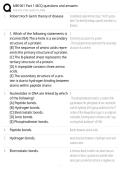
1. Robert Koch Germ theory of disease Established experimental steps, "Koch's postu-
lates", for directly linking a specific microbe to a
disease
2. 1. Which of the following statements is C
incorrect?[A] The a-helix is a secondary the tertiary structure of a protein
structure of a protein. - The B pleated sheet represents the secondary
[B] The sequence of amino acids repre- structure of a protein.
sents the primary structure of a protein.
[C] The B-pleated sheet represents the
tertiary structure of a protein.
[D] A tripeptide contains three amino
acids.
[E] The secondary structure of a pro-
tein is due to hydrogen binding between
atoms within peptide chains
3. Nucleotides in DNA are linked by which E
of the following? - The phosphodiester bond is a covalent link-
[A] Peptide bonds. age between the phosphate of one nucleotide
[B] Hydrogen bonds. and the hydroxyl (OH) group attached to the 3′
[C] Electrostatic bonds. carbon of the deoxyribose sugar in an adjacent
[D] Ionic bonds. nucleotide, forming what is known as the "sug-
[E] Phosphodiester bonds. ar-phosphate backbone" of DNA.
4. Peptide bonds. Bonds between amino acids
5. Hydrogen bonds. weak attraction between a hydrogen atom and
another atom
6. Electrostatic bonds. a chemical bond in which one atom loses an
electron to form a positive ion and the other
atom gains an electron to form a negative ion.
, MB1001 Part 1 MCQ questions and answers
Study online at https://quizlet.com/_fw9kke
7. Ionic bonds. The ionic bond is the electrostatic force of at-
traction between a positively charged metal ion
and a negatively charged non-metal ion. Metals
form positive ions because they lose electrons
to become stable.
8. Which of the following scientists devel- Louis Pasteur developed a vaccine for rabies.
oped a vaccine for rabies?
[A] Louis Pasteur.
[B] Edward Jenner.
[C] Richard Petri.
[D] Fannie Hesse.
[E] Robert Koch.
9. Edward Jenner developed a vaccine for smallpox
10. Richard Petri. developed the petri dish
11. Fannie Hesse. suggested that agar could be used as a solidi-
fying agent
12. Which of the following statements is Thymine pairs with Adenine.
true?
[A] Adenine pairs with Guanine.
[B] Guanine pairs with Thymine.
[C] Thymine pairs with Adenine.
[D] Cytosine pairs with Thymine.
[E] Uracil pairs with Cytosine.
13. Adenine pairs with thymine
14. Guanine pairs with cytosine
, MB1001 Part 1 MCQ questions and answers
Study online at https://quizlet.com/_fw9kke
15. Cytosine pairs with guanine (G)
16. Uracil pairs with adenine and replaces thymine
17. 5. Which of the following is not a con- Alanine -Alanine is an amino acid that is used to
stituent of DNA make proteins. It is used to break down trypto-
A] Alanine phan and vitamin B-6. It is a source of energy
[B] Thymine for muscles and the central nervous system.
[C] Guanine
[D] Cytosine
[E] Deoxyribose
18. Thymine a pyrimidine base C5H6N2O2 that is one of the
four bases coding genetic information in the
polynucleotide chain of DNA
19. Guanine A component of nucleic acids that carries hered-
itary information in DNA and RNA in cells. Chem-
ically, it is a purine base.
20. Cytosine A component of nucleic acids that carries hered-
itary information in DNA and RNA in cells. Chem-
ically, it is a pyrimidine base.
21. Deoxyribose A five-carbon sugar that is a component of DNA
nucleotides
22. Spontaneous generation was finally dis- Louis Pasteur - he germ theory of disease and
proved by for inventing the process of pasteurization -
A] Jan Baptista van Helmont which is named after him - to preserve foods.
[B] Louis Pasteur
[C] Edward Jenner
Study online at https://quizlet.com/_fw9kke
1. Robert Koch Germ theory of disease Established experimental steps, "Koch's postu-
lates", for directly linking a specific microbe to a
disease
2. 1. Which of the following statements is C
incorrect?[A] The a-helix is a secondary the tertiary structure of a protein
structure of a protein. - The B pleated sheet represents the secondary
[B] The sequence of amino acids repre- structure of a protein.
sents the primary structure of a protein.
[C] The B-pleated sheet represents the
tertiary structure of a protein.
[D] A tripeptide contains three amino
acids.
[E] The secondary structure of a pro-
tein is due to hydrogen binding between
atoms within peptide chains
3. Nucleotides in DNA are linked by which E
of the following? - The phosphodiester bond is a covalent link-
[A] Peptide bonds. age between the phosphate of one nucleotide
[B] Hydrogen bonds. and the hydroxyl (OH) group attached to the 3′
[C] Electrostatic bonds. carbon of the deoxyribose sugar in an adjacent
[D] Ionic bonds. nucleotide, forming what is known as the "sug-
[E] Phosphodiester bonds. ar-phosphate backbone" of DNA.
4. Peptide bonds. Bonds between amino acids
5. Hydrogen bonds. weak attraction between a hydrogen atom and
another atom
6. Electrostatic bonds. a chemical bond in which one atom loses an
electron to form a positive ion and the other
atom gains an electron to form a negative ion.
, MB1001 Part 1 MCQ questions and answers
Study online at https://quizlet.com/_fw9kke
7. Ionic bonds. The ionic bond is the electrostatic force of at-
traction between a positively charged metal ion
and a negatively charged non-metal ion. Metals
form positive ions because they lose electrons
to become stable.
8. Which of the following scientists devel- Louis Pasteur developed a vaccine for rabies.
oped a vaccine for rabies?
[A] Louis Pasteur.
[B] Edward Jenner.
[C] Richard Petri.
[D] Fannie Hesse.
[E] Robert Koch.
9. Edward Jenner developed a vaccine for smallpox
10. Richard Petri. developed the petri dish
11. Fannie Hesse. suggested that agar could be used as a solidi-
fying agent
12. Which of the following statements is Thymine pairs with Adenine.
true?
[A] Adenine pairs with Guanine.
[B] Guanine pairs with Thymine.
[C] Thymine pairs with Adenine.
[D] Cytosine pairs with Thymine.
[E] Uracil pairs with Cytosine.
13. Adenine pairs with thymine
14. Guanine pairs with cytosine
, MB1001 Part 1 MCQ questions and answers
Study online at https://quizlet.com/_fw9kke
15. Cytosine pairs with guanine (G)
16. Uracil pairs with adenine and replaces thymine
17. 5. Which of the following is not a con- Alanine -Alanine is an amino acid that is used to
stituent of DNA make proteins. It is used to break down trypto-
A] Alanine phan and vitamin B-6. It is a source of energy
[B] Thymine for muscles and the central nervous system.
[C] Guanine
[D] Cytosine
[E] Deoxyribose
18. Thymine a pyrimidine base C5H6N2O2 that is one of the
four bases coding genetic information in the
polynucleotide chain of DNA
19. Guanine A component of nucleic acids that carries hered-
itary information in DNA and RNA in cells. Chem-
ically, it is a purine base.
20. Cytosine A component of nucleic acids that carries hered-
itary information in DNA and RNA in cells. Chem-
ically, it is a pyrimidine base.
21. Deoxyribose A five-carbon sugar that is a component of DNA
nucleotides
22. Spontaneous generation was finally dis- Louis Pasteur - he germ theory of disease and
proved by for inventing the process of pasteurization -
A] Jan Baptista van Helmont which is named after him - to preserve foods.
[B] Louis Pasteur
[C] Edward Jenner


