NREMT Paramedic Exam Review Questions and 100% Correct
Answers 2026/27 Update - CAHE
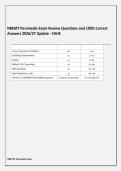
CATEGORY QUESTIONS QUESTION #s
Airway, Respiration & Ventilation 20 1–20
Cardiology & Resuscitation 25 21–45
Trauma 20 46–65
Medical / OB / Gynecology 40 66–105
EMS Operations 20 106–125
Special Populations / Misc 25 126–150
CLINICAL JUDGMENT SCENARIOS (separate) 7 scenarios (35 questions) CJ-1 through CJ-7
NREMT Paramedic Exam
, AIRWAY, RESPIRATION & VENTILATION
(Questions 1–20)
1. You arrive to find an unresponsive 42-year-old male with snoring respirations. Jaw thrust and airway
repositioning do not open the airway. The patient has no gag reflex. Which airway adjunct is MOST appropriate?
A. Nasopharyngeal airway (NPA)
B. Oropharyngeal airway (OPA)
C. Supraglottic airway
D. Bag-valve mask only
CORRECT ANSWER: B | RATIONALE: An OPA is indicated in an unconscious patient with no gag reflex. The absence
of a gag reflex makes an OPA safe and appropriate. An NPA is used when a gag reflex is present. A supraglottic device is not
indicated without first attempting basic adjuncts.
2. You are ventilating an intubated patient and notice the EtCO2 waveform is flat and reads 0 mmHg. The most
likely cause is:
A. Bronchospasm
B. Right mainstem intubation
C. Esophageal intubation
D. Tension pneumothorax
CORRECT ANSWER: C | RATIONALE: A flat EtCO2 of zero in a ventilated patient strongly indicates esophageal
intubation. No CO2 is exhaled from the esophagus. Bronchospasm causes a shark fin waveform. Right mainstem intubation causes
absent sounds on the left but EtCO2 would still be present.
3. A 58-year-old patient with severe COPD is in respiratory distress with SpO2 of 86%. The patient is alert and
cooperative. Which intervention is MOST appropriate?
A. BVM at 15 L/min O2
B. CPAP at 5 cmH2O with FiO2 to maintain SpO2 88–92%
C. Withhold supplemental oxygen due to hypoxic drive
D. Non-rebreather mask at 15 L/min to maximize oxygenation
CORRECT ANSWER: B | RATIONALE: CPAP is indicated for alert cooperative patients with COPD exacerbation and
hypoxia. Targeting SpO2 of 88–92% is appropriate for COPD. Withholding oxygen from a hypoxic patient is dangerous. BVM is
not indicated in an alert, spontaneously breathing patient.
4. A 19-year-old is found unresponsive after a suspected heroin overdose. After 2 mg of naloxone, the patient is awake
but combative. Two minutes later the patient becomes increasingly drowsy again. What is the MOST appropriate
next action?
A. Administer an additional dose of nalo\one
B. Initiate RSI
C. Supraglottic airway placement
D. Insert NPA and transport without further naloxone
CORRECT ANSWER: A | RATIONALE: Naloxone has a shorter half-life than most opioids. Resedation after initial
response is expected and requires repeat naloxone dosing. The patient initially responded, confirming opioid toxidrome. RSI i s
premature unless airway protection fails entirely.
5. During RSI of a burn patient (48 hours post-injury), you are selecting a paralytic. The MOST appropriate choice
is:
A. Succinylcholine 1.5 mg/kg
B. Vecuronium 0.1 mg/kg
C. Rocuronium 1.2 mg/kg
D. Pancuronium 0.1 mg/kg
NREMT Paramedic Exam
, CORRECT ANSWER: C | RATIONALE: Succinylcholine is contraindicated in burn patients beyond the first 24 hours due
to up-regulation of acetylcholine receptors, causing massive potassium release and potentially fatal hyperkalemia. Rocuronium is the
safe non-depolarizing alternative for RSI.
6. You intubate a patient and hear diminished breath sounds on the left with good sounds on the right. EtCO2
waveform is present. The MOST likely cause is:
A. Left tension pneumothorax
B. Right mainstem intubation
C. Esophageal intubation
D. Left hemothorax
CORRECT ANSWER: B | RATIONALE: Right mainstem intubation is the most common tube misplacement. The right
mainstem bronchus angles more acutely, making it the path of least resistance. This produces absent or diminished sounds on the left
with normal sounds on the right. EtCO2 presence confirms tracheal placement.
7. A patient in respiratory arrest was intubated. Peak inspiratory pressures are now elevated and the ventilator
alarms for high pressure. You have confirmed tube position is correct and there is no kink. What is your NEXT step
in the DOPE assessment?
A. Reintubate the patient
B. Suction the airway
C. Decompress for tension pneumothorax
D. Switch to BVM and check for equipment failure
CORRECT ANSWER: B | RATIONALE: DOPE: Displacement (confirmed correct), Obstruction (next — suction for
secretions, check for biting), Pneumothorax, Equipment failure. The sequence should proceed in order. Suction addresses obstruction
before escalating to pneumothorax decompression.
8. For which of the following patients is CPAP CONTRAINDICATED?
A. 64-year-old with CHF and SpO2 of 82%, awake and alert
B. 48-year-old with COPD exacerbation, awake, RR 28
C. 55-year-old with pulmonary edema, cooperative, BP 160/90
D. 38-year-old with GCS 6 and suspected aspiration
CORRECT ANSWER: D | RATIONALE: CPAP requires patient cooperation and the ability to protect the airway. GCS 6
indicates the patient cannot maintain airway patency or cooperate. CPAP in this patient risks aspiration and is contraindicated.
The other patients are alert and cooperative.
9. A 60-year-old has an extensive mid-face fracture with significant bleeding into the oropharynx. You are unable to
visualize the cords due to blood. All oral intubation attempts have failed. The patient's SpO2 is dropping to 78%.
What is your next intervention?
A. Repeat DL attempt with a smaller blade
B. Supraglottic airway
C. Surgical cricothyrotomy
D. Nasotracheal intubation
CORRECT ANSWER: C | RATIONALE: This is a CICO (Cannot Intubate, Cannot Oxygenate) scenario. Failed oral
intubation with ongoing desaturation is the indication for surgical cricothyrotomy. Nasotracheal intubation is contraindicate d with
mid-face trauma. Supraglottic devices may not seal adequately with significant airway bleeding.
10. A capnography waveform shows a characteristic 'shark fin' pattern. This is MOST consistent with:
A. Esophageal intubation
B. Bronchospasm / obstructive airway disease
C. Proper tube placement and normal ventilation
D. Cardiac arrest with no perfusion
CORRECT ANSWER: B | RATIONALE: The shark fin (sloped expiratory plateau) waveform reflects incomplete CO2
elimination due to bronchospasm. Air trapping causes gradual CO2 release during expiration. This is classic for asthma or COP D
exacerbation. Esophageal intubation gives a flat line.
NREMT Paramedic Exam
, 11. You are preparing to intubate a trauma patient with suspected increased ICP. Which induction agent is MOST
appropriate?
A. Etomidate 0.3 mg/kg
B. Propofol 2 mg/kg
C. Midazolam 0.3 mg/kg
D. Ketamine 2 mg/kg
CORRECT ANSWER: A | RATIONALE: Etomidate is hemodynamically neutral and does not significantly affect cerebral
perfusion pressure. Although ketamine has been reconsidered for head injury, etomidate remains the classic recommended agent for
hemodynamically stable trauma with suspected ICP elevation. Propofol and midazolam both cause hypotension, which is
devastating in TBI.
12. A 6-year-old child in respiratory arrest has been ventilated by BVM. You are preparing to intubate. What is the
MOST reliable method to confirm ETT placement?
A. Bilateral breath sounds with bag compression
B. Chest rise visualization
C. Continuous EtCO2 waveform capnography
D. Absence of gastric sounds over epigastrium
CORRECT ANSWER: C | RATIONALE: EtCO2 waveform capnography is the gold standard for ETT confirmation in
all patients including pediatrics. Breath sounds and chest rise can be misleading. Absence of gastric sounds is supportive bu t not
definitive.
13. A patient was emergently intubated and is now on a transport ventilator with AC/VC mode, Vt 500 mL, RR 14,
PEEP 5, FiO2 100%. During transport you note the patient has tachycardia, hypertension, and tears. What is the
MOST appropriate intervention?
A. Decrease Vt to 450 mL
B. Increase PEEP to 10
C. Administer midazolam and fentanyl
D. Switch ventilator mode to SIMV
CORRECT ANSWER: C | RATIONALE: Tachycardia, hypertension, and tears in a paralyzed patient indicate inadequate
sedation and analgesia. The ventilator settings are irrelevant to this problem. The patient is aware but paralyzed — this is an
ethical emergency requiring immediate sedation and pain management.
14. Which of the following is the CORRECT location for needle thoracostomy in a tension pneumothorax?
A. 5th intercostal space, midaxillary line
B. 2nd intercostal space, midclavicular line
C. 4th intercostal space, midclavicular line
D. 2nd intercostal space, midaxillary line
CORRECT ANSWER: B | RATIONALE: Traditional needle decompression for tension pneumothorax is performed at the
2nd intercostal space, midclavicular line (anterior approach). The 4th–5th ICS anterior axillary line is an alternative with better
success rates due to thinner chest wall. The 2nd ICS MCL is the NREMT standard answer.
15. An NPA is being considered for a semiconscious patient with a gag reflex. You note significant periorbital
ecchymosis (raccoon eyes) and clear fluid from the nose. What action is MOST appropriate?
A. Insert the NPA carefully on the right side
B. Avoid the NPA; use an OPA instead
C. Avoid all airway adjuncts and use head positioning only
D. Attempt nasal intubation instead
CORRECT ANSWER: B | RATIONALE: Raccoon eyes and cerebrospinal fluid rhinorrhea are signs of a basilar skull
fracture. NPA is absolutely contraindicated with suspected skull base fracture due to risk of intracranial placement. An OPA is
appropriate if the patient lacks a protective gag reflex. If the gag reflex is intact, jaw thrust and positioning are used.
NREMT Paramedic Exam
Answers 2026/27 Update - CAHE
CATEGORY QUESTIONS QUESTION #s
Airway, Respiration & Ventilation 20 1–20
Cardiology & Resuscitation 25 21–45
Trauma 20 46–65
Medical / OB / Gynecology 40 66–105
EMS Operations 20 106–125
Special Populations / Misc 25 126–150
CLINICAL JUDGMENT SCENARIOS (separate) 7 scenarios (35 questions) CJ-1 through CJ-7
NREMT Paramedic Exam
, AIRWAY, RESPIRATION & VENTILATION
(Questions 1–20)
1. You arrive to find an unresponsive 42-year-old male with snoring respirations. Jaw thrust and airway
repositioning do not open the airway. The patient has no gag reflex. Which airway adjunct is MOST appropriate?
A. Nasopharyngeal airway (NPA)
B. Oropharyngeal airway (OPA)
C. Supraglottic airway
D. Bag-valve mask only
CORRECT ANSWER: B | RATIONALE: An OPA is indicated in an unconscious patient with no gag reflex. The absence
of a gag reflex makes an OPA safe and appropriate. An NPA is used when a gag reflex is present. A supraglottic device is not
indicated without first attempting basic adjuncts.
2. You are ventilating an intubated patient and notice the EtCO2 waveform is flat and reads 0 mmHg. The most
likely cause is:
A. Bronchospasm
B. Right mainstem intubation
C. Esophageal intubation
D. Tension pneumothorax
CORRECT ANSWER: C | RATIONALE: A flat EtCO2 of zero in a ventilated patient strongly indicates esophageal
intubation. No CO2 is exhaled from the esophagus. Bronchospasm causes a shark fin waveform. Right mainstem intubation causes
absent sounds on the left but EtCO2 would still be present.
3. A 58-year-old patient with severe COPD is in respiratory distress with SpO2 of 86%. The patient is alert and
cooperative. Which intervention is MOST appropriate?
A. BVM at 15 L/min O2
B. CPAP at 5 cmH2O with FiO2 to maintain SpO2 88–92%
C. Withhold supplemental oxygen due to hypoxic drive
D. Non-rebreather mask at 15 L/min to maximize oxygenation
CORRECT ANSWER: B | RATIONALE: CPAP is indicated for alert cooperative patients with COPD exacerbation and
hypoxia. Targeting SpO2 of 88–92% is appropriate for COPD. Withholding oxygen from a hypoxic patient is dangerous. BVM is
not indicated in an alert, spontaneously breathing patient.
4. A 19-year-old is found unresponsive after a suspected heroin overdose. After 2 mg of naloxone, the patient is awake
but combative. Two minutes later the patient becomes increasingly drowsy again. What is the MOST appropriate
next action?
A. Administer an additional dose of nalo\one
B. Initiate RSI
C. Supraglottic airway placement
D. Insert NPA and transport without further naloxone
CORRECT ANSWER: A | RATIONALE: Naloxone has a shorter half-life than most opioids. Resedation after initial
response is expected and requires repeat naloxone dosing. The patient initially responded, confirming opioid toxidrome. RSI i s
premature unless airway protection fails entirely.
5. During RSI of a burn patient (48 hours post-injury), you are selecting a paralytic. The MOST appropriate choice
is:
A. Succinylcholine 1.5 mg/kg
B. Vecuronium 0.1 mg/kg
C. Rocuronium 1.2 mg/kg
D. Pancuronium 0.1 mg/kg
NREMT Paramedic Exam
, CORRECT ANSWER: C | RATIONALE: Succinylcholine is contraindicated in burn patients beyond the first 24 hours due
to up-regulation of acetylcholine receptors, causing massive potassium release and potentially fatal hyperkalemia. Rocuronium is the
safe non-depolarizing alternative for RSI.
6. You intubate a patient and hear diminished breath sounds on the left with good sounds on the right. EtCO2
waveform is present. The MOST likely cause is:
A. Left tension pneumothorax
B. Right mainstem intubation
C. Esophageal intubation
D. Left hemothorax
CORRECT ANSWER: B | RATIONALE: Right mainstem intubation is the most common tube misplacement. The right
mainstem bronchus angles more acutely, making it the path of least resistance. This produces absent or diminished sounds on the left
with normal sounds on the right. EtCO2 presence confirms tracheal placement.
7. A patient in respiratory arrest was intubated. Peak inspiratory pressures are now elevated and the ventilator
alarms for high pressure. You have confirmed tube position is correct and there is no kink. What is your NEXT step
in the DOPE assessment?
A. Reintubate the patient
B. Suction the airway
C. Decompress for tension pneumothorax
D. Switch to BVM and check for equipment failure
CORRECT ANSWER: B | RATIONALE: DOPE: Displacement (confirmed correct), Obstruction (next — suction for
secretions, check for biting), Pneumothorax, Equipment failure. The sequence should proceed in order. Suction addresses obstruction
before escalating to pneumothorax decompression.
8. For which of the following patients is CPAP CONTRAINDICATED?
A. 64-year-old with CHF and SpO2 of 82%, awake and alert
B. 48-year-old with COPD exacerbation, awake, RR 28
C. 55-year-old with pulmonary edema, cooperative, BP 160/90
D. 38-year-old with GCS 6 and suspected aspiration
CORRECT ANSWER: D | RATIONALE: CPAP requires patient cooperation and the ability to protect the airway. GCS 6
indicates the patient cannot maintain airway patency or cooperate. CPAP in this patient risks aspiration and is contraindicated.
The other patients are alert and cooperative.
9. A 60-year-old has an extensive mid-face fracture with significant bleeding into the oropharynx. You are unable to
visualize the cords due to blood. All oral intubation attempts have failed. The patient's SpO2 is dropping to 78%.
What is your next intervention?
A. Repeat DL attempt with a smaller blade
B. Supraglottic airway
C. Surgical cricothyrotomy
D. Nasotracheal intubation
CORRECT ANSWER: C | RATIONALE: This is a CICO (Cannot Intubate, Cannot Oxygenate) scenario. Failed oral
intubation with ongoing desaturation is the indication for surgical cricothyrotomy. Nasotracheal intubation is contraindicate d with
mid-face trauma. Supraglottic devices may not seal adequately with significant airway bleeding.
10. A capnography waveform shows a characteristic 'shark fin' pattern. This is MOST consistent with:
A. Esophageal intubation
B. Bronchospasm / obstructive airway disease
C. Proper tube placement and normal ventilation
D. Cardiac arrest with no perfusion
CORRECT ANSWER: B | RATIONALE: The shark fin (sloped expiratory plateau) waveform reflects incomplete CO2
elimination due to bronchospasm. Air trapping causes gradual CO2 release during expiration. This is classic for asthma or COP D
exacerbation. Esophageal intubation gives a flat line.
NREMT Paramedic Exam
, 11. You are preparing to intubate a trauma patient with suspected increased ICP. Which induction agent is MOST
appropriate?
A. Etomidate 0.3 mg/kg
B. Propofol 2 mg/kg
C. Midazolam 0.3 mg/kg
D. Ketamine 2 mg/kg
CORRECT ANSWER: A | RATIONALE: Etomidate is hemodynamically neutral and does not significantly affect cerebral
perfusion pressure. Although ketamine has been reconsidered for head injury, etomidate remains the classic recommended agent for
hemodynamically stable trauma with suspected ICP elevation. Propofol and midazolam both cause hypotension, which is
devastating in TBI.
12. A 6-year-old child in respiratory arrest has been ventilated by BVM. You are preparing to intubate. What is the
MOST reliable method to confirm ETT placement?
A. Bilateral breath sounds with bag compression
B. Chest rise visualization
C. Continuous EtCO2 waveform capnography
D. Absence of gastric sounds over epigastrium
CORRECT ANSWER: C | RATIONALE: EtCO2 waveform capnography is the gold standard for ETT confirmation in
all patients including pediatrics. Breath sounds and chest rise can be misleading. Absence of gastric sounds is supportive bu t not
definitive.
13. A patient was emergently intubated and is now on a transport ventilator with AC/VC mode, Vt 500 mL, RR 14,
PEEP 5, FiO2 100%. During transport you note the patient has tachycardia, hypertension, and tears. What is the
MOST appropriate intervention?
A. Decrease Vt to 450 mL
B. Increase PEEP to 10
C. Administer midazolam and fentanyl
D. Switch ventilator mode to SIMV
CORRECT ANSWER: C | RATIONALE: Tachycardia, hypertension, and tears in a paralyzed patient indicate inadequate
sedation and analgesia. The ventilator settings are irrelevant to this problem. The patient is aware but paralyzed — this is an
ethical emergency requiring immediate sedation and pain management.
14. Which of the following is the CORRECT location for needle thoracostomy in a tension pneumothorax?
A. 5th intercostal space, midaxillary line
B. 2nd intercostal space, midclavicular line
C. 4th intercostal space, midclavicular line
D. 2nd intercostal space, midaxillary line
CORRECT ANSWER: B | RATIONALE: Traditional needle decompression for tension pneumothorax is performed at the
2nd intercostal space, midclavicular line (anterior approach). The 4th–5th ICS anterior axillary line is an alternative with better
success rates due to thinner chest wall. The 2nd ICS MCL is the NREMT standard answer.
15. An NPA is being considered for a semiconscious patient with a gag reflex. You note significant periorbital
ecchymosis (raccoon eyes) and clear fluid from the nose. What action is MOST appropriate?
A. Insert the NPA carefully on the right side
B. Avoid the NPA; use an OPA instead
C. Avoid all airway adjuncts and use head positioning only
D. Attempt nasal intubation instead
CORRECT ANSWER: B | RATIONALE: Raccoon eyes and cerebrospinal fluid rhinorrhea are signs of a basilar skull
fracture. NPA is absolutely contraindicated with suspected skull base fracture due to risk of intracranial placement. An OPA is
appropriate if the patient lacks a protective gag reflex. If the gag reflex is intact, jaw thrust and positioning are used.
NREMT Paramedic Exam