
PSY 101 Graded Exam 3 - Foundations of Psychology - 250
Verified Questions & Answers | 2026/2027 Edition
PSY 101 Graded Exam 3 2026-2027 QUESTIONS AND ANSWERS ALREADY GRADED A+. 100% Verified
Solutions | Updated Per Latest StraighterLine Guidelines | Graded A+
This comprehensive exam preparation document contains 250 verified questions and answers for PSY
101 Graded Exam 3, covering core topics in foundations of psychology. Each question is accompanied
by a detailed rationale and explanation to reinforce learning and ensure mastery. Updated for the
2026/2027 academic year, this resource aligns with the latest StraighterLine curriculum and exam
blueprints. Ideal for students seeking a high score, this document provides a thorough review of key
psychological concepts, theories, and research methods.
Abstract:
This document serves as a definitive study guide for PSY 101 Graded Exam 3, meticulously compiled from actual
StraighterLine assessments. It encompasses 250 verified questions that span the breadth of foundational
psychology, including biological psychology, learning, memory, cognition, motivation, and personality. Each
question is presented with the correct answer and a comprehensive rationale that explains the underlying
psychological principles, often contrasting incorrect options to deepen understanding. The content is structured to
mirror the exam's weight distribution, ensuring efficient study. Updated for the 2026/2027 academic year, this
resource incorporates the latest research and aligns with current instructional standards. It is designed to
facilitate active recall and application, making it an indispensable tool for achieving a high grade. The inclusion of
detailed answer explanations transforms this document into a mini-textbook, reinforcing key concepts through
contextual learning. By engaging with these materials, students will develop a robust conceptual framework and
the analytical skills necessary for success in psychology coursework and beyond.
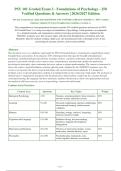
Content Area Overview:
Content Area Questions Key Topics Weight
Biological Psychology 1-50 Neurons, neurotransmitters, brain structures, 20%
nervous system, endocrine system
Learning 51-100 Classical conditioning, operant conditioning, 20%
observational learning, reinforcement
schedules
Memory 101-150 Encoding, storage, retrieval, forgetting, 20%
amnesia, memory models
Cognition and Language 151-180 Problem-solving, decision-making, 12%
heuristics, language development,
bilingualism
Motivation and Emotion 181-210 Theories of motivation, hunger, sexual 12%
motivation, emotion theories, stress
Personality 211-250 Psychodynamic, humanistic, trait, 16%
social-cognitive theories, assessment
Page 1
,Q1. In a study on the spacing effect, participants learned a list of words either in a single massed
session or distributed across multiple sessions. A week later, recall was significantly better in the
distributed condition. Which memory process best explains this advantage?
A. Encoding specificity
B. Consolidation enhancement
C. Retrieval practice effect
D. Elaborative rehearsal
Correct Answer: B. Consolidation enhancement
Rationale: The spacing effect enhances long-term retention primarily by promoting memory
consolidation, as distributed practice allows for repeated reactivation and strengthening of neural traces.
Encoding specificity (A) refers to context-dependent memory, retrieval practice (C) is the benefit of
testing, and elaborative rehearsal (D) involves deep processing but does not specifically account for the
temporal distribution advantage.
Why Wrong:
A - Encoding specificity is about matching context at encoding and retrieval, not about spacing.
C - The retrieval practice effect involves actively recalling information, not simply spacing study
sessions.
D - Elaborative rehearsal improves encoding depth but does not explain the benefit of distributed
over massed practice.
Reference: Baddeley, A. (2014). Memory. Psychology Press.
Q2. A researcher uses fMRI to examine neural activity during a working memory task. Participants
maintain a spatial location in memory while ignoring distractors. Increased activation is observed in
the dorsolateral prefrontal cortex (DLPFC). Which function does this region primarily support?
A. Sensory registration of spatial information
B. Rehearsal and maintenance of spatial representations
C. Long-term consolidation of spatial memories
D. Emotional modulation of memory
Correct Answer: B. Rehearsal and maintenance of spatial representations
Rationale: The DLPFC is critically involved in the active maintenance and manipulation of information
in working memory, particularly spatial information. Sensory registration (A) occurs in primary sensory
cortices, long-term consolidation (C) involves the hippocampus, and emotional modulation (D) is
associated with the amygdala.
Why Wrong:
A - Sensory registration is performed by primary sensory cortices, not DLPFC.
C - Long-term consolidation is primarily hippocampal-dependent.
D - Emotional modulation involves amygdala and ventromedial prefrontal cortex.
Reference: Goldman-Rakic, P. S. (1995). Cellular basis of working memory. Neuron, 14(3), 477-485.
Page 2
,Q3. In a classic experiment, rats that received pairings of a tone with a mild shock subsequently
showed a conditioned fear response to the tone. However, if the tone was paired with a shock in a
different context, the fear response was weaker. This phenomenon is best explained by:
A. Stimulus generalization
B. Renewal effect
C. Occasion setting
D. Latent inhibition
Correct Answer: B. Renewal effect
Rationale: The renewal effect occurs when a conditioned response returns after extinction because the
context has changed, indicating that extinction is context-dependent. Stimulus generalization (A) is
responding to similar stimuli, occasion setting (C) involves a cue that signals when a CS-US relationship
is in effect, and latent inhibition (D) is slower learning due to prior exposure to the CS alone.
Why Wrong:
A - Stimulus generalization refers to responding to similar stimuli, not context change.
C - Occasion setting involves a cue that modulates the CS-US association, not context change after
extinction.
D - Latent inhibition is about pre-exposure to CS slowing subsequent conditioning.
Reference: Bouton, M. E. (2004). Context and behavioral processes in extinction. Learning & Memory,
11(5), 485-494.
Q4. According to the dual-process model of persuasion, which of the following scenarios is most
likely to result in attitude change via the peripheral route?
A. A voter carefully analyzes a candidate's policy positions before deciding
B. A consumer buys a product because a celebrity endorses it
C. A student critically evaluates arguments in a debate
D. A jury member deliberates on evidence presented in court
Correct Answer: B. A consumer buys a product because a celebrity endorses it
Rationale: The peripheral route relies on superficial cues such as attractiveness or credibility of the
source, rather than careful elaboration of arguments. Celebrity endorsement is a classic peripheral cue.
Options A, C, and D all involve systematic processing of message content, characteristic of the central
route.
Why Wrong:
A - Analyzing policy positions involves central route processing.
C - Critical evaluation of arguments uses the central route.
D - Deliberating on evidence is central route processing.
Reference: Petty, R. E., & Cacioppo, J. T. (1986). Communication and persuasion: Central and
peripheral routes to attitude change. Springer-Verlag.
Page 3
, Q5. A study finds that individuals with high scores on a trait measure of conscientiousness tend to
have better health outcomes and longer lifespans. Which mechanism is LEAST likely to mediate this
relationship?
A. Greater adherence to medical regimens
B. Lower engagement in risky behaviors
C. Higher baseline cortisol levels
D. More effective stress coping strategies
Correct Answer: C. Higher baseline cortisol levels
Rationale: Higher baseline cortisol levels are typically associated with chronic stress and poorer health,
not better outcomes. Conscientiousness is linked to health-promoting behaviors (A), avoidance of risks
(B), and adaptive coping (D), all of which improve health. Thus, higher cortisol is not a plausible
mediator.
Why Wrong:
A - Greater adherence is a known mediator; conscientious people follow medical advice better.
B - Lower risk-taking is a known mediator; conscientious people avoid dangerous behaviors.
D - Effective coping is a known mediator; conscientious people use problem-focused coping.
Reference: Bogg, T., & Roberts, B. W. (2004). Conscientiousness and health-related behaviors: A
meta-analysis. Psychological Bulletin, 130(6), 887-919.
Q6. Which of the following best illustrates the concept of 'learned helplessness' as originally
demonstrated in Seligman's experiments?
A. A person fails a test and decides to study harder for the next one
B. A dog that receives shocks regardless of its behavior later fails to escape even when escape is
possible
C. A student who performs well on exams due to high self-efficacy
D. An athlete who improves performance after receiving positive feedback
Correct Answer: B. A dog that receives shocks regardless of its behavior later fails to escape even
when escape is possible
Rationale: Learned helplessness occurs when exposure to uncontrollable aversive events leads to a
passive acceptance of later controllable situations. Seligman's classic experiment involved dogs that
initially received inescapable shocks and later did not attempt to escape avoidable shocks. Option A is an
adaptive response, C is self-efficacy, D is reinforcement.
Why Wrong:
A - This is an adaptive response to failure, not helplessness.
C - Self-efficacy is the belief in one's ability, the opposite of helplessness.
D - Positive feedback enhances performance, not helplessness.
Reference: Seligman, M. E. P. (1972). Learned helplessness. Annual Review of Medicine, 23, 407-412.
Page 4
Verified Questions & Answers | 2026/2027 Edition
PSY 101 Graded Exam 3 2026-2027 QUESTIONS AND ANSWERS ALREADY GRADED A+. 100% Verified
Solutions | Updated Per Latest StraighterLine Guidelines | Graded A+
This comprehensive exam preparation document contains 250 verified questions and answers for PSY
101 Graded Exam 3, covering core topics in foundations of psychology. Each question is accompanied
by a detailed rationale and explanation to reinforce learning and ensure mastery. Updated for the
2026/2027 academic year, this resource aligns with the latest StraighterLine curriculum and exam
blueprints. Ideal for students seeking a high score, this document provides a thorough review of key
psychological concepts, theories, and research methods.
Abstract:
This document serves as a definitive study guide for PSY 101 Graded Exam 3, meticulously compiled from actual
StraighterLine assessments. It encompasses 250 verified questions that span the breadth of foundational
psychology, including biological psychology, learning, memory, cognition, motivation, and personality. Each
question is presented with the correct answer and a comprehensive rationale that explains the underlying
psychological principles, often contrasting incorrect options to deepen understanding. The content is structured to
mirror the exam's weight distribution, ensuring efficient study. Updated for the 2026/2027 academic year, this
resource incorporates the latest research and aligns with current instructional standards. It is designed to
facilitate active recall and application, making it an indispensable tool for achieving a high grade. The inclusion of
detailed answer explanations transforms this document into a mini-textbook, reinforcing key concepts through
contextual learning. By engaging with these materials, students will develop a robust conceptual framework and
the analytical skills necessary for success in psychology coursework and beyond.
Content Area Overview:
Content Area Questions Key Topics Weight
Biological Psychology 1-50 Neurons, neurotransmitters, brain structures, 20%
nervous system, endocrine system
Learning 51-100 Classical conditioning, operant conditioning, 20%
observational learning, reinforcement
schedules
Memory 101-150 Encoding, storage, retrieval, forgetting, 20%
amnesia, memory models
Cognition and Language 151-180 Problem-solving, decision-making, 12%
heuristics, language development,
bilingualism
Motivation and Emotion 181-210 Theories of motivation, hunger, sexual 12%
motivation, emotion theories, stress
Personality 211-250 Psychodynamic, humanistic, trait, 16%
social-cognitive theories, assessment
Page 1
,Q1. In a study on the spacing effect, participants learned a list of words either in a single massed
session or distributed across multiple sessions. A week later, recall was significantly better in the
distributed condition. Which memory process best explains this advantage?
A. Encoding specificity
B. Consolidation enhancement
C. Retrieval practice effect
D. Elaborative rehearsal
Correct Answer: B. Consolidation enhancement
Rationale: The spacing effect enhances long-term retention primarily by promoting memory
consolidation, as distributed practice allows for repeated reactivation and strengthening of neural traces.
Encoding specificity (A) refers to context-dependent memory, retrieval practice (C) is the benefit of
testing, and elaborative rehearsal (D) involves deep processing but does not specifically account for the
temporal distribution advantage.
Why Wrong:
A - Encoding specificity is about matching context at encoding and retrieval, not about spacing.
C - The retrieval practice effect involves actively recalling information, not simply spacing study
sessions.
D - Elaborative rehearsal improves encoding depth but does not explain the benefit of distributed
over massed practice.
Reference: Baddeley, A. (2014). Memory. Psychology Press.
Q2. A researcher uses fMRI to examine neural activity during a working memory task. Participants
maintain a spatial location in memory while ignoring distractors. Increased activation is observed in
the dorsolateral prefrontal cortex (DLPFC). Which function does this region primarily support?
A. Sensory registration of spatial information
B. Rehearsal and maintenance of spatial representations
C. Long-term consolidation of spatial memories
D. Emotional modulation of memory
Correct Answer: B. Rehearsal and maintenance of spatial representations
Rationale: The DLPFC is critically involved in the active maintenance and manipulation of information
in working memory, particularly spatial information. Sensory registration (A) occurs in primary sensory
cortices, long-term consolidation (C) involves the hippocampus, and emotional modulation (D) is
associated with the amygdala.
Why Wrong:
A - Sensory registration is performed by primary sensory cortices, not DLPFC.
C - Long-term consolidation is primarily hippocampal-dependent.
D - Emotional modulation involves amygdala and ventromedial prefrontal cortex.
Reference: Goldman-Rakic, P. S. (1995). Cellular basis of working memory. Neuron, 14(3), 477-485.
Page 2
,Q3. In a classic experiment, rats that received pairings of a tone with a mild shock subsequently
showed a conditioned fear response to the tone. However, if the tone was paired with a shock in a
different context, the fear response was weaker. This phenomenon is best explained by:
A. Stimulus generalization
B. Renewal effect
C. Occasion setting
D. Latent inhibition
Correct Answer: B. Renewal effect
Rationale: The renewal effect occurs when a conditioned response returns after extinction because the
context has changed, indicating that extinction is context-dependent. Stimulus generalization (A) is
responding to similar stimuli, occasion setting (C) involves a cue that signals when a CS-US relationship
is in effect, and latent inhibition (D) is slower learning due to prior exposure to the CS alone.
Why Wrong:
A - Stimulus generalization refers to responding to similar stimuli, not context change.
C - Occasion setting involves a cue that modulates the CS-US association, not context change after
extinction.
D - Latent inhibition is about pre-exposure to CS slowing subsequent conditioning.
Reference: Bouton, M. E. (2004). Context and behavioral processes in extinction. Learning & Memory,
11(5), 485-494.
Q4. According to the dual-process model of persuasion, which of the following scenarios is most
likely to result in attitude change via the peripheral route?
A. A voter carefully analyzes a candidate's policy positions before deciding
B. A consumer buys a product because a celebrity endorses it
C. A student critically evaluates arguments in a debate
D. A jury member deliberates on evidence presented in court
Correct Answer: B. A consumer buys a product because a celebrity endorses it
Rationale: The peripheral route relies on superficial cues such as attractiveness or credibility of the
source, rather than careful elaboration of arguments. Celebrity endorsement is a classic peripheral cue.
Options A, C, and D all involve systematic processing of message content, characteristic of the central
route.
Why Wrong:
A - Analyzing policy positions involves central route processing.
C - Critical evaluation of arguments uses the central route.
D - Deliberating on evidence is central route processing.
Reference: Petty, R. E., & Cacioppo, J. T. (1986). Communication and persuasion: Central and
peripheral routes to attitude change. Springer-Verlag.
Page 3
, Q5. A study finds that individuals with high scores on a trait measure of conscientiousness tend to
have better health outcomes and longer lifespans. Which mechanism is LEAST likely to mediate this
relationship?
A. Greater adherence to medical regimens
B. Lower engagement in risky behaviors
C. Higher baseline cortisol levels
D. More effective stress coping strategies
Correct Answer: C. Higher baseline cortisol levels
Rationale: Higher baseline cortisol levels are typically associated with chronic stress and poorer health,
not better outcomes. Conscientiousness is linked to health-promoting behaviors (A), avoidance of risks
(B), and adaptive coping (D), all of which improve health. Thus, higher cortisol is not a plausible
mediator.
Why Wrong:
A - Greater adherence is a known mediator; conscientious people follow medical advice better.
B - Lower risk-taking is a known mediator; conscientious people avoid dangerous behaviors.
D - Effective coping is a known mediator; conscientious people use problem-focused coping.
Reference: Bogg, T., & Roberts, B. W. (2004). Conscientiousness and health-related behaviors: A
meta-analysis. Psychological Bulletin, 130(6), 887-919.
Q6. Which of the following best illustrates the concept of 'learned helplessness' as originally
demonstrated in Seligman's experiments?
A. A person fails a test and decides to study harder for the next one
B. A dog that receives shocks regardless of its behavior later fails to escape even when escape is
possible
C. A student who performs well on exams due to high self-efficacy
D. An athlete who improves performance after receiving positive feedback
Correct Answer: B. A dog that receives shocks regardless of its behavior later fails to escape even
when escape is possible
Rationale: Learned helplessness occurs when exposure to uncontrollable aversive events leads to a
passive acceptance of later controllable situations. Seligman's classic experiment involved dogs that
initially received inescapable shocks and later did not attempt to escape avoidable shocks. Option A is an
adaptive response, C is self-efficacy, D is reinforcement.
Why Wrong:
A - This is an adaptive response to failure, not helplessness.
C - Self-efficacy is the belief in one's ability, the opposite of helplessness.
D - Positive feedback enhances performance, not helplessness.
Reference: Seligman, M. E. P. (1972). Learned helplessness. Annual Review of Medicine, 23, 407-412.
Page 4


