

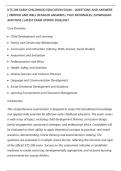
ILTS 206 EARLY CHILDHOOD EDUCATION EXAM – QUESTIONS AND ANSWERS
| VERIFIED AND WELL DETAILED ANSWERS | PLUS RATIONALES | DOWNLOAD
AND PASS | LATEST EXAM UPDATE 2026/2027
Core Domains:
Child Development and Learning
Family and Community Relationships
Curriculum and Instruction (Literacy, Math, Science, Social Studies)
Assessment and Evaluation
Professionalism and Ethics
Health, Safety, and Nutrition
Diverse Learners and Inclusive Practices
Language and Communication Development
Social-Emotional Development and Guidance
Learning Environments and Classroom Management
Introduction
This comprehensive examination is designed to assess the foundational knowledge
and applied skills essential for effective early childhood educators. The exam covers
a wide array of topics, including child development theories, curriculum design,
family engagement, assessment strategies, and professional ethics. Candidates will
be evaluated on their ability to apply theoretical concepts to practical, real-world
scenarios, demonstrating critical thinking and sound decision-making. The
questions are presented in multiple-choice format, reflecting the structure and rigor
of the official ILTS 206 exam. Success on this assessment indicates a candidate's
readiness to create nurturing, developmentally appropriate, and inclusive learning
environments for young children.
,SECTION ONE: QUESTIONS 1 – 50
1. A kindergarten teacher observes a child consistently building complex
structures with blocks but struggling to hold a pencil correctly. This disparity is
best explained by which concept of development?
A. Development is a universal and linear process.
B. Development is influenced by multiple interacting factors.
C. Development occurs at different rates in different domains.
D. Development is primarily determined by genetic factors.
🟢 Correct Answer: C. Development occurs at different rates in different domains.
🔴 Explanation: Development is asynchronous; children often show advanced
skills in one domain (e.g., fine motor/construction) while lagging in another (e.g.,
fine motor/writing). This concept highlights that developmental domains are
interconnected but do not progress at the same pace, which is critical for teachers
to understand to provide appropriate support.
2. According to Piaget's theory, a 4-year-old who believes the amount of liquid
changes when poured from a short, wide glass into a tall, thin glass is
demonstrating a lack of:
A. Object permanence.
B. Egocentrism.
C. Conservation.
D. Abstract reasoning.
🟢 Correct Answer: C. Conservation.
🔴 Explanation: Conservation is the understanding that quantity remains the
same despite changes in appearance. Preoperational children (ages 2-7) lack this
ability, focusing on the height of the water rather than the amount. This is a
classic Piagetian concept.
,3. Ms. Ramirez notices a child in her classroom is often aggressive with peers.
Based on the principles of positive guidance, what is her most appropriate first
response?
A. Immediately place the child in a time-out for 10 minutes.
B. Ignore the behavior and hope it will stop.
C. Calmly approach the child, state the rule, and guide them toward a more
appropriate action.
D. Send the child to the principal's office.
🟢 Correct Answer: C. Calmly approach the child, state the rule, and guide them
toward a more appropriate action.
🔴 Explanation: Positive guidance focuses on teaching appropriate behavior
through calm, consistent, and proactive interactions. It addresses the behavior
while maintaining the child's dignity and helping them learn self-regulation,
making it more effective than punitive measures.
4. Which of the following scenarios is the most developmentally appropriate
assessment practice for a pre-kindergarten student?
A. A standardized, timed test on letter recognition.
B. A formal written test with multiple-choice questions.
C. An observation of the child during a small-group reading activity.
D. A portfolio of work samples only.
🟢 Correct Answer: C. An observation of the child during a small-group reading
activity.
🔴 Explanation: Authentic, naturalistic assessments like observations are most
appropriate for young children. They assess skills in a natural context, providing a
holistic view of a child's development and learning, which is more valid and
reliable than formal testing for this age group.
, 5. A new student from a non-English-speaking home joins a first-grade
classroom. What is the teacher's first and most important step to support this
child's language acquisition?
A. Immediately begin intense phonics instruction.
B. Provide a translator for all classroom instruction.
C. Create a welcoming, low-anxiety environment that values the child's home
language.
D. Recommend that the child be placed in a separate ESL classroom for most of
the day.
🟢 Correct Answer: C. Create a welcoming, low-anxiety environment that values
the child's home language.
🔴 Explanation: According to Krashen's Affective Filter Hypothesis, a low-anxiety
environment is crucial for second language acquisition. Valuing the home
language fosters a sense of identity and belonging, which lowers the affective
filter and encourages risk-taking in the new language.
6. According to Maslow's hierarchy of needs, which condition MUST be met
before a child can effectively focus on learning?
A. The child has access to age-appropriate educational materials.
B. The child has a strong relationship with their teacher.
C. The child feels physically safe and has their basic physiological needs met.
D. The child has a high level of self-esteem.
🟢 Correct Answer: C. The child feels physically safe and has their basic
physiological needs met.
🔴 Explanation: Maslow's theory posits that basic needs (physiological and
safety) must be satisfied before higher-level needs like belonging, esteem, and
self-actualization (which includes learning) can be successfully pursued. A child
who is hungry, tired, or feels unsafe cannot effectively focus on academic tasks.
| VERIFIED AND WELL DETAILED ANSWERS | PLUS RATIONALES | DOWNLOAD
AND PASS | LATEST EXAM UPDATE 2026/2027
Core Domains:
Child Development and Learning
Family and Community Relationships
Curriculum and Instruction (Literacy, Math, Science, Social Studies)
Assessment and Evaluation
Professionalism and Ethics
Health, Safety, and Nutrition
Diverse Learners and Inclusive Practices
Language and Communication Development
Social-Emotional Development and Guidance
Learning Environments and Classroom Management
Introduction
This comprehensive examination is designed to assess the foundational knowledge
and applied skills essential for effective early childhood educators. The exam covers
a wide array of topics, including child development theories, curriculum design,
family engagement, assessment strategies, and professional ethics. Candidates will
be evaluated on their ability to apply theoretical concepts to practical, real-world
scenarios, demonstrating critical thinking and sound decision-making. The
questions are presented in multiple-choice format, reflecting the structure and rigor
of the official ILTS 206 exam. Success on this assessment indicates a candidate's
readiness to create nurturing, developmentally appropriate, and inclusive learning
environments for young children.
,SECTION ONE: QUESTIONS 1 – 50
1. A kindergarten teacher observes a child consistently building complex
structures with blocks but struggling to hold a pencil correctly. This disparity is
best explained by which concept of development?
A. Development is a universal and linear process.
B. Development is influenced by multiple interacting factors.
C. Development occurs at different rates in different domains.
D. Development is primarily determined by genetic factors.
🟢 Correct Answer: C. Development occurs at different rates in different domains.
🔴 Explanation: Development is asynchronous; children often show advanced
skills in one domain (e.g., fine motor/construction) while lagging in another (e.g.,
fine motor/writing). This concept highlights that developmental domains are
interconnected but do not progress at the same pace, which is critical for teachers
to understand to provide appropriate support.
2. According to Piaget's theory, a 4-year-old who believes the amount of liquid
changes when poured from a short, wide glass into a tall, thin glass is
demonstrating a lack of:
A. Object permanence.
B. Egocentrism.
C. Conservation.
D. Abstract reasoning.
🟢 Correct Answer: C. Conservation.
🔴 Explanation: Conservation is the understanding that quantity remains the
same despite changes in appearance. Preoperational children (ages 2-7) lack this
ability, focusing on the height of the water rather than the amount. This is a
classic Piagetian concept.
,3. Ms. Ramirez notices a child in her classroom is often aggressive with peers.
Based on the principles of positive guidance, what is her most appropriate first
response?
A. Immediately place the child in a time-out for 10 minutes.
B. Ignore the behavior and hope it will stop.
C. Calmly approach the child, state the rule, and guide them toward a more
appropriate action.
D. Send the child to the principal's office.
🟢 Correct Answer: C. Calmly approach the child, state the rule, and guide them
toward a more appropriate action.
🔴 Explanation: Positive guidance focuses on teaching appropriate behavior
through calm, consistent, and proactive interactions. It addresses the behavior
while maintaining the child's dignity and helping them learn self-regulation,
making it more effective than punitive measures.
4. Which of the following scenarios is the most developmentally appropriate
assessment practice for a pre-kindergarten student?
A. A standardized, timed test on letter recognition.
B. A formal written test with multiple-choice questions.
C. An observation of the child during a small-group reading activity.
D. A portfolio of work samples only.
🟢 Correct Answer: C. An observation of the child during a small-group reading
activity.
🔴 Explanation: Authentic, naturalistic assessments like observations are most
appropriate for young children. They assess skills in a natural context, providing a
holistic view of a child's development and learning, which is more valid and
reliable than formal testing for this age group.
, 5. A new student from a non-English-speaking home joins a first-grade
classroom. What is the teacher's first and most important step to support this
child's language acquisition?
A. Immediately begin intense phonics instruction.
B. Provide a translator for all classroom instruction.
C. Create a welcoming, low-anxiety environment that values the child's home
language.
D. Recommend that the child be placed in a separate ESL classroom for most of
the day.
🟢 Correct Answer: C. Create a welcoming, low-anxiety environment that values
the child's home language.
🔴 Explanation: According to Krashen's Affective Filter Hypothesis, a low-anxiety
environment is crucial for second language acquisition. Valuing the home
language fosters a sense of identity and belonging, which lowers the affective
filter and encourages risk-taking in the new language.
6. According to Maslow's hierarchy of needs, which condition MUST be met
before a child can effectively focus on learning?
A. The child has access to age-appropriate educational materials.
B. The child has a strong relationship with their teacher.
C. The child feels physically safe and has their basic physiological needs met.
D. The child has a high level of self-esteem.
🟢 Correct Answer: C. The child feels physically safe and has their basic
physiological needs met.
🔴 Explanation: Maslow's theory posits that basic needs (physiological and
safety) must be satisfied before higher-level needs like belonging, esteem, and
self-actualization (which includes learning) can be successfully pursued. A child
who is hungry, tired, or feels unsafe cannot effectively focus on academic tasks.


