
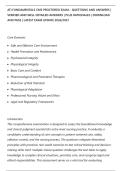
ATI FUNDAMENTALS CMS PROCTORED EXAM – QUESTIONS AND ANSWERS |
VERIFIED AND WELL DETAILED ANSWERS | PLUS RATIONALES | DOWNLOAD
AND PASS | LATEST EXAM UPDATE 2026/2027
Core Domains
Safe and Effective Care Environment
Health Promotion and Maintenance
Psychosocial Integrity
Physiological Integrity
Basic Care and Comfort
Pharmacological and Parenteral Therapies
Reduction of Risk Potential
Physiological Adaptation
Professional Nursing Values and Ethics
Legal and Regulatory Frameworks
Introduction
This comprehensive examination is designed to assess the foundational knowledge
and clinical judgment essential for entry-level nursing practice. It evaluates a
candidate's understanding of core concepts in patient-centered care, safety,
infection control, and the nursing process. The questions integrate theoretical
principles with practical, real-world scenarios to test critical thinking and decision-
making skills. Each multiple-choice question challenges the test-taker to apply
knowledge to complex clinical situations, prioritize care, and recognize legal and
ethical responsibilities. This assessment serves as a vital tool for evaluating
,readiness for professional nursing practice and ensuring the delivery of high-quality,
safe patient care.
SECTION ONE: QUESTIONS 1 – 50
1. A nurse is preparing to administer medications to a client. Which of the
following actions is the priority prior to administration?
A. Verify the client's diagnosis.
B. Check the client's allergies.
C. Review the client's laboratory results.
D. Assess the client's pain level.
🟢 Correct Answer: B. Check the client's allergies.
🔴 Explanation: The priority action before administering any medication is to
verify the client's allergies to prevent a potentially life-threatening anaphylactic
reaction. While other actions are important, safety protocols mandate allergy
verification as the primary safeguard.
2. A client is experiencing a seizure. Which of the following is the most
appropriate nursing action?
A. Restrain the client's limbs to prevent injury.
B. Insert a tongue depressor to prevent aspiration.
C. Position the client on their side.
D. Place a pillow under the client's head.
🟢 Correct Answer: C. Position the client on their side.
,🔴 Explanation: Positioning the client on their side (lateral recumbent position)
helps maintain a patent airway and allows secretions to drain, reducing the risk of
aspiration. Restraining the client or inserting objects into the mouth can cause
injury.
3. A nurse is assessing a client who has a new diagnosis of type 2 diabetes
mellitus. Which of the following findings is a risk factor for this condition?
A. Hypotension.
B. BMI of 30.
C. Age younger than 40 years.
D. Regular physical activity.
🟢 Correct Answer: B. BMI of 30.
🔴 Explanation: A BMI of 30 or greater is a significant risk factor for type 2
diabetes mellitus due to its association with insulin resistance. Hypotension,
younger age, and regular physical activity are not risk factors.
4. A nurse is caring for a client who is postoperative. Which of the following
findings indicates the client is experiencing a complication?
A. Pain rating of 3 on a scale of 0 to 10.
B. Respiratory rate of 18 breaths per minute.
C. Heart rate of 110 beats per minute.
D. Blood pressure of 118/76 mm Hg.
🟢 Correct Answer: C. Heart rate of 110 beats per minute.
, 🔴 Explanation: A heart rate of 110 bpm indicates tachycardia, which can be a
sign of complications such as hemorrhage, infection, or pain. The other options
are within normal parameters for a postoperative client.
5. A nurse is educating a client about stress management. Which of the
following is an example of a cognitive coping strategy?
A. Exercising regularly.
B. Deep breathing exercises.
C. Journaling about feelings.
D. Reframing negative thoughts.
🟢 Correct Answer: D. Reframing negative thoughts.
🔴 Explanation: Reframing, or cognitive restructuring, is a cognitive strategy that
involves changing negative thought patterns to manage stress. The other options
are behavioral or physical coping strategies.
6. A nurse is preparing a client for a procedure that requires informed consent.
Which of the following must be included in the consent form?
A. The exact time of the procedure.
B. The name of the primary care provider.
C. A list of all potential risks and benefits.
D. The cost of the procedure.
🟢 Correct Answer: C. A list of all potential risks and benefits.
🔴 Explanation: Informed consent must include a clear explanation of the
procedure, its risks, benefits, and alternatives. The exact time, provider's name,
VERIFIED AND WELL DETAILED ANSWERS | PLUS RATIONALES | DOWNLOAD
AND PASS | LATEST EXAM UPDATE 2026/2027
Core Domains
Safe and Effective Care Environment
Health Promotion and Maintenance
Psychosocial Integrity
Physiological Integrity
Basic Care and Comfort
Pharmacological and Parenteral Therapies
Reduction of Risk Potential
Physiological Adaptation
Professional Nursing Values and Ethics
Legal and Regulatory Frameworks
Introduction
This comprehensive examination is designed to assess the foundational knowledge
and clinical judgment essential for entry-level nursing practice. It evaluates a
candidate's understanding of core concepts in patient-centered care, safety,
infection control, and the nursing process. The questions integrate theoretical
principles with practical, real-world scenarios to test critical thinking and decision-
making skills. Each multiple-choice question challenges the test-taker to apply
knowledge to complex clinical situations, prioritize care, and recognize legal and
ethical responsibilities. This assessment serves as a vital tool for evaluating
,readiness for professional nursing practice and ensuring the delivery of high-quality,
safe patient care.
SECTION ONE: QUESTIONS 1 – 50
1. A nurse is preparing to administer medications to a client. Which of the
following actions is the priority prior to administration?
A. Verify the client's diagnosis.
B. Check the client's allergies.
C. Review the client's laboratory results.
D. Assess the client's pain level.
🟢 Correct Answer: B. Check the client's allergies.
🔴 Explanation: The priority action before administering any medication is to
verify the client's allergies to prevent a potentially life-threatening anaphylactic
reaction. While other actions are important, safety protocols mandate allergy
verification as the primary safeguard.
2. A client is experiencing a seizure. Which of the following is the most
appropriate nursing action?
A. Restrain the client's limbs to prevent injury.
B. Insert a tongue depressor to prevent aspiration.
C. Position the client on their side.
D. Place a pillow under the client's head.
🟢 Correct Answer: C. Position the client on their side.
,🔴 Explanation: Positioning the client on their side (lateral recumbent position)
helps maintain a patent airway and allows secretions to drain, reducing the risk of
aspiration. Restraining the client or inserting objects into the mouth can cause
injury.
3. A nurse is assessing a client who has a new diagnosis of type 2 diabetes
mellitus. Which of the following findings is a risk factor for this condition?
A. Hypotension.
B. BMI of 30.
C. Age younger than 40 years.
D. Regular physical activity.
🟢 Correct Answer: B. BMI of 30.
🔴 Explanation: A BMI of 30 or greater is a significant risk factor for type 2
diabetes mellitus due to its association with insulin resistance. Hypotension,
younger age, and regular physical activity are not risk factors.
4. A nurse is caring for a client who is postoperative. Which of the following
findings indicates the client is experiencing a complication?
A. Pain rating of 3 on a scale of 0 to 10.
B. Respiratory rate of 18 breaths per minute.
C. Heart rate of 110 beats per minute.
D. Blood pressure of 118/76 mm Hg.
🟢 Correct Answer: C. Heart rate of 110 beats per minute.
, 🔴 Explanation: A heart rate of 110 bpm indicates tachycardia, which can be a
sign of complications such as hemorrhage, infection, or pain. The other options
are within normal parameters for a postoperative client.
5. A nurse is educating a client about stress management. Which of the
following is an example of a cognitive coping strategy?
A. Exercising regularly.
B. Deep breathing exercises.
C. Journaling about feelings.
D. Reframing negative thoughts.
🟢 Correct Answer: D. Reframing negative thoughts.
🔴 Explanation: Reframing, or cognitive restructuring, is a cognitive strategy that
involves changing negative thought patterns to manage stress. The other options
are behavioral or physical coping strategies.
6. A nurse is preparing a client for a procedure that requires informed consent.
Which of the following must be included in the consent form?
A. The exact time of the procedure.
B. The name of the primary care provider.
C. A list of all potential risks and benefits.
D. The cost of the procedure.
🟢 Correct Answer: C. A list of all potential risks and benefits.
🔴 Explanation: Informed consent must include a clear explanation of the
procedure, its risks, benefits, and alternatives. The exact time, provider's name,


