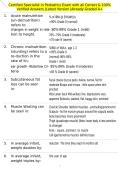
Certified Specialist in Pediatrics Exam with all Correct & 100%
Verified Answers |Latest Version |Already Graded A+
1. Acute malnutrition % of IBW @ 50%Wt/Ln
(un-dernutrition) >90% Grade 0 (normal)
refers to
changes in weight in rela- 80%-89% Grade 1 (mild)
tion to height. 70% -79% Grade Il (moderate)
<70 rade lIl (severe)
2. Chronic malnutrition %IBW of Wt/Ln, age 1-3
(stunting) refers to a >95% Grade 0
re-duction in the (normal) 90%-94%
rate of lin- Grade I (mild)
ear growth -Waterlow Cri- 85%-89% Grade II (moderate)
teria <85 % Grade III (severe)
3. Subcutaneous fat Facial cheeks (buccal pads) -hallow, narrow, flat for
loss can be seen moderate Biceps and triceps - little space when skin
in: pinched
Ribs Lower back Mid-axillary line- depressions very
apparent Buttocks- wasted, flat, baggy skin, wrinkled
4. Muscle Wasting can Clavicle Shoulder (deltoid muscles) - protruding/prominennt
be seen in: Scapula - As the muscle groups around the scapula waste,
bone becomes more prominent
Thigh (quadriceps muscle) (Note: lower body is less sensitive
to change)
Knee - square, proninent, no muscle
Calf (gastrocnemius muscle)- definite tissue
5. In average infant, reduction The time they reach 6 months old
weight doubles by:
6. In average infant, One year of age
weight triples by:
1/
101
, Certified Specialist in Pediatrics Exam with all Correct & 100%
Verified Answers |Latest Version |Already Graded A+
7. Premie growth velocity <2kg = 15-20g/d
>2kg = 20-30g/d
2/
101
, Certified Specialist in Pediatrics Exam with all Correct & 100%
Verified Answers |Latest Version |Already Graded A+
8. 0-4 month infant 23-34g/d
growth velocity:
9. 4 - 8 month infant growth 10 - 16g/d
velocity:
10. Growth velocity infant
8- 13.
12 mo
11. 12- 24 month
infant growth
velocity
12. Infant nutritional
history, assess:
3/
101
, Certified Specialist in Pediatrics Exam with all Correct & 100%
Verified Answers |Latest Version |Already Graded A+
6-11 g/d 13. Review social, economic and environmental factors
4-9g/d
1. Current method of feeding
2. Type of milk/formula per feed
3. Number of times per day, child is
breastfed or takes bottle
4. Duration of feed and
abnormal symptoms (including
sweating, increased work of
breathing, choking or coughing)
5. Method for preparation (i.e. ratio
of formula to water and source of
water)
6. Special formula including rationale for
modification
7. Number of meals/snacks per day
(assess meal content)
8. Assess for developmental delay, oral
aversions
9. Frequency of wet diapers and
stooling patterns, stool consistency
and frequency
10. Feeding history to include
milestones, texture, progression, and
variety
11. Food allergies/intolerances
12. Vitamins minerals herbal
and/or food supplements (quantity,
frequency, and duration)
4/
101
Verified Answers |Latest Version |Already Graded A+
1. Acute malnutrition % of IBW @ 50%Wt/Ln
(un-dernutrition) >90% Grade 0 (normal)
refers to
changes in weight in rela- 80%-89% Grade 1 (mild)
tion to height. 70% -79% Grade Il (moderate)
<70 rade lIl (severe)
2. Chronic malnutrition %IBW of Wt/Ln, age 1-3
(stunting) refers to a >95% Grade 0
re-duction in the (normal) 90%-94%
rate of lin- Grade I (mild)
ear growth -Waterlow Cri- 85%-89% Grade II (moderate)
teria <85 % Grade III (severe)
3. Subcutaneous fat Facial cheeks (buccal pads) -hallow, narrow, flat for
loss can be seen moderate Biceps and triceps - little space when skin
in: pinched
Ribs Lower back Mid-axillary line- depressions very
apparent Buttocks- wasted, flat, baggy skin, wrinkled
4. Muscle Wasting can Clavicle Shoulder (deltoid muscles) - protruding/prominennt
be seen in: Scapula - As the muscle groups around the scapula waste,
bone becomes more prominent
Thigh (quadriceps muscle) (Note: lower body is less sensitive
to change)
Knee - square, proninent, no muscle
Calf (gastrocnemius muscle)- definite tissue
5. In average infant, reduction The time they reach 6 months old
weight doubles by:
6. In average infant, One year of age
weight triples by:
1/
101
, Certified Specialist in Pediatrics Exam with all Correct & 100%
Verified Answers |Latest Version |Already Graded A+
7. Premie growth velocity <2kg = 15-20g/d
>2kg = 20-30g/d
2/
101
, Certified Specialist in Pediatrics Exam with all Correct & 100%
Verified Answers |Latest Version |Already Graded A+
8. 0-4 month infant 23-34g/d
growth velocity:
9. 4 - 8 month infant growth 10 - 16g/d
velocity:
10. Growth velocity infant
8- 13.
12 mo
11. 12- 24 month
infant growth
velocity
12. Infant nutritional
history, assess:
3/
101
, Certified Specialist in Pediatrics Exam with all Correct & 100%
Verified Answers |Latest Version |Already Graded A+
6-11 g/d 13. Review social, economic and environmental factors
4-9g/d
1. Current method of feeding
2. Type of milk/formula per feed
3. Number of times per day, child is
breastfed or takes bottle
4. Duration of feed and
abnormal symptoms (including
sweating, increased work of
breathing, choking or coughing)
5. Method for preparation (i.e. ratio
of formula to water and source of
water)
6. Special formula including rationale for
modification
7. Number of meals/snacks per day
(assess meal content)
8. Assess for developmental delay, oral
aversions
9. Frequency of wet diapers and
stooling patterns, stool consistency
and frequency
10. Feeding history to include
milestones, texture, progression, and
variety
11. Food allergies/intolerances
12. Vitamins minerals herbal
and/or food supplements (quantity,
frequency, and duration)
4/
101