BIOL 252 Human Anatomy & Physiology II | Module 5 Assessment
Review | 70+ Expert-Reviewed Questions
SECTION 1: INTRODUCTION TO ANATOMY & PHYSIOLOGY
(Questions 1-10)
Question 1:
Which of the following descriptions accurately defines the standard anatomical
position?
A) The body is seated, arms crossed over the chest, with palms facing inward.
B) The body is supine, feet wide apart, with palms flat against the thighs.
C) The body is standing erect, feet flat on the floor, arms at the sides, with palms
facing forward.
D) The body is prone, arms extended above the head, with thumbs pointing
inward.
Answer: C) The body is standing erect, feet flat on the floor, arms at the sides,
with palms facing forward.
Rationale: Standard anatomical position serves as the universal reference frame
for all directional terms. It requires an erect stance with the upper limbs at the sides
and the palms turned forward so that the radius and ulna are parallel.
,Question 2:
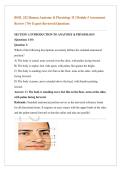
Which letter is labelling the dorsum nasi?
A) A
B) B
C) C
D) D
E) E
Answer: B) B
Rationale: The dorsum nasi is the bridge or ridge of the nose that runs from the
root (between the eyes) down to the tip (apex). In the diagram, letter B is
positioned along this superior ridge, making it the correct label for the dorsum nasi.
For reference:
• A = Root of the nose (superior, between the eyes)
• B = Dorsum nasi (bridge) ✓
• C = Apex (tip of the nose)
• D = Ala (flared side/nostril rim)
• E = Naris (nostril opening)
Question 3:
Which vertical plane passes directly through the midline of the body, dividing it
into exactly equal right and left halves?
A) Frontal plane
B) Transverse plane
C) Midsagittal plane
D) Parasagittal plane
Answer: C) Midsagittal plane
,Rationale: A sagittal plane splits the body into right and left portions. If that split
runs directly down the anatomical midline to create equal halves, it is a midsagittal
(or median) plane.
Question 4:
Which anatomical cavity contains the brain and spinal cord?
A) Ventral cavity
B) Thoracic cavity
C) Dorsal cavity
D) Abdominopelvic cavity
Answer: C) Dorsal cavity
Rationale: The dorsal cavity is located on the posterior aspect of the body and
houses the central nervous system structures, specifically the brain (cranial cavity)
and spinal cord (spinal cavity). The ventral cavity contains the thoracic and
abdominopelvic organs.
Question 5:
The stomach, liver, and intestines are contained inside which major body cavity?
A) Dorsal cavity
B) Vertebral cavity
C) Abdominal cavity
D) Thoracic cavity
Answer: C) Abdominal cavity
Rationale: The ventral cavity houses visceral organs. Its inferior division below
the diaphragm is the abdominopelvic cavity, with the abdominal sub-cavity
holding digestive organs like the stomach and liver .
, Question 6:
A blood pressure reading shifts away from the homeostatic set point, triggering
mechanisms that cause blood vessels to dilate and return pressure back to normal.
This sequence is an example of which process?
A) A negative feedback loop
B) A positive feedback loop
C) Chemical cellular mutation
D) Systemic metabolic imbalance
Answer: A) A negative feedback loop
Rationale: Negative feedback mechanisms work to reverse or counter a deviation
from the set point, bringing the internal variable back toward its normal
physiological range. This is the most common type of homeostatic regulation .
Question 7:
What structural level of organization is represented by a group of similar cells
working together to execute a shared, specialized function?
A) Cellular level
B) Tissue level
C) Organ level
D) Organismal level
Answer: B) Tissue level
Rationale: The biological hierarchy progresses from chemical to cellular, and then
to the tissue level, which is defined as an aggregation of structurally similar cells
working together .
Review | 70+ Expert-Reviewed Questions
SECTION 1: INTRODUCTION TO ANATOMY & PHYSIOLOGY
(Questions 1-10)
Question 1:
Which of the following descriptions accurately defines the standard anatomical
position?
A) The body is seated, arms crossed over the chest, with palms facing inward.
B) The body is supine, feet wide apart, with palms flat against the thighs.
C) The body is standing erect, feet flat on the floor, arms at the sides, with palms
facing forward.
D) The body is prone, arms extended above the head, with thumbs pointing
inward.
Answer: C) The body is standing erect, feet flat on the floor, arms at the sides,
with palms facing forward.
Rationale: Standard anatomical position serves as the universal reference frame
for all directional terms. It requires an erect stance with the upper limbs at the sides
and the palms turned forward so that the radius and ulna are parallel.
,Question 2:
Which letter is labelling the dorsum nasi?
A) A
B) B
C) C
D) D
E) E
Answer: B) B
Rationale: The dorsum nasi is the bridge or ridge of the nose that runs from the
root (between the eyes) down to the tip (apex). In the diagram, letter B is
positioned along this superior ridge, making it the correct label for the dorsum nasi.
For reference:
• A = Root of the nose (superior, between the eyes)
• B = Dorsum nasi (bridge) ✓
• C = Apex (tip of the nose)
• D = Ala (flared side/nostril rim)
• E = Naris (nostril opening)
Question 3:
Which vertical plane passes directly through the midline of the body, dividing it
into exactly equal right and left halves?
A) Frontal plane
B) Transverse plane
C) Midsagittal plane
D) Parasagittal plane
Answer: C) Midsagittal plane
,Rationale: A sagittal plane splits the body into right and left portions. If that split
runs directly down the anatomical midline to create equal halves, it is a midsagittal
(or median) plane.
Question 4:
Which anatomical cavity contains the brain and spinal cord?
A) Ventral cavity
B) Thoracic cavity
C) Dorsal cavity
D) Abdominopelvic cavity
Answer: C) Dorsal cavity
Rationale: The dorsal cavity is located on the posterior aspect of the body and
houses the central nervous system structures, specifically the brain (cranial cavity)
and spinal cord (spinal cavity). The ventral cavity contains the thoracic and
abdominopelvic organs.
Question 5:
The stomach, liver, and intestines are contained inside which major body cavity?
A) Dorsal cavity
B) Vertebral cavity
C) Abdominal cavity
D) Thoracic cavity
Answer: C) Abdominal cavity
Rationale: The ventral cavity houses visceral organs. Its inferior division below
the diaphragm is the abdominopelvic cavity, with the abdominal sub-cavity
holding digestive organs like the stomach and liver .
, Question 6:
A blood pressure reading shifts away from the homeostatic set point, triggering
mechanisms that cause blood vessels to dilate and return pressure back to normal.
This sequence is an example of which process?
A) A negative feedback loop
B) A positive feedback loop
C) Chemical cellular mutation
D) Systemic metabolic imbalance
Answer: A) A negative feedback loop
Rationale: Negative feedback mechanisms work to reverse or counter a deviation
from the set point, bringing the internal variable back toward its normal
physiological range. This is the most common type of homeostatic regulation .
Question 7:
What structural level of organization is represented by a group of similar cells
working together to execute a shared, specialized function?
A) Cellular level
B) Tissue level
C) Organ level
D) Organismal level
Answer: B) Tissue level
Rationale: The biological hierarchy progresses from chemical to cellular, and then
to the tissue level, which is defined as an aggregation of structurally similar cells
working together .